


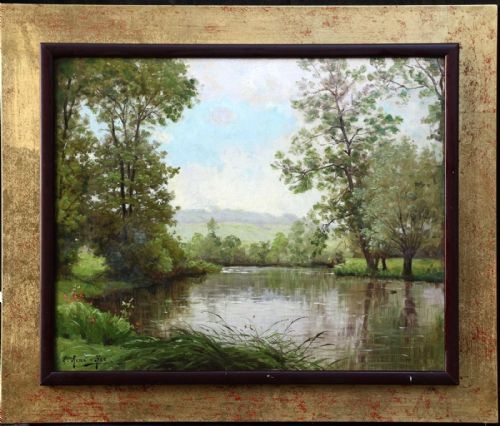


Naturalistic Landscape Painting
Naturalistic landscape painting captures the open air and quiet corners of the countryside with an honest eye for light and atmosphere.
Naturalistic Landscape Painting
Naturalistic landscape painting brings the countryside and river valleys indoors through framed views of fields, woods, and waterways. When you search for naturalistic landscape painting, you encounter works that prioritize observed light and topographical truth over theatrical invention.
The pieces listed here span the nineteenth century and the early decades of the twentieth century, including Victorian works and British Impressionism. Most examples take the form of oil paintings on canvas or watercolours on paper.
Subjects range from Welsh river views and Scottish mountains to Yorkshire hayfields and wooded paths. These compositions record recognisable rural scenery through the working practices of regional artists.
Materials and methods
Painters used oil paint on stretched canvas and watercolour pigment on paper, housed within timber and glass frames. These traditional supports provided the stable surfaces necessary for layered brushwork and fine detail.
Artists applied oil and watercolour to build up depth in skies, foliage, and water, utilising the natural reflectivity of canvas and the luminous quality of paper to capture shifting daylight.
Current listings feature watercolours on paper and oil paintings on canvas spanning the nineteenth century up to nineteen-twenty.
Distinguishing quality
Quality rests in the precision of the handling and the conviction of the atmosphere, where confident brushwork brings movement to water and foliage. Stronger works demonstrate a sure command of tone and perspective that anchors the viewer within the scene.
The distinction between standard works and finer pieces lies in the subtlety of the colour palette and the articulation of light. Artists who captured transient weather effects and specific topographical details produced more engaging compositions.
Ernest Higgins Rigg·Thomas Hunn·Walter Follen Bishop·Herbert Royle·Abraham Hulk Jnr·Sidney Richard Percy·Eugene Verboeckhoven·Charles Edmond Rene His·William Mander
The Naturalistic Landscape Painting Glossary
- Canvas
- A heavy woven fabric stretched across a wooden frame to serve as a painting surface. It provides a resilient texture that holds thick layers of oil paint.
- Watercolour pigment
- Finely ground colour suspended in a water-soluble binder for use on paper. It relies on the white of the paper showing through transparent washes to create luminosity.
- Victorian Naturalism
- An artistic approach from the nineteenth century that emphasised faithful observation of the natural world. It avoided excessive romantic idealization in favour of recognizable rural subjects.
- British Impressionism
- A painting style influenced by French movements that focused on capturing everyday scenes and natural light outdoors. Practitioners worked with visible brushstrokes and lighter palettes.
Naturalistic Landscape Painting: Frequently Asked Questions
What is naturalistic landscape painting?
Naturalistic landscape painting is an artwork style focused on depicting the countryside, rivers, and mountains with attention to real light and observed detail. These works prioritize believable topography and atmospheric conditions over dramatic fantasy.
Created primarily during the nineteenth and early twentieth centuries, these pieces document specific rural locations across Britain and Europe using oil and watercolour.
How should I hang these paintings?
These framed works suit traditional reception rooms, studies, and hallways where natural light complements the painted surface. Avoid placing oil and watercolour paintings in direct sunlight or damp environments to protect the canvas, paper, and wooden frame.
Ensure the wall fixings match the weight of the timber frames and glass panels typical of nineteenth-century framing.
How do I date a landscape painting?
Dating relies on stylistic clues, the framing methods, and signatures or inscriptions left by the artist on the canvas or reverse. Victorian works often feature distinct framing styles and academic brushwork common to the nineteenth century.
Later pieces from the early twentieth century show the influence of Impressionism with lighter palettes and looser application of paint.
What subjects appear in these landscapes?
The subjects include Welsh river valleys, Scottish mountainous regions, Yorkshire hayfields, and quiet woodland paths. Artists recorded working rural scenes, livestock near rivers, and seasonal changes in foliage.
These topographical choices reflect a widespread nineteenth-century appreciation for domestic scenery and local geography.