
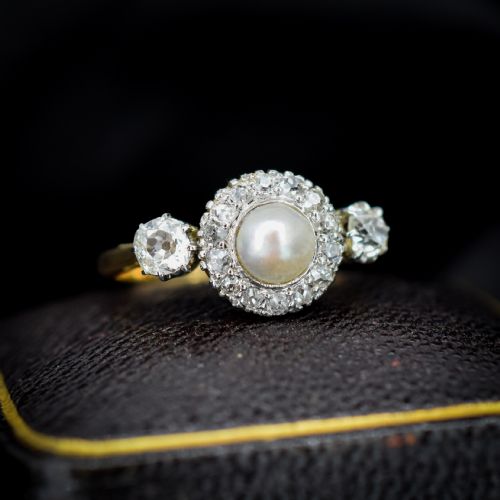
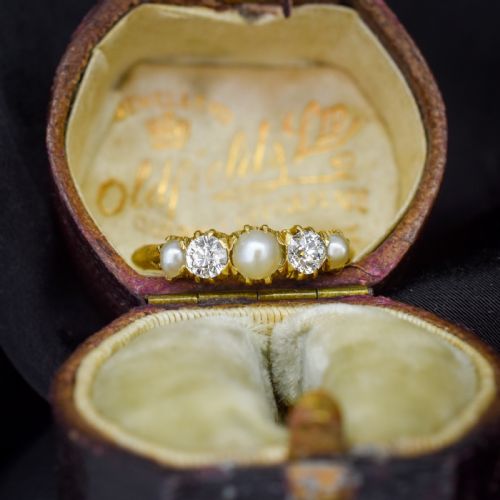


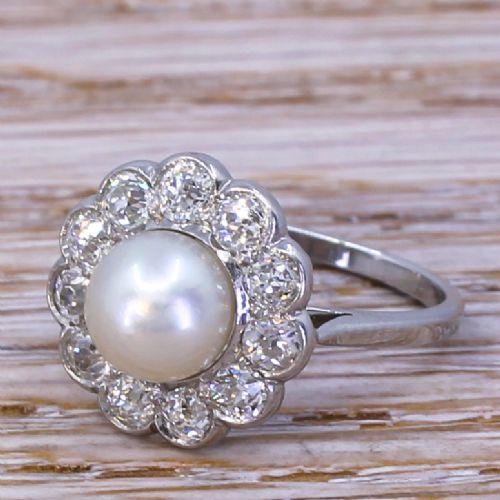

Natural Pearl Diamond Ring
A natural pearl diamond ring pairs organic marine gems with antique stones in enduring precious metal settings.
Natural Pearl Diamond Ring
A natural pearl diamond ring unites ocean-formed pearls with hand-cut diamonds across distinct historical periods. The search phrase natural pearl diamond ring brings together pieces shaped by Victorian, Edwardian, Art Deco and Mid-Century aesthetics.
Edwardian and Belle Époque designs dominate the selection, frequently pairing natural pearls with old-cut diamonds in platinum-topped gold. Cluster configurations and crossover motifs appear most often alongside solitaire and multi-stone band arrangements.
Victorian examples anchor the earlier end of the timeline with yellow gold bands and rose-cut diamonds, whilst Art Deco pieces introduce geometric platinum mountings. Mid-Century items complete the span with bolder mid-century profiles and alternative gold purities.
How They Were Made
Goldsmiths utilised 18ct yellow gold, white gold, and platinum to fabricate mountings that secure both the pearl and the surrounding diamonds. Platinum gained widespread favour during the Edwardian era for its strength in delicate, lace-like configurations.
Diamonds within these pieces feature old cuts, rose cuts, and early brilliant facets shaped entirely by hand. Pearls are set natively, often as buttons, blister forms, or spherical saltwater specimens nestled directly into claw or bezel settings.
Natural Pearl Diamond Ring Retail Price Guide 2026
Typical asking prices for natural pearl diamond ring among the pieces listed under this phrase on Sellingantiques today, from the lower quarter to the upper quarter. They describe what is for sale here now, not the wider market.
Listings span from the 19th century through the Victorian, Edwardian, Art Deco, and Mid-Century eras in yellow gold, white gold, and platinum.
What Varies in Quality
Quality rests upon the natural origin and matching of the pearl alongside the cut and brilliance of the accompanying diamonds. Superior examples display strong orient within the pearl and minimal inclusions within the hand-cut stones.
The precision of the metalwork defines the construction tier, from simple everyday bands to intricate openwork platinum galleries. Preservation of the original setting without modern re-tipping preserves the historical integrity of the piece.
The Natural Pearl Diamond Ring Glossary
- Old cut diamond
- A hand-faceted diamond shape preceding modern brilliant cuts, characterised by a smaller table, higher crown, and open culet. These stones possess a distinctive candlelight sparkle.
- Crossover ring
- A ring design where two distinct elements, such as a pearl and a diamond, sweep towards each other and overlap on the finger. This style is also known as a Toi et Moi configuration.
- Cluster ring
- A central gem surrounded by a tight border of smaller stones, typically diamonds encircling a pearl. This arrangement maximises visual presence.
- Saltwater pearl
- A pearl formed naturally within marine molluscs without human intervention. They are prized for their specific lustre and layered nacre.
- Rose cut diamond
- A vintage diamond cut featuring a flat base and a domed crown of triangular facets resembling an unopened rosebud. It offers a soft, translucent glow.
Natural Pearl Diamond Ring: Frequently Asked Questions
How do I care for a natural pearl ring?
Pearls are organic gems that require gentle handling, avoiding direct contact with perfumes, cosmetics, and harsh cleaning chemicals.
Wipe the pearl softly with a damp cloth after wearing and store it separately from hard diamond jewellery to prevent scratching.
Can I wear my natural pearl ring daily?
Daily wear is possible if the ring is treated with care, though softer organic pearls demand more caution than all-metal bands.
Removing the ring during manual tasks or swimming protects both the pearl's delicate nacre and the antique setting.
What is the difference between Edwardian and Art Deco settings?
Edwardian mountings focus on delicate platinum-topped yellow gold with lace-like wirework and flowing floral motifs.
Art Deco settings shift towards geometric precision, symmetrical lines, and stark white platinum frames.
How can I tell a natural pearl from a cultured one?
Natural pearls form organically in the wild without human seeding, showing irregular growth patterns under magnification.
Specialist gemmological testing confirms the internal structure and nacre density unique to natural saltwater specimens.