


Natural Coral Jewellery
Natural coral jewellery brings together organic ocean forms and precious metals from Georgian, Victorian, and later periods.

Natural Coral Jewellery
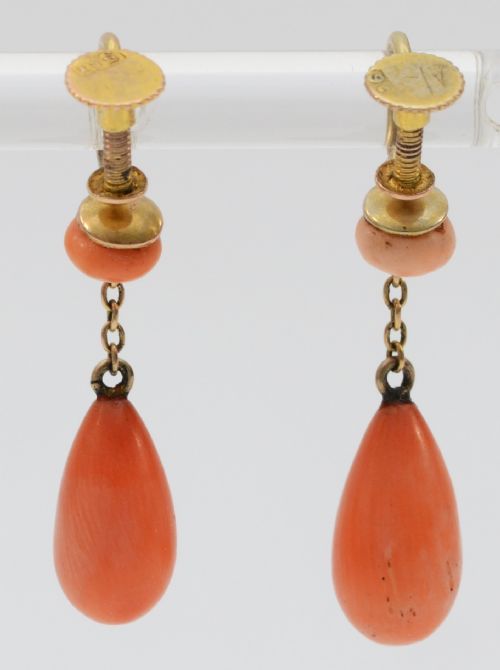
Natural coral jewellery consists of necklaces, earrings, rings, pendants, bracelets, and brooches formed from marine coral. The pieces available range from Georgian and early Victorian examples to Edwardian, Art Deco, and Mid-Century Modern creations.
Necklaces appear frequently, spanning single and multi-strand beaded lengths, sometimes paired with seed pearls or secured with silver and gold clasps. Earrings and rings showcase carved motifs, drop designs, and cluster settings.
Brooches and pendants often incorporate detailed work such as floral cameos, animal forms like snakes and flies, and domed cluster structures. Materials extend beyond coral to include gold, silver, pearls, and silk thread.
Qualities of distinction
Quality rests upon the uniformity and size of the coral beads, the depth of the red, pink, or salmon colour, and the complexity of the metal mountings. Graduated strands and finely carved cameos demonstrate higher levels of artisanal skill.
The integrity of the material, the security of the settings in gold or silver, and the preservation of original elements such as clasps and silk thread dictate the standing of each piece within its period.
Victorian makers occasionally turned marine creatures into accessories, immortalising coral flies and coiled coral snakes in gold.
The Natural Coral Jewellery Glossary
- Cameo
- A method of carving where a raised design stands out from a background. In this collection, coral is carved into floral subjects.
- Graduated bead
- Beads that increase progressively in size from the ends of a necklace to the centre. This layout requires careful sorting of natural coral.
- Seed pearl
- Very small pearls utilised alongside coral in Georgian and Victorian necklaces, earrings, and pendants. They provide a white textural contrast to the red and pink coral.
- Cluster brooch
- A piece of jewellery featuring a central grouping of stones or carved coral surrounded by further elements. Victorian examples often utilise tiered gold structures.
- Baroque pearl
- A pearl with an irregular, non-spherical shape. These appear alongside natural coral in drop earrings.
Natural Coral Jewellery: Frequently Asked Questions
How do I care for natural coral jewellery?
Coral is an organic material that is relatively soft and sensitive to acids, cosmetics, and harsh cleaning agents. Wipe it gently with a soft cloth after wearing and store it separately to avoid scratches.
Keep beaded necklaces away from moisture and check silk thread periodically if the pieces are worn regularly.
How can I tell a Georgian piece from a Victorian one?
Georgian coral pieces often feature closed-back settings, foil backs, or specific handcrafted gold work typical of the late eighteenth and early nineteenth centuries. Victorian items frequently display greater industrial standardisation alongside distinct stylistic revivals.
Maker's marks, metal purities, and the specific style of carving or clasp design also offer reliable clues to the exact period of manufacture.
Is all coral jewellery un-dyed?
The listings include specifically noted un-dyed red coral alongside other natural coral varieties showing pink and salmon tones. Natural coral displays organic variations in colour and surface texture rather than uniform artificial saturation.
Examining the piece under magnification can reveal natural growth patterns characteristic of genuine marine coral.
What metals were commonly used with coral?
Silver and various purities of gold, including nine carat, fourteen carat, fifteen carat, and eighteen carat, appear across the eras. Georgian and Victorian makers frequently paired coral with yellow gold or silver mounts.
Later pieces from the mid-twentieth century continue this tradition with heavier gold mountings and distinct modernist chain links.