



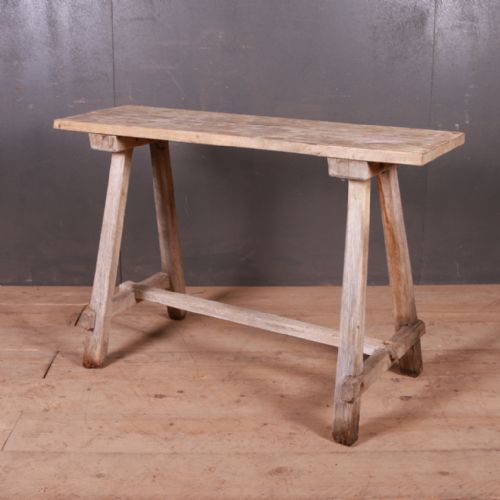
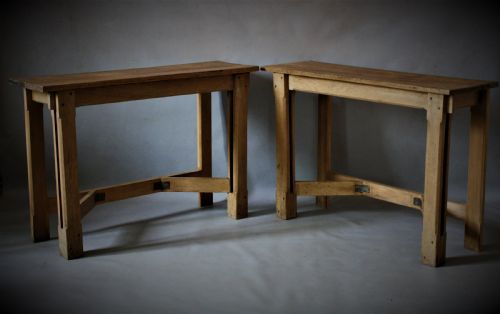
Narrow Oak Hall Table
A narrow oak hall table solves the eternal problem of the tight entranceway, offering a surface for letters and keys without blocking the path.
Narrow Oak Hall Table
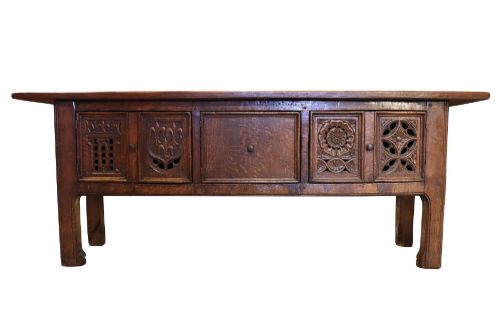
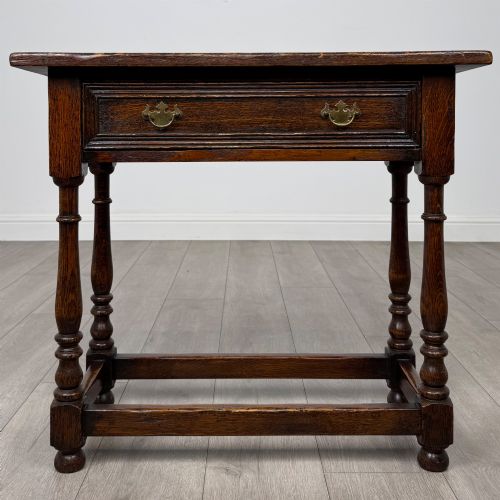
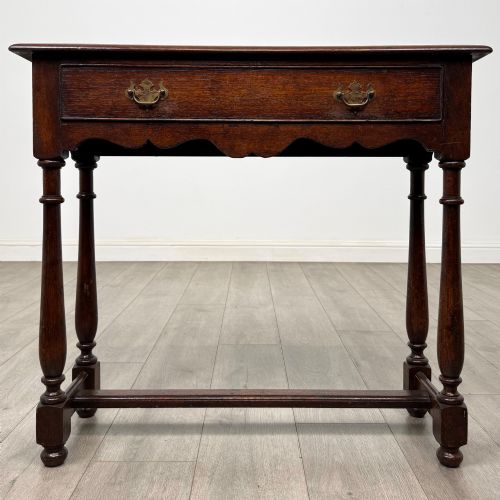
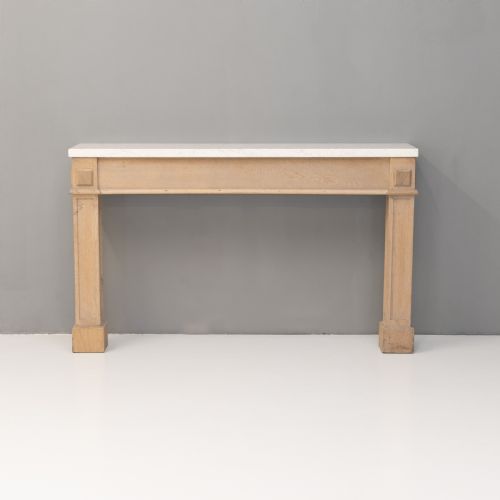
When you search for a narrow oak hall table, you are looking at furniture designed to fit compact spaces, most frequently appearing as Edwardian side tables, console tables, and small dresser bases from the nineteenth and twentieth centuries.
The pieces on this page span several decades, including Edwardian examples alongside older nineteenth-century survivals, all sharing reduced depth to suit hallways, landings, and narrow corridors.
Makers adapted traditional forms like the refectory and trestle into slender proportions, utilising timber and oak alongside marble, brass, and pine.
How they were made
Construction relies heavily on solid timber and oak, often shaped into trestle formats, console frames, or smaller sideboard bases.
Workshops employed carving techniques seen in Jacobean Revival and Gothic Revival styles, whilst other surfaces show ebonised wood or bleached oak finishes.
Design styles span from French Provincial and Gothic Revival to Neoclassical and Arts & Crafts.
What varies in quality
Quality rests in the handling of the timber and the crispness of any carving, distinguishing standard utility pieces from finer examples in the Arts & Crafts manner.
The integrity of the construction, particularly in the joinery of console and trestle frames, dictates how well a piece handles daily use in a busy entrance.
The Narrow Oak Hall Table Glossary
- Console table
- A table fixed against a wall, often supported by brackets or legs that require stability from its position.
- Trestle table
- A table comprising two or more supports connected by a horizontal beam, frequently seen in French provincial forms.
- Dresser base
- A low sideboard or cupboard unit offering enclosed storage beneath a narrow serving surface.
- Jacobean Revival
- A nineteenth-century style imitating seventeenth-century English furniture, typically featuring heavy carving and turnings.
- Ebonised wood
- Timber treated with a chemical stain or finish to imitate ebony, producing a dark, dense appearance.
Narrow Oak Hall Table: Frequently Asked Questions
Where should I put a narrow oak hall table?
These pieces suit narrow hallways, landings, and small entryways where depth is at a premium and floor space remains restricted.
They also function effectively behind sofas or as slim display surfaces in living rooms.
How do I date an antique oak table?
Dating relies on construction methods, tool marks, timber selection, and stylistic details such as Gothic Revival or Arts & Crafts influences.
Examining the underside and drawer joints often reveals the period of manufacture more clearly than exterior finishes.
Are these tables sturdy enough for daily use?
Solid timber construction provides the strength needed for everyday tasks like holding keys, lamps, and post.
Trestle and console designs depend on secure wall placement or well-balanced frames to maintain stability.
What is the difference between a console and a side table?
A console table traditionally stands against a wall and sometimes secures directly to it for added balance.
A side table is generally freestanding and stands independently on four legs.