

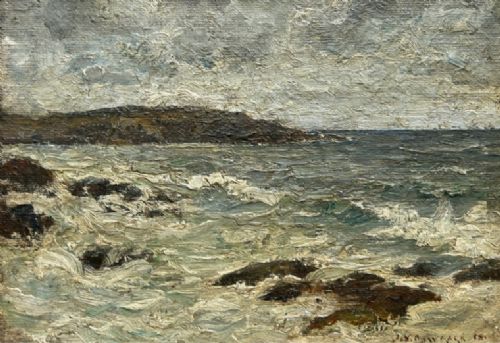
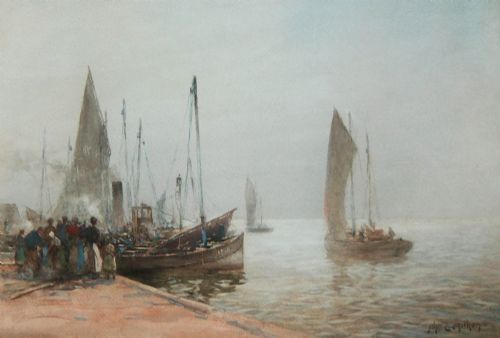


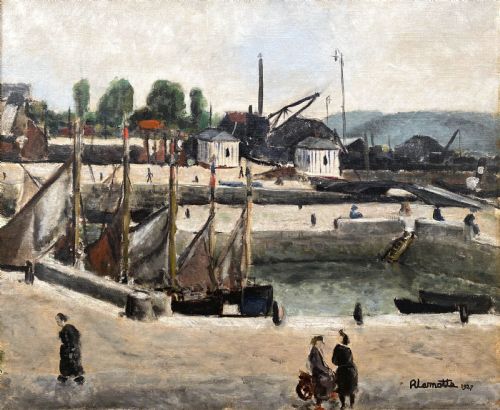


Muted Grey Marine Painting
These muted grey marine painting examples capture coastal waters and harbours through subtle tones, offering buyers atmospheric depictions of maritime scenes.
Muted Grey Marine Painting
A muted grey marine painting focuses on coastal waters, harbours, boats and seaside views rendered in restrained, sober palettes. These works emerge primarily across the nineteenth and twentieth centuries, spanning Victorian, Edwardian, Impressionist and Modern British styles.
The pieces on this page appear as watercolours on paper and oil paintings on canvas or board. Subject matter ranges from Scottish coastal seascapes and Yorkshire harbours to French Riviera fishing ports and industrial cityscapes by the sea.
Materials and methods
Artists create these maritime works utilising watercolour pigment on paper or oil paint applied to canvas and board. The technique ranges from delicate washes in watercolour to textured impasto in oil.
Support materials vary from traditional stretched canvas and prepared wooden board to heavy paper sheets. Pigments lean towards atmospheric greys, blues and earth tones to render coastal light and water.
Several artists recorded local fishermen and boats with such precision that the weather appears almost damp.
Assessing the work
Quality rests upon the artist's handling of light and atmosphere, particularly in capturing the subdued tones characteristic of these coastal scenes. Strong composition and assured brushwork distinguish accomplished works from routine topographical views.
The preservation of the paper, canvas or board also influences the standing of a piece. Intact surfaces without excessive fading or retouching maintain the visual integrity intended by the painter.
Kenneth Cozens·James E. Aitken·Tom Clough·Ernest F. Hill·Rowland Henry Hill·William Lee Hankey·William Collins·Lamotte·Harry Wanless·GM de L'Aubiniere
The Muted Grey Marine Painting Glossary
- Impasto
- Paint applied thickly to a canvas or board, standing out in relief from the surface. This technique adds texture and tactile weight to coastal elements like waves or cliffs.
- Watercolour
- A painting method in which the paints are made of pigments suspended in a water-based solution. It is typically executed on paper to achieve translucent effects.
- Seascape
- A work of art depicting the sea, coastal views or maritime scenes. These compositions often feature harbours, ships and shorelines.
- Monogram
- A motif made by overlapping or combining letters to form a single symbol used by an artist to sign a work. It provides an alternative to a full signature.
Muted Grey Marine Painting: Frequently Asked Questions
What periods do these paintings cover?
The selection spans from the nineteenth century through the Edwardian and Victorian eras into the mid-twentieth century. Works reflect stylistic shifts from traditional academic approaches to impressionist and modern British movements.
Dates and periods align with the active years of the artists and the production eras recorded in the listings.
How should I display a watercolour?
Watercolours on paper require framing behind glass with conservation-grade mounts to protect the pigment from ultraviolet light and atmospheric moisture.
Positioning works away from direct sunlight preserves the delicate washes and paper supports over time.
What subjects feature in these works?
Common subjects include Scottish and Yorkshire harbours, fishing ports, coastal seascapes, river boats and maritime views. Locations range from British coastal towns to the French Riviera.
Each depiction captures specific maritime activities and coastal architecture characteristic of its period.
How do oil paintings differ from watercolours here?
Oil paintings utilise pigments bound in oil applied to canvas or board, offering heavier textures and deeper colour saturation. Watercolours use water-soluble pigment on paper, yielding lighter and more translucent effects.
Both mediums share a focus on marine and coastal subject matter.