



Muted Green Landscape Art
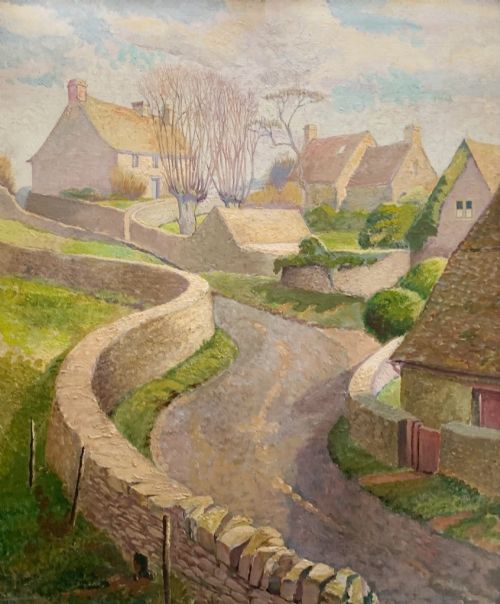
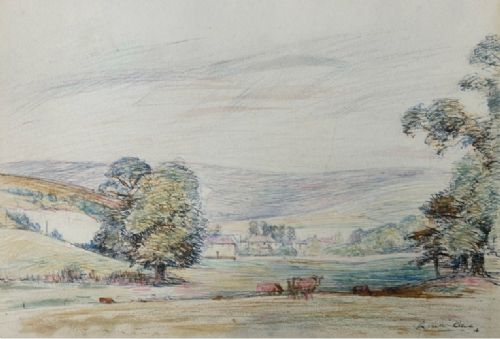
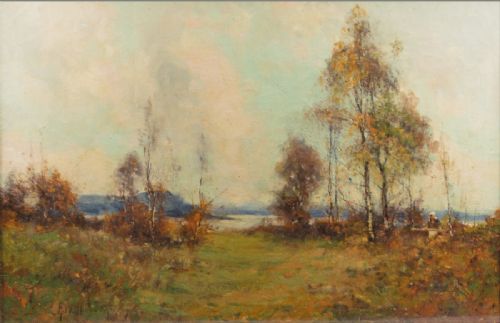
These muted green landscape art pieces capture pastoral valleys and quiet rivers through the subtle, earthy tones favoured by early twentieth-century painters.
Muted Green Landscape Art
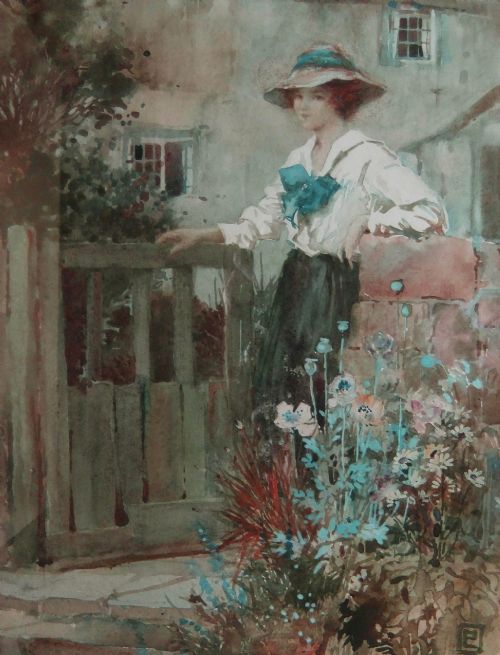
When you search for muted green landscape art, you find pastoral watercolours and oil paintings depicting British and Irish countryside scenes. These works span from the Victorian era through to the mid-twentieth century, capturing rivers, farmyards, and village gates.
The pieces you are most likely to meet on this page belong to the Edwardian period and the 1920s. They record tranquil rural life in subdued tones of olive, sage, and grey-green.
The range includes both finished gallery pieces and smaller plein air studies on paper, canvas, and panel. They reflect the rural preoccupations of British Impressionism, Scottish Impressionism, and the Barbizon School.
How they were made
Artists applied oil paint and watercolour onto stretched canvas, primed wood panels, and heavy paper supports. The handling relies on fluid brushwork for water and skies alongside heavier impasto for foliage and terrain.
Painters mixed earthy pigments to achieve restrained palettes dominated by muted greens and browns. These materials allowed creators to build atmospheric depth outdoors and finish detailed compositions within the studio.
Several Victorian cows remain permanently stationed in their fields, faithfully grazing away through a century of changing decor.
What varies in quality
The strongest works demonstrate confident draftsmanship and subtle control of tone, where the muted green palette creates genuine atmospheric weight. Weaker examples lean on formulaic compositions and heavier, flat applications of colour that lack spatial depth.
Support condition and pigment stability separate finer survivals from damaged pieces. Works retaining their original untouched surfaces and clear tonal harmony sit firmly at the top of the range.
Russell Sidney Reeves·Percy Lancaster·Alexander Wellwood Rattray·Ernest Higgins Rigg·Cuthbert Crossley·Thomas Hunn·James Orrock·Percy Robertson·Florence Hess·Linnie Watt·Henri Joseph Harpignies·Herbert Royle·Sidney James Beer·Henry Charles Fox·Robert Russell MacNee·Pierre Emmanuel Eugene Damoye·Harold Swanwick·William Hatherell·Henry Sykes·Thomas Mackay·George Faulkner Wetherbee·William Greaves·Frank Shenton·Kershaw Schofield·Clarence Woodburn
The Muted Green Landscape Art Glossary
- Impasto
- Paint applied thickly to a canvas or panel, standing out in relief from the surface. This technique adds tactile dimension to foliage and water.
- Watercolour
- A painting method where fine pigment is suspended in a water-based, translucent solution. It is typically applied to paper to achieve soft washes of colour.
- Barbizon School
- A nineteenth-century movement focused on tonal realism and painting directly from nature. Artists of this circle emphasised earthy palettes and landscape subjects.
- Impressionism
- A style defined by visible brush strokes, open composition, and an emphasis on light in its changing qualities. British variants often subdued the palette towards quieter greens and greys.
Muted Green Landscape Art: Frequently Asked Questions
What periods do these paintings date from?
The works span from the nineteenth century through the Edwardian era and into the mid-twentieth century. Most examples cluster around the early decades of the nineteen-hundreds.
You will find pieces reflecting Victorian sensibilities alongside later modernist and impressionist approaches to the British countryside.
What subjects appear in these landscapes?
The scenes focus primarily on pastoral views, riversides, farmyards, and coastal stretches. Cows in fields, cottage gates, and wooded paths recur frequently.
Artists drew inspiration from specific rural locations across Britain and Ireland, recording quiet villages and agricultural life.
How should I frame an antique painting on paper?
Watercolours on paper require conservation mounting with acid-free board to prevent discolouration over time. Glazing protects the delicate pigment surface from atmospheric moisture and dust.
Keep the framed work away from direct sunlight to preserve the subtle tones of the original greens and earth pigments.
How do I identify the medium used?
Watercolours display translucent washes on paper where the white ground often shines through the pigment layers. Oil paintings exhibit a heavier surface texture on canvas or wood panels.
Examining the piece closely reveals whether the artist built up rich impasto or worked in thin, fluid glazes.