
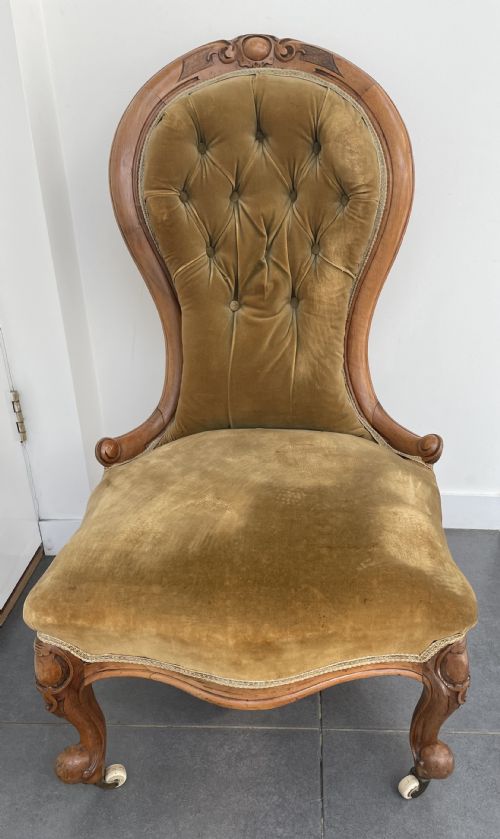


Mustard Velvet Armchair
A mustard velvet armchair brings warmth and texture to a room, offering a seat that commands attention through rich upholstery and historic form.
Mustard Velvet Armchair
A mustard velvet armchair is a seating piece defined by its striking yellow textile and traditional wooden frame. When searching for a mustard velvet armchair, buyers encounter various historical iterations spanning the nineteenth and early twentieth centuries.
The selections on this page encompass styles ranging from Victorian and Edwardian to Italian Baroque Revival, English Traditional, and Anglo-Indian Colonial. Occasional chairs, barrel back armchairs, club chairs, and open armchairs dominate the available forms.
Makers and workshops of the nineteenth century utilised robust woods such as walnut, mahogany, and hardwood to construct these frames. Many pieces exhibit classic seating configurations like button backs and open arms, upholstered in rich fabrics.
How they were made
Makers fashioned the structural frames of these armchairs using dense timbers including walnut, mahogany, and general hardwood. These woods provided the necessary skeletal strength for supporting upholstered bodies and detailed woodwork.
Craftsmen applied decorative techniques such as bobbin turning and intricate carving, particularly visible in Anglo-Indian colonial examples. Metal studs and brass details frequently accented the upholstery boundaries and framework joints.
Velvet served as the primary tactile textile for covering the padding, yielding a soft surface texture. Ceramic elements occasionally appeared in the supporting structures or associated fittings of these seating pieces.
Some chairs sport bobbin-turned legs so enthusiastically bumpy they practically wiggle across the floor on their own.
What varies in quality
The refinement of the carved woodwork and the complexity of frame shaping separate standard examples from finer works. Master carvers and established cabinet makers invested greater detail into the timber components, creating distinctive silhouettes like the Italian bobbin turned style or Anglo-Indian carved hardwood.
The integrity of the structural timber dictates longevity, with dense hardwoods like mahogany and walnut offering superior baseline durability compared to softer woods. Original joinery and well-preserved frame construction maintain the structural fidelity of the armchair over generations.
Hindley And Sons·Howard And Sons
The Mustard Velvet Armchair Glossary
- Button back
- An upholstery technique where depressions are formed in the padding by pulling thread through to secure buttons, creating a tufted surface pattern. This method adds traditional texture and firmness to the backrest.
- Bobbin turned
- A style of woodturning where the lathe creates a series of spherical or cylindrical shapes resembling bobbins along the length of a spindle or leg. It is characteristic of specific revival periods.
- Barrel back
- A seating form where the backrest curves continuously around in a semi-circle, enclosing the sitter much like the staves of a barrel. This design offers an enveloping and supportive posture.
- Open armchair
- A seating design featuring uncovered wooden arms rather than upholstered armrests, exposing the structural framework at the sides. This style highlights the carved or turned woodwork of the frame.
- Occasional chair
- A light, movable seating piece designed to be used intermittently in various rooms rather than as primary seating. These chairs often emphasise decorative stylistic elements.
Mustard Velvet Armchair: Frequently Asked Questions
What is a mustard velvet armchair?
A mustard velvet armchair is a historic seating piece upholstered in a deep yellow velvet fabric. These chairs date from the nineteenth and early twentieth centuries, featuring frames built from woods like mahogany, walnut, and hardwood.
They appear in various traditional forms, including occasional chairs, barrel back designs, and open armchairs. Each piece reflects the aesthetic preferences of periods such as the Victorian and Edwardian eras.
How do I date a mustard velvet armchair?
Dating these armchairs involves examining the style of the wooden frame, the turning techniques used on the legs, and specific design markers. Victorian and Edwardian pieces often display distinct characteristics like button backs or bobbin turning.
Reference to specific makers or stylistic revivals, such as Italian Baroque Revival or Anglo-Indian Colonial, helps narrow down the historical timeframe of manufacture. Construction materials like mahogany and walnut also align with nineteenth-century cabinet making traditions.
What are open armchairs used for?
Open armchairs serve as versatile seating options that allow the detailed woodwork of the frame to remain visible. They function well as occasional seating in living spaces or reception rooms.
The absence of heavy upholstery on the arms provides a lighter visual profile while maintaining supportive backrests, such as barrel backs or buttoned configurations.