
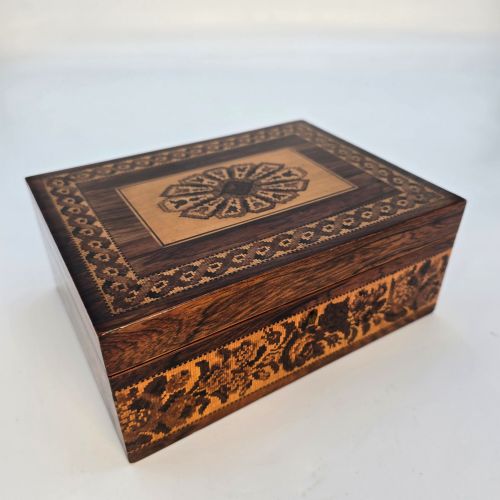


Mosaic Wood Trinket Box
These mosaic wood trinket boxes bring together miniature wood tesserae and geometric marquetry, offering small-scale storage for keepsakes.
Mosaic Wood Trinket Box
A mosaic wood trinket box forms part of a tradition of decorative small-scale containers designed for jewellery, gloves, and keepsakes. When you search for a mosaic wood trinket box, you encounter nineteenth-century pieces that showcase meticulous geometric woodwork or inlaid stone panels.
The nineteenth-century pieces on this page lean heavily towards Tunbridge Ware and Anglo-Indian work, spanning the Victorian era from eighteen-forty to eighteen-ninety. Forms range from octagonal baskets and tea caddies to dedicated ladies glove boxes and compact trinket containers.
Rosewood, walnut, boxwood, ebony, and ebonised wood provide the primary carcass and framing materials for these items. Artisans constructed these small containers to display immense patience through micro-mosaic tesserae and multi-toned timber inlay.
Materials and construction methods
Craftsmen utilised woods such as rosewood, walnut, boxwood, and ebony to form the structural bodies of these boxes. Mixed woods supplied the vast array of natural colours required for pictorial and geometric mosaic patterns without resorting to artificial stains.
The characteristic surface decoration relies on assembling thousands of tiny tinted wood prisms into complex pictorial or geometric matrices. Workers sliced these assembled wooden blocks into thin veneers and applied them directly to the solid timber carcasses.
Selected examples integrate pietra dura mounts onto ebonised wood surfaces, combining inlaid stone panels with traditional cabinet making. Interior linings of paper or fabric finish the compartments designed to hold small personal valuables.
Listings feature nineteenth-century pieces utilising rosewood, walnut, boxwood, ebony, and ebonised wood alongside pietra dura and mixed wood elements.
Judgements of quality and execution
Quality rests upon the microscopic precision of the timber tesserae and the complexity of the geometric or pictorial design. Tighter joints between individual mosaic pieces and greater variety in natural wood tones elevate an example above simpler production.
The integrity of the underlying carcass, whether rosewood, walnut, or ebonised wood, dictates the longevity and structural stability of the box. Superior pieces retain crisp edges to their geometric borders and secure fitting lids without warping over decades of handling.
Edmund Nye·Henry Hollamby
The Mosaic Wood Trinket Box Glossary
- Tunbridge Ware
- A form of nineteenth-century woodwork originating from Kent, characterised by minute mosaic tiles made from naturally coloured woods arranged to create pictorial or geometric designs.
- Marquetry
- The art of applying thin veneers of wood to a structural carcass to form decorative patterns, pictures, or ornamental borders.
- Pietra Dura
- An Italian technique of inlaying cut and fitted polished coloured stones to form highly detailed pictorial designs on a dark stone or wooden base.
- Tesserae
- The individual small blocks of wood or stone that combine to form the mosaic surface pattern on the exterior of the box.
- Sadeli Work
- A specialised form of nineteenth-century Anglo-Indian mosaic micro-work utilising geometric patterns formed from materials such as horn, ivory, and various woods.
Mosaic Wood Trinket Box: Frequently Asked Questions
What were mosaic wood trinket boxes used for?
These small containers served domestic spaces as secure receptacles for jewellery, pins, letters, and small personal valuables. Victorian users placed them on dressing tables, writing desks, and parlour side tables as both decorative objects and functional storage.
Craftsmen tailored specific internal compartments for items such as gloves, tea leaves, or trinkets. Their portable nature allowed owners to move them easily between rooms within larger nineteenth-century houses.
How do I date a Tunbridge Ware box?
Dating relies on stylistic shifts, timber choices, and specific documentation associated with documented makers from the nineteenth century. Earlier pieces often display floral or architectural motifs, while later Victorian examples frequently utilise complex geometric borders.
Box construction methods and lining materials also provide chronological clues for distinguishing mid-nineteenth-century items from those produced towards eighteen-ninety. Maker signatures or paper trade labels pasted inside lids offer the most precise chronological anchors.
How should I clean my mosaic wood box?
Maintenance requires dry dusting with a soft, lint-free brush to prevent moisture from entering microscopic joints in the mosaic veneer. Introducing liquids or modern chemical polishes risks lifting the fragile timber tesserae from the underlying carcass.
Keeping the container away from direct sunlight and dramatic humidity changes protects the natural wood colours and prevents the veneer from cracking. Gentle care preserves the historical integrity of the fragile exterior surfaces.
What is the difference between Tunbridge Ware and Sadeli work?
Tunbridge Ware originates from nineteenth-century England and uses micro-mosaic wood prisms cut from naturally coloured British and exotic timbers. The resulting patterns often depict castles, butterflies, or geometric tessellation.
Sadeli work represents nineteenth-century Anglo-Indian craftsmanship, typically featuring intricate geometric patterns built from slender sticks of ivory, horn, metal, and various woods. While both rely on mosaic principles, their regional material palettes and aesthetic traditions remain distinct.