

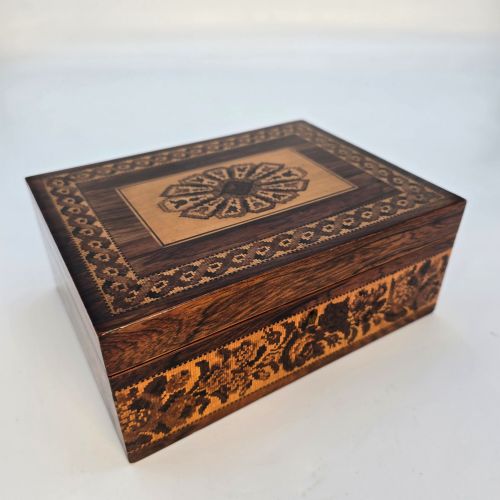


Mosaic Inlaid Box
A mosaic inlaid box brings together microscopic wood tesserae, hardstones, and bone veneers to create geometric patterns that collectors prize for their intricate craftsmanship.
Mosaic Inlaid Box
A mosaic inlaid box is a desk or dressing table accessory designed to hold jewellery, stationery, tea, or small personal items. The pieces on this page span the Regency, Victorian, and later nineteenth century, alongside Anglo-Indian and Persian traditions.
The most common examples you will encounter are Tunbridge Ware boxes fashioned from rosewood or walnut, featuring detailed geometric or pictorial lid panels. These sit alongside Italian pietra dura caskets and Anglo-Indian bone or Sadeli mosaic work.
Forms vary widely from tea caddies and sewing boxes to glove boxes, cribbage boards, and small trinket chests. Each utilises small-scale assembly methods to create dense surface patterns across lids and sides.
How They Were Made
Tunbridge Ware makers constructed patterns by bundling thousands of minuscule wood rods of various natural colours - such as boxwood, holly, and walnut - then slicing them crosswise to produce identical mosaic tiles. These tiles were glued onto rosewood or mahogany carcass frames to form elaborate pictorial or geometric bands.
Anglo-Indian and Persian makers employed alternate techniques, utilising carved wood structures inlaid with bone veneers, horn, and intricate Sadeli micro-mosaic strips. Italian workshops favoured pietra dura, embedding sliced hardstones like jasper and malachite into ormolu-mounted ebonised wood or marble bases.
Mosaic Inlaid Box Retail Price Guide 2026
Typical asking prices for mosaic inlaid box among the pieces listed under this phrase on Sellingantiques today, from the lower quarter to the upper quarter. They describe what is for sale here now, not the wider market.
The listings on this page span the Victorian era, Regency period, and early twentieth century, incorporating rosewood, walnut, and pietra dura.
What Varies in Quality
The quality of a mosaic inlaid box depends upon the density and precision of the individual tesserae. Finer pieces demonstrate exceptionally microscopic wooden cubes or perfectly aligned hardstone plaques with virtually invisible mortar or glue lines.
Makers such as Edmund Nye and Henry Hollamby achieved superior depth and perspective in their perspective cubes and floral panels, elevating standard cabinet work to miniature art. The choice of carcass wood, interior silk linings, and original fitted compartments further distinguishes finer examples from simpler production.
Edmund Nye·Henry Hollamby
The Mosaic Inlaid Box Glossary
- Tunbridge Ware
- A type of nineteenth-century English woodwork originating from Tunbridge Wells, characterised by mosaic designs built from thousands of dyed and natural wood blocks. These pieces often depict local castles, butterflies, or geometric tessellations.
- Pietra Dura
- An Italian technique of inlaying cut and fitted polished coloured stones to form pictorial images. The method uses hard minerals like marble, quartz, and jasper.
- Sadeli Mosaic
- An intricate form of micro-mosaic work originating in India, using geometric slivers of bone, horn, and metal arranged in repeating patterns. It typically decorates sandalwood or ebony boxes.
- Khatamkari
- A Persian technique of marquetry and mosaic inlay that uses delicate stars and geometric polygons formed from bone, wood, and wire. These elements are glued onto the wooden base in precise arrays.
- Tessera
- An individual small block or tile of wood, stone, or bone used in the construction of a mosaic pattern. The skill of the maker lies in the uniformity of these tiny components.
Mosaic Inlaid Box: Frequently Asked Questions
What are Tunbridge Ware boxes?
Tunbridge Ware boxes are nineteenth-century wooden containers decorated with microscopic mosaic tiles arranged to form geometric patterns or pictorial views.
Craftsmen in Tunbridge Wells produced these by gluing together thousands of dyed wood rods before slicing them into thin sheets for veneer.
How do I care for a mosaic inlaid box?
Keep wooden and mosaic boxes away from direct sunlight and dramatic humidity changes to prevent the tiny wooden or bone tesserae from shrinking and lifting.
Dust gently with a dry, soft cloth and avoid applying liquid polishes or modern cleaning agents to the delicate inlaid surfaces.
What is pietra dura?
Pietra dura is an Italian hardstone inlay technique where finely cut and polished mineral slices form pictorial designs on stone or wood plaques.
Craftsmen used materials such as malachite, lapis lazuli, and various coloured jaspers to create lasting tabletop and casket decorations.
How were Anglo-Indian boxes decorated?
Anglo-Indian boxes often combined carved wooden structures with intricate bone veneers, horn, and Sadeli micro-mosaic banding.
These decorative techniques created high-contrast geometric surfaces that reflect nineteenth-century cross-cultural design exchanges.