





Moriage Ceramic Vases
These moriage ceramic vases bring raised clay decoration and heavy gilding straight into a room, offering rich Japanese craftsmanship from the Meiji era.
Moriage Ceramic Vases
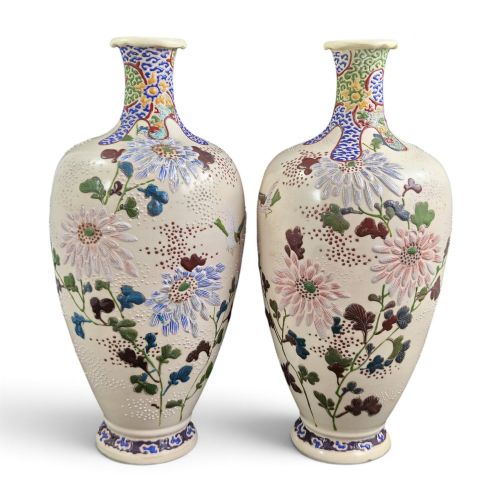
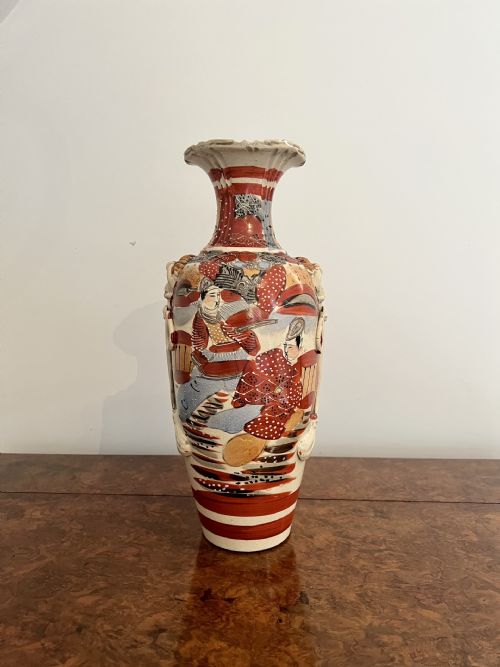
Moriage ceramic vases are defined by their distinct raised enamel and clay detailing, creating a tactile surface that stands proud of the main body. The pieces available here predominantly span the Meiji period and the early twentieth century, showing strong connections to traditional Kyoto Satsuma and Kutani production.
Buyers will most frequently encounter earthenware and porcelain vessels decorated with cobalt grounds, court figures, dragons, and chrysanthemums. Many of these vases arrive paired, while others stand alone as substantial decorative centrepieces featuring lion handles or intricate gilt panels.
How they were made
The makers built up the characteristic raised designs by piping liquid clay or enamel onto the ceramic surface before firing and painting. Artisans then applied extensive gold leaf and gold gilt highlights over the motifs to catch the light and add depth to the panels.
Potters shaped these vessels from earthenware or porcelain, often finishing them with a crackle glaze that formed the canvas for detailed hand-painted scenes. Wood stands occasionally accompanied the larger vases to provide a stable base for display.
Moriage Ceramic Vases Retail Price Guide 2026
Typical asking prices for moriage ceramic vases among the pieces listed under this phrase on Sellingantiques today, from the lower quarter to the upper quarter. They describe what is for sale here now, not the wider market.
Some larger vases come with their own dedicated wooden stands, ensuring lions and dragons have a proper stage.
What varies in quality
Quality rests in the precision and density of the raised moriage work, where finer pieces display crisp, controlled lines rather than heavy or flat application. The complexity of the hand-painted figures and landscape panels also dictates the standard of the vessel.
The richness and preservation of the gold leaf and gilt work separate standard production from superior pieces. Additionally, balanced proportions and the inclusion of signed artist marks or specific regional attributions elevate individual vases.
Nanzan mark
The Moriage Ceramic Vases Glossary
- Moriage
- A Japanese ceramic technique where clay or enamel is piped onto the surface to create raised decorative patterns. This method gives the pottery a distinct three-dimensional texture.
- Satsuma
- A type of Japanese earthenware traditionally featuring a ivory-coloured crackled glaze and elaborate polychrome and gilt enamel decoration. These wares became highly sought after in the West during the late nineteenth century.
- Gilt
- A thin layer of gold applied to the surface of the ceramic to accent specific motifs and borders. It provides a warm metallic contrast against cobalt grounds and intricate painted scenes.
- Kutani
- A style of Japanese porcelain known for bold pictorial designs and vibrant overglaze enamel palettes. These pieces frequently incorporate detailed figures, flowers, and geometric borders.
- Meiji Period
- The era in Japanese history spanning from eighteen sixty-eight to nineteen twelve, marked by intense artistic production for international export. Work from this time is celebrated for its intricate detail and technical skill.
Moriage Ceramic Vases: Frequently Asked Questions
What is moriage pottery?
Moriage pottery is a style of Japanese ceramic decoration where slip is piped onto the vessel before glazing and firing to build up raised designs.
This technique creates a textured surface that artisans then highlight with enamels and gold gilt.
How old are these vases?
Most of these vases date from the late nineteenth century through to the early decades of the twentieth century, largely encompassing the Meiji period.
Production methods and material choices from this era reflect the peak of Japanese export ceramics destined for Western collectors.
How do I style a moriage vase?
These decorative vases work best as standalone display pieces on mantelpieces, sideboards, or dedicated wooden stands where their detailed panels can be appreciated up close.
Because many feature delicate hand-painted figures and raised enamel, they are typically displayed empty rather than used for fresh flowers.
How do Satsuma and Kutani differ?
Satsuma wares generally utilise a cream-coloured earthenware body covered in a fine crackle glaze, heavily embellished with gold and polychrome figures.
Kutani pieces are traditionally porcelain based, favouring bold, vibrant colour palettes dominated by reds, greens, and intricate pictorial scenes.