


Modernist Reading Light
A modernist reading light brings honest industrial geometry and focused illumination to a desk, shaped by the radical design movements of the interwar years.
Modernist Reading Light
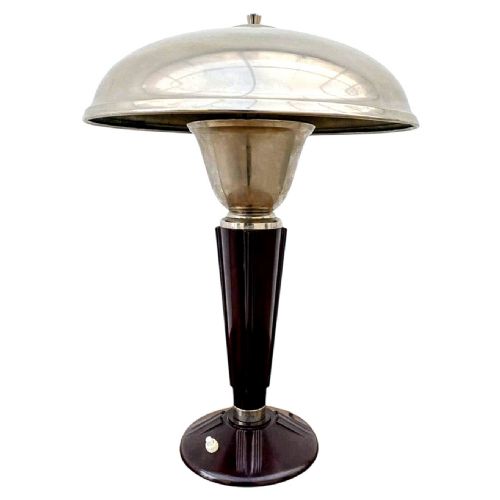
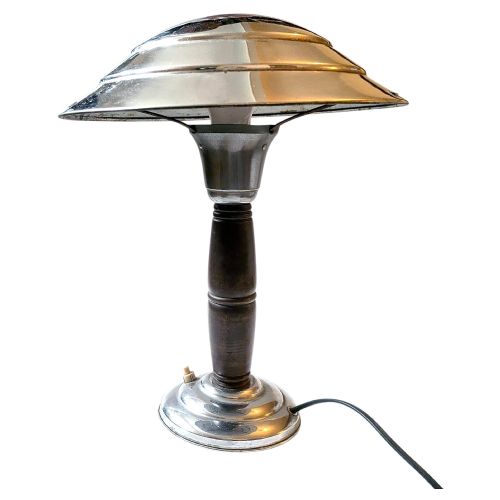
A modernist reading light serves as both a practical desk companion and a sculptural statement of early twentieth-century design. When searching for a modernist reading light, buyers encounter pieces primarily originating from the nineteen-twenties and nineteen-thirties, embodying the clean lines of the Art Deco, Machine Age, and Bauhaus movements.
The selections available on this page concentrate heavily on table lamps and desk lamps designed for direct, functional illumination. These pieces take their aesthetic cues from influential figures like Eileen Grey and Wilhelm Wagenfeld, translating industrial utility into domestic elegance.
Materials and construction
Makers of the period utilised a deliberate palette of newly industrial materials, combining polished chrome and nickel with dense, dark Bakelite. Metal and brass provide structural rigour, while opaline glass diffuses light evenly across the workspace.
Construction techniques emphasise mechanical efficiency and visible assembly rather than hidden joinery. Wooden accents occasionally warm the cold metallic surfaces, anchoring the functional forms of the Machine Age.
Even mid-century French painters occasionally paused to capture a quiet moment of a woman reading beneath the trees.
Judging the work
Quality in these lamps rests upon the purity of their geometric silhouette and the fidelity of their material execution. Finer examples display a harmonious weight between heavy bases and articulated arms, reflecting thoughtful proportion rather than mere ornament.
The distinction between standard production and exceptional design lies in the crispness of the chrome plating and the integrity of the original Bakelite components. Superior pieces capture the genuine ethos of Bauhaus and Machine Age principles without relying on pastiche.
Eileen Grey·Wilhelm Wagenfeld
The Modernist Reading Light Glossary
- Bakelite
- An early form of synthetic phenol formaldehyde resin valued for its lustrous dark finish and durability. It forms the tactile switches and bases of many interwar desk lamps.
- Opaline glass
- A milky, semi-translucent glass used in lamp shades to soften glare and distribute light evenly. It softens the harsh geometry typical of industrial metalwork.
- Bauhaus
- A German art school operational from nineteen-nineteen to nineteen-thirty-three that prioritised function, mass production, and clean modern forms. Its philosophy heavily influences minimalist table lighting.
- Machine Age
- An era spanning the interwar period where design celebrated the aesthetics of industry, speed, and technology. Chrome plating and tubular metal are hallmarks of this style.
- Art Deco
- A visual arts style that emerged in France before World War I and flourished internationally during the nineteen-twenties and thirties. It combines modern sensibilities with rich materials and streamlined shapes.
Modernist Reading Light: Frequently Asked Questions
What defines a modernist reading light?
A modernist reading light is characterised by its emphasis on utility, clean geometric lines, and the use of industrial materials such as chrome, nickel, and Bakelite. These lamps reject excessive ornamentation in favour of form following function.
Originating mostly during the nineteen-twenties and nineteen-thirties, they reflect the philosophies of the Bauhaus and Machine Age movements.
Were these lamps used on desks?
Yes, the majority of these pieces were engineered specifically as table lamps and desk lamps for focused illumination. Their adjustable arms and directional shades provided practical lighting for reading and writing.
Their robust construction made them suitable for both professional offices and domestic studies during the interwar period.
How do I date a modernist lamp?
Dating relies on identifying the characteristic materials and stylistic markers associated with specific interwar periods, such as nineteen-twenty or nineteen-thirty. The presence of early synthetics like Bakelite alongside tubular chrome typically points to the height of the Machine Age.
Design influences, such as those derived from Wilhelm Wagenfeld or Eileen Grey, also help narrow down the decade of production.
Can I use modern bulbs in them?
Most vintage lamps accommodate modern standard bulbs, provided the electrical wiring has been appropriately updated for safety. Many surviving examples have been rewired to meet contemporary standards while preserving their original exterior hardware.
It is advisable to check the internal lamp holder and consult a professional electrician regarding appropriate wattage.