
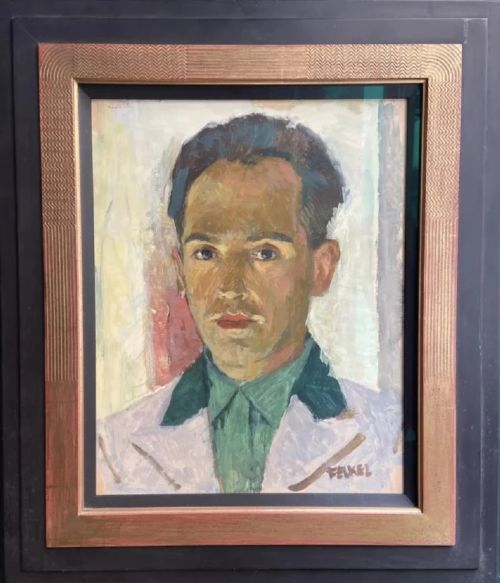
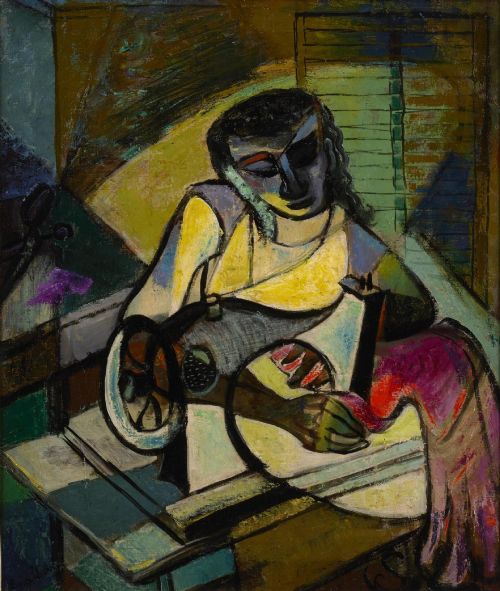


Modernist Portrait Oil Canvas
These modernist portrait oil canvas works capture twentieth-century faces and forms through bold strokes and distinct personal vision.
Modernist Portrait Oil Canvas
A modernist portrait oil canvas brings together striking twentieth-century subjects, from intimate self-portraits and studies of artists' models to figures caught in quiet interiors or open landscapes. These paintings emerge from diverse artistic centres, including French bohemian circles, New York studios and British artistic groups.
The works on this page span several decades of creative experimentation, moving from the stylistic shifts of the 1920s and 1930s through to mid-century compositions. Buyers encounter framed canvases that showcase both named artists and anonymous creators working within Expressionism, Art Deco and School of Paris traditions.
Subjects range from seated nudes and sunbathing figures to religious and cultural icons like the Black Madonna, alongside specific historical personalities such as avant-garde women artists and creators connected to Marcel Duchamp. Each piece preserves the physical texture and immediate touch of the painter's brush.
How they were made
Artists built these compositions primarily using oil paint applied directly onto stretched canvas surfaces, often mounted within supportive wooden or gilt wood frames. The medium allowed painters to layer rich pigments, manipulate opacity and create varied surface textures.
Some works incorporate metallic leaf to catch the light and add decorative resonance to the painted field. Support structures rely on traditional wooden stretchers and frames that protect the perimeter of the canvas while complementing the aesthetic of the period.
One canvas preserves a Parisian bohemian snapshot from 1930 featuring an artist's model taking a rest during studio life.
What varies in quality
Quality reveals itself in the confidence of the brushwork and the structural integrity of the composition, where the artist commands the spatial relationships between figure and ground. Stronger examples demonstrate a distinct personal voice within movements such as Expressionism or Mid-Century Modernism, rather than relying on standard academic formulas.
The depth of psychological engagement with the sitter separates routine decorative canvases from compelling works of fine art. Handling of light, shadow and pigment density contributes significantly to the visual weight and lasting impact of the portrait.
Carl Felkel·Lena Gurr·Raymond Moritz·Pinchus Krémègne·Yo Mayer·Yetta Kane·Bernard Meninsky
The Modernist Portrait Oil Canvas Glossary
- Expressionism
- A modernist style where artists prioritize emotional experience and subjective vision over objective realism. Distorted forms and vigorous brushstrokes convey inner states.
- Bloomsbury Group
- An influential association of English writers, intellectuals and artists associated with modernist domestic interiors and portraiture. Their approach emphasised flat planes of colour and expressive immediacy.
- School of Paris
- A diverse community of international artists working in Paris during the decades between the world wars. Many contributors gravitated towards Montparnasse to explore avant-century idioms.
- Metallic leaf
- Thin sheets of metal applied to portions of a painting or frame to produce reflective highlights. This technique enhances the decorative presence of modernist compositions.
- Canvas
- A heavy woven fabric stretched tightly over a wooden frame to serve as the primary support for oil paintings. Its texture influences how paint sits across the surface.
Modernist Portrait Oil Canvas: Frequently Asked Questions
How do I date a modernist portrait?
Dating relies on stylistic markers within the brushwork, clothing, hair styling and framing methods typical of the 1920s, 1930s, 1940s or 1950s. Signatures, exhibition labels or archival records on the reverse of the canvas often provide definitive chronological clues.
Changes in canvas preparation and stretcher construction also help contextualise the period of production. Comparing the handling of pigment with documented works by the same artist confirms the timeline.
Where should I hang an oil painting?
Select a wall with stable environmental conditions away from direct sunlight, high humidity and sudden temperature fluctuations. Proper placement protects both the oil pigment and the underlying canvas from premature degradation.
Ensure the painting hangs at eye level in a room where you can appreciate the texture and tonal range of the brushwork. Adequate ambient lighting without harsh glare brings out the subtleties of mid-century palettes.
Are these paintings original?
The listings comprise original oil paintings created by hand on canvas during the twentieth century. Each piece represents a unique artistic creation rather than a modern reproduction or print.
Physical inspection of the paint layer reveals the raised ridges of impasto and the distinct interaction of pigment with the weave of the canvas. These tactile qualities confirm the direct hand of the artist.
What is the School of Paris?
The School of Paris refers to the vibrant community of foreign and French-born artists who lived and worked in the French capital during the early twentieth century. These painters gathered in bohemian quarters like Montparnasse to push artistic boundaries.
Artists within this loose affiliation absorbed influences from Cubism, Expressionism and fauvism to forge highly individual portrait styles. Their output forms a cornerstone of modernist painting.