


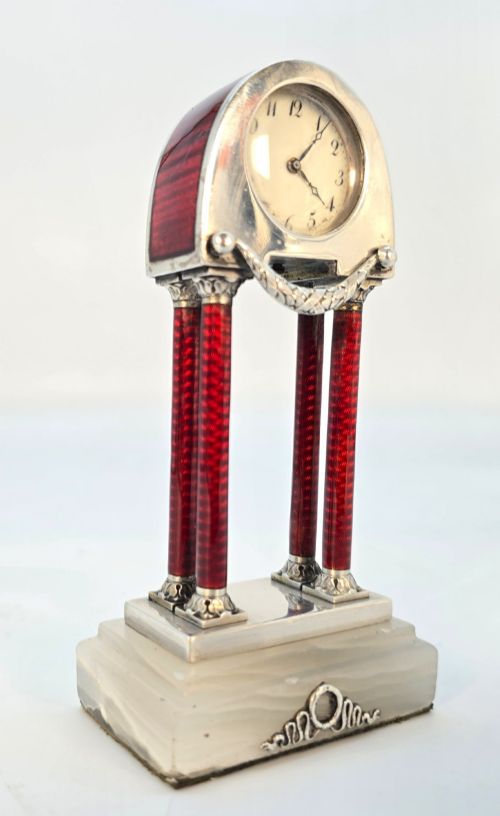


Miniature Silver Table Clock
These miniature silver table clock pieces are compact domestic timepieces housed in precious metal cases, offering desk or travel utility with fine decorative detail.
Miniature Silver Table Clock
When you search for a miniature silver table clock, you encounter portable timepieces spanning the nineteenth century through the Edwardian and Art Deco decades. These objects take the form of carriage clocks, bracket clocks, desk clocks, and portico clocks designed for small spaces.
The pieces on this page originate from British, Viennese, and French makers, utilising silver, sterling silver, and glass. Styles range from Victorian Gothic and George II style to Arts and Crafts and Art Nouveau.
You are most likely to meet carriage clock forms rendered in solid sterling silver or hammered finishes. These examples display the mechanical and decorative priorities of their respective periods.
Materials and construction
Surface decoration relies on traditional silversmithing techniques, including hand-hammered textures and precise hallmarking. Wood, walnut, and onyx occasionally support or frame the metal housings depending on the prevailing style of the era.
Miniature Silver Table Clock Retail Price Guide 2026
Typical asking prices for miniature silver table clock among the pieces listed under this phrase on Sellingantiques today, from the lower quarter to the upper quarter. They describe what is for sale here now, not the wider market.
Some travel clocks managed to pack an alarm function into a case no larger than a matchbox.
Judging quality
Quality rests upon the crispness of the silversmith's handwork and the preservation of any enamel decoration. Pieces featuring fully intact guilloche enamel and clearly struck London hallmarks demonstrate superior original production.
The sophistication of the internal movement also distinguishes the range, with eight-day striking mechanisms or specialised portico configurations representing finer execution than standard timepieces. Case weight and structural integrity complete the assessment of standard versus exceptional examples.
Mappin & Webb·Georg Adam Scheid·J Batson & Son·Henry Matthews·Liberty's London·Bayard
The Miniature Silver Table Clock Glossary
- Guilloche enamel
- A decorative technique involving precise mechanical patterns engraved beneath translucent enamel. This method creates a repeating geometric shimmer across the metal surface.
- Carriage clock
- A small, portable spring-driven timepiece originally designed for travel. These items typically feature glass sides and a carrying handle.
- Portico clock
- A architectural clock style resembling a miniature classical portico with supporting columns. Viennese makers often utilised this format.
- Hallmark
- An official stamp applied to precious metals indicating purity, origin, and assay office. British pieces display these marks to verify sterling silver standard.
Miniature Silver Table Clock: Frequently Asked Questions
How do I wind a miniature silver table clock?
Most of these timepieces use a small key applied to arbors on the backplate or dial. Turn the key gently until resistance signals the mainspring is fully wound.
Avoid over-winding to protect the historical mechanism from undue tension.
Where should I place a miniature clock at home?
Position your clock on a stable desk, mantelpiece, or bookshelf away from direct sunlight and damp environments. These compact surfaces allow the detailed silver and glass panels to catch ambient light.
Ensure the location experiences minimal vibration to keep the movement beating steadily.
How do I distinguish Edwardian from Victorian examples?
Victorian pieces often lean towards heavier historic revival styles, such as Victorian Gothic or ornate traditional casting. Edwardian and later pieces frequently adopt cleaner lines or lighter Arts and Crafts influences.
Checking the assay office hallmarks provides a definitive date for British silver cases.
How should I clean the silver case?
Use a soft, dry microfibre cloth to remove dust from the silver and glass surfaces. Avoid aggressive chemical dips that might strip away patination or damage delicate enamel panels.
Professional clockmakers should handle any cleaning of the internal mechanical movement.