


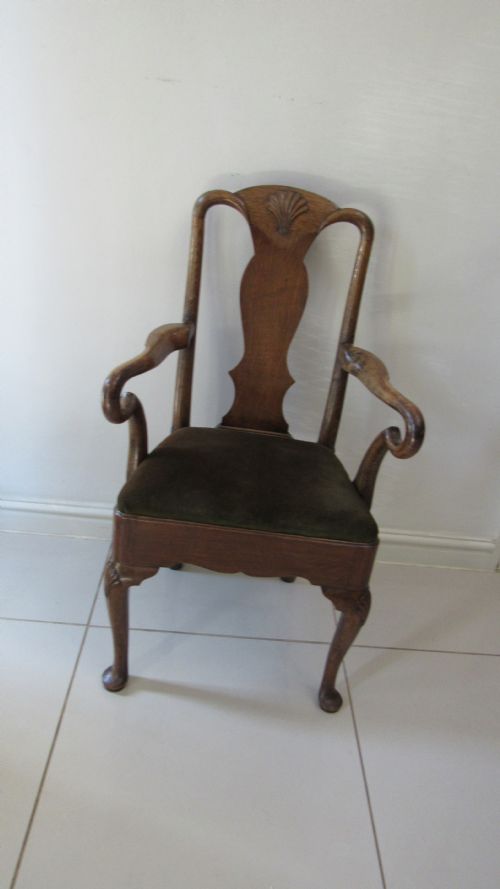


Miniature Mahogany Chair
Miniature mahogany chair forms are delightful small-scale seats built in timber, fabric and leather, offering historic cabinet-making skill in a compact form.
Miniature Mahogany Chair
A miniature mahogany chair search brings up small-scale seating designed for children or created as master craftsman samples, spanning periods from the eighteenth century through the Edwardian era. These pieces appear in forms such as armchairs, side chairs, and children's open arm carvers.
The selections on this page lean heavily towards nineteenth-century Victorian and Edwardian examples, alongside revival pieces modelled on earlier Georgian and Regency designs. Makers often scaled down full-sized seating patterns to create functional items for children or decorative display pieces.
Origins range across various British domestic contexts, utilising traditional forms like the caned bergere alongside simpler side chair shapes. Buyers encounter both plain timber frames and variants enhanced with upholstery in leather, velvet, and damask.
How they were made
Construction relies upon solid mahogany framing, shaped and joined by hand to replicate the structural integrity of full-sized domestic furniture. Cabinet-makers used timber with rich grain patterns, sometimes integrating inlay work to decorate the surfaces.
Upholstery methods varied according to the period, incorporating materials like fabric, leather, cane, and damask to form padded seats and backrests. Additional detailing occasionally included brass elements to accent the timber and textile combinations.
Listings feature mahogany, fabric, leather, brass, textile, velvet, cane, and damask upholstery across Victorian, Regency, and Edwardian periods.
What varies in quality
The standard of a miniature mahogany chair depends upon the proportion and fidelity of the scale reduction, where superior examples maintain the precise architectural balance of full-sized seating. Finer pieces demonstrate expert joinery in the frame and careful selection of the mahogany timber grain.
Upholstery execution also distinguishes the grade of a piece, with high-quality versions featuring period-appropriate textiles such as hand-applied leather, damask, or tight cane work. Secondary details, including subtle inlay work or brass fittings, separate standard workshop output from finer cabinet-maker creations.
The Miniature Mahogany Chair Glossary
- Bergere
- An enclosed armchair with a cushioned seat, where the back and sides are typically filled with cane work. This French-influenced form appears in British miniature seating during the nineteenth century.
- Carver chair
- An open armchair, usually designed with arms that match a set of dining side chairs. These scaled-down versions provide miniature seating with structural armrests.
- Inlay
- A decorative technique where contrasting materials are inserted into recessed cavities in the mahogany surface. Edwardian and later pieces frequently employ this method for visual refinement.
- Damask
- A reversible figured fabric traditionally woven on a jacquard loom, frequently utilised for period upholstery. It provides a textured pattern that complements polished timber frames.
- Side chair
- An upright chair without arms, intended for occasional seating. Miniature variants reproduce full-scale dining or parlor seating in reduced dimensions.
Miniature Mahogany Chair: Frequently Asked Questions
How do I date a miniature chair?
Dating relies upon observing the stylistic revival period or primary construction era indicated by the framing and upholstery materials. Pieces from the Georgian and Regency eras show different turning, leg styles, and joinery techniques compared to later Victorian, Edwardian, or 1900 revival items.
Examining the underlying timber preparation and the type of secondary woods used inside the frame helps establish a chronological window. The presence of specific textiles like damask or cane can also point toward the prevailing taste of the manufacturing decade.
Are these chairs safe for children?
While many pieces originated as functional children's chairs in past centuries, their age and antique status mean they are generally unsuited for modern daily juvenile use. Structural joints and historic adhesives may have weakened over decades or centuries of atmospheric changes.
Most buyers treat these items as decorative display pieces or collector's items rather than practical furniture for children today. Preserving the delicate timber and original upholstery requires careful placement away from heavy physical strain.
What is the difference between Georgian and revival styles?
Original Georgian pieces were manufactured during the eighteenth or early nineteenth centuries, bearing the authentic construction methods and wear associated with that era. In contrast, revival pieces were produced later, such as around 1900 or during the Edwardian period, deliberately copying the earlier aesthetic.
Revival furniture often utilises machinery-assisted cuts alongside traditional hand-finishing, reflecting the manufacturing capabilities of the later date. Examining tool marks and timber seasoning helps differentiate a period original from a later stylistic interpretation.