

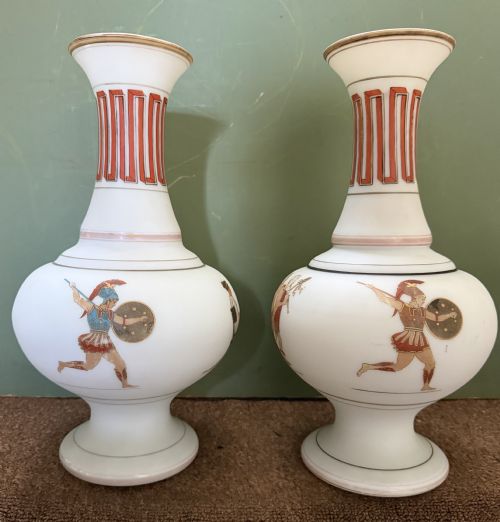
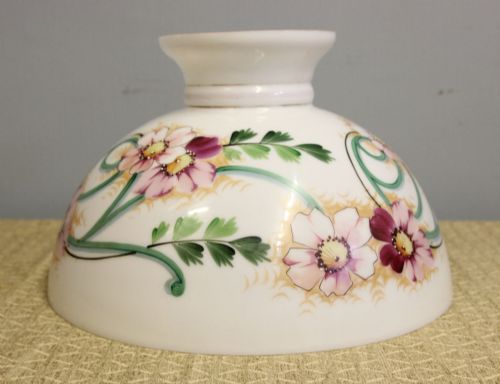


Milk Glass Painting
Milk glass painting brings together lustrous white opaline surfaces and detailed hand-applied enamel work, offering a decorative punch that lifts a whole room.
Milk Glass Painting
The selection ranges across several distinct forms, including bulb vases, tankards, and decanters. Pieces originating from Bohemia and France appear alongside domestic Victorian pieces, showing how widely this decorative technique spread across Europe during the eighteenth and nineteenth centuries.
Vessels span multiple decades, drawing on eighteenth-century Bohemian traditions as well as nineteenth-century French and Victorian manufacturing methods. The form most commonly met on this page is the oil lamp, often paired with brass fittings or mounted on wooden bases.
How they were made
Makers formed the base objects using opaque opaline glass or white glass, often blowing the material into moulds to create vases, lamp fonts, and decanters. This glass body provided a solid, pale canvas designed to take bright pigments and metallic highlights.
Artisans applied enamel colours and gilding directly to the glass surface by hand, depicting floral sprays and panels before firing the pieces to fix the pigments. Brass and gilt components frequently complemented the glass bodies, particularly on lighting fixtures where metal hardware held the shades and fonts in place.
Milk Glass Painting Retail Price Guide 2026
Typical asking prices for milk glass painting among the pieces listed under this phrase on Sellingantiques today, from the lower quarter to the upper quarter. They describe what is for sale here now, not the wider market.
Listings feature items spanning the eighteenth and nineteenth centuries, including Victorian pieces, Biedermeier examples, and French opaline glass.
What varies in quality
Quality rests heavily on the precision and artistry of the hand-painted enamel work, distinguishing mass-produced items from skilled studio pieces. Superior examples display crisp brushwork, well-defined floral details, and carefully applied gilding that remains crisp across the curved glass surface.
The weight and clarity of the opaline glass itself mark the division between standard production and finer wares. Heavier, more evenly coloured glass bodies with well-integrated brass mounts and intact enamel panels stand at the higher end of the scale.
Jean Francois Robert·Baccarat
The Milk Glass Painting Glossary
- Opaline glass
- A type of opaque or translucent glass, typically white, used extensively for nineteenth-century decorative objects and lighting. It provides a smooth, pale background well-suited for enamel painting.
- Enamel
- A glassy substance melted onto the surface of glass or metal for decoration. In these pieces, coloured enamels form floral patterns and detailed picture panels.
- Gilding
- The application of gold leaf or gold powder to a surface. It appears on borders and highlights to accent the painted enamel designs.
- Biedermeier
- A Central European style from the first half of the nineteenth century focusing on utilitarian comfort and clean forms. Pieces from this period balance decoration with domestic utility.
Milk Glass Painting: Frequently Asked Questions
What is milk glass painting?
Milk glass painting refers to the decorative application of enamel and gilt designs onto opaque white opaline or white glass. Artisans used this technique to ornament functional household objects like vases, decanters, and lamp shades.
Items decorated this way gained popularity during the Victorian period, combining a solid white glass ground with colourful hand-painted botanical or abstract motifs.
How were milk glass oil lamps used?
Victorian households relied on oil lamps for interior illumination before electric lighting became widespread. These lamps used paraffin or other burning oils held within glass or metal fonts, topped with glass shades to diffuse the light.
Decorative painted opaline lamps served as both functional lighting and striking parlour ornaments during the nineteenth century.
How do I care for painted glass?
Painted glass requires gentle handling to protect the delicate enamel and gilt decorations from abrasion or flaking. Cleaning should be done using a soft, dry cloth or a slightly damp sponge without harsh chemical cleaners.
Avoiding abrasive materials ensures the hand-painted floral panels and metallic highlights remain intact on the glass surface.
How can I date these pieces?
Dating relies on examining the manufacturing style, the form of the object, and the characteristics of the glass body. Victorian pieces often feature distinct brass hardware proportions and specific Victorian aesthetic preferences.
Earlier eighteenth-century Bohemian examples display heavier glass manipulation and different enamel palettes compared to later nineteenth-century French production.