

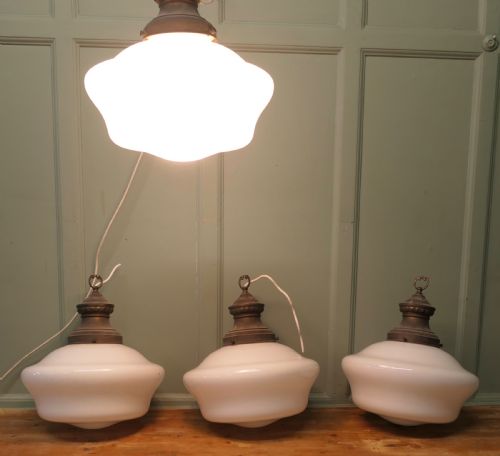


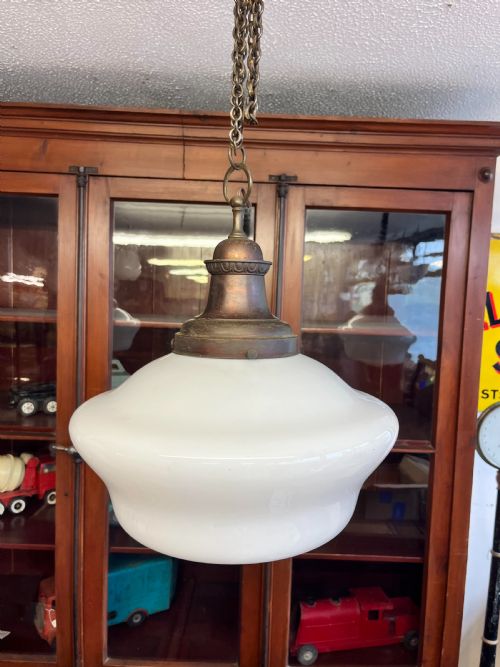


Milk Glass Globe Shade
A milk glass globe shade diffuses harsh electric and oil light into a soft, even glow that suits period interiors.
Milk Glass Globe Shade
A milk glass globe shade takes the form of spherical or domed lighting diffusers designed for pendant lights, ceiling lights, and oil lamps. When you search for a milk glass globe shade, you encounter functional white glass vessels created to soften glare across domestic and commercial spaces.
The pieces appearing on this page span the nineteenth century through the nineteen-thirties, covering Victorian, Edwardian, Art Deco, and industrial styles. You are most likely to meet utilitarian opaline pendant lights from the early twentieth century alongside decorative oil lamp globes from the Victorian era.
Forms range from diminutive lamp shades to huge chapel and pharmacy pendants, occasionally mounted with brass rings or paired with metal ceiling hardware. These fittings served practical illumination needs in hallways, workshops, and living spaces.
Materials and construction
Makers produced these shades using opaque, opal, and moonstone glass, which diffuses light evenly without complete transparency. This dense white or milky glass achieved its distinctive appearance through the addition of bone ash, tin oxide, or arsenic during manufacturing.
Mounting hardware often incorporates brass or chrome collars and rings to secure the glass bowls to ceiling suspensions and oil lamp bases. Heavier industrial and gothic style fittings combined these glass globes with structural metalwork to withstand commercial use.
Milk Glass Globe Shade Retail Price Guide 2026
Typical asking prices for milk glass globe shade among the pieces listed under this phrase on Sellingantiques today, from the lower quarter to the upper quarter. They describe what is for sale here now, not the wider market.
Fish scale opaline glass proves that even utilitarian nineteen-thirties factory lighting could not resist a touch of piscine vanity.
Judging quality in milk glass
Quality rests upon the density and purity of the glass mix, which dictates how evenly the shade diffuses light when illuminated. Finer examples display a smooth, consistent opacity without excessive bubbles or thin patches that reveal the internal bulb too sharply.
The distinction between ordinary utility items and superior pieces often lies in the weight of the glass and the sophistication of any accompanying brass or metal fittings. Early twentieth-century opaline shades with distinct textures, such as fish scale patterns, show greater ambition in mould-blowing technique.
The Milk Glass Globe Shade Glossary
- Opaline glass
- A semi-opaque glass with a milky or pastel appearance that became popular for nineteenth and twentieth-century lighting. It diffuses light gently while adding a subtle coloured tint or dense white finish.
- Pendant light
- A hanging light fixture suspended from the ceiling by a cord, chain, or metal rod. These fixtures frequently utilise globe shades to direct illumination downward while casting a soft ambient glow.
- Gothic Revival
- An architectural and decorative style drawing inspiration from medieval design. In lighting, it manifests through pointed arches, heavy brass framework, and structured glass configurations typical of the nineteenth and early twentieth centuries.
Milk Glass Globe Shade: Frequently Asked Questions
What is a milk glass globe shade?
A milk glass globe shade is a rounded diffuser made from opaque white glass used to soften the glare of light bulbs or oil flames.
These shades were fitted to pendant lights, ceiling fixtures, and oil lamps across the nineteenth and early twentieth centuries.
How do I date a milk glass globe?
Dating relies on the manufacturing style, the type of glass, and the associated brass or metal hardware found on the fixture.
Victorian and Edwardian examples often pair with oil lamp burners or ornate brackets, whereas nineteen-thirties pieces tend toward clean Art Deco and industrial pendant fittings.
Were these shades used with oil or electricity?
They served both fuel sources, transitioning from nineteenth-century oil lamps to early twentieth-century electric pendant and ceiling installations.
Many surviving shades originally housed oil burners before being converted or manufactured specifically for the early expansion of domestic electric lighting.
How do I clean an antique glass shade?
Careful washing in warm soapy water removes accumulated dust and grime without harming the delicate milky surface of the glass.
Avoid abrasive scourers that might scratch the opaline finish or damage any original brass rims attached to the fitter neck.