
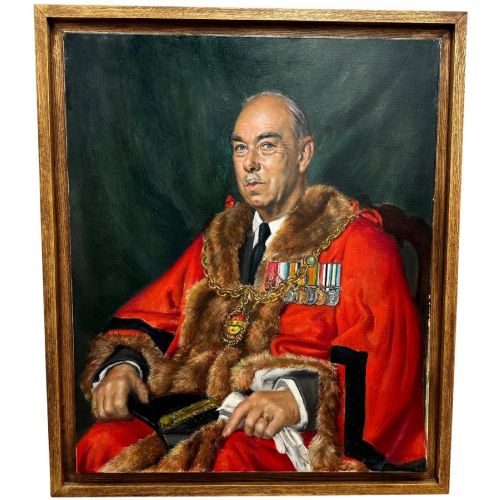
Mid-century Gentleman Portrait
A mid-century gentleman portrait brings serious character to a wall, combining mid-century realism with older aristocratic subjects.
Mid-century Gentleman Portrait
A mid-century gentleman portrait captures male subjects through oil paint, canvas, and framed art, with works spanning from the seventeenth century through the mid-twentieth century. Buyers searching for a mid-century gentleman portrait encounter oil paintings dated around nineteen-fifty alongside earlier depictions executed in various historic schools.
The selection ranges from twentieth-century realism and mid-century realism to Georgian, German Baroque, Flemish Baroque, and Tudor revival styles. Many pieces record specific historical figures, mayors, geologists, and writers, framed in wood for wall display.
Materials and Construction
Finished works sit within wood frames, sometimes incorporating glass for protection. The physical construction combines canvas stretching over wooden frames with protective exterior mouldings.
The inventory includes works from German, Flemish, and French schools alongside twentieth-century British realism.
Quality Variations
Quality depends upon the skill of the artist in handling oil paint and capturing the likeness and gravity of the sitter. Works by named painters or established regional schools demonstrate superior brushwork and compositional depth compared to anonymous or primitive executions.
The preservation of the canvas, the integrity of the wood frame, and the clarity of the oil medium distinguish finer examples. Stronger portraits retain vibrant pigment and stable surfaces without heavy restoration.
Bernard Hailstone·William Robert Dickinson·Arthur Spooner·Cowan Dobson·William Dring·Andrea Soldi·Thomas Hudson·J Bizo
The Mid-century Gentleman Portrait Glossary
- Oil paint
- A medium consisting of pigments suspended in a drying oil, typically linseed oil, allowing for rich colour blending and depth.
- Canvas
- A heavy woven fabric used as a surface for oil paintings, stretched tightly across a wooden frame.
- Realism
- An artistic style that depicts subjects truthfully and without artificiality, prominent in twentieth-century portraiture.
- Baroque
- An ornate artistic style originating in the seventeenth century, characterised by drama and rich detail seen in Flemish and German schools.
- Jabot
- A decorative ruffle attached to the collar of a shirt, frequently visible in eighteenth-century gentleman portraits.
Mid-century Gentleman Portrait: Frequently Asked Questions
What periods do these portraits cover?
The selections span from the seventeenth century through the Victorian era and into the mid-twentieth century. Many pieces date specifically to the nineteen-fifties while depicting subjects from earlier centuries.
Some works adopt historic styles like German Baroque and Tudor revival while being produced in later decades.
How were these portraits framed?
Most works utilise wood frames to house the canvas or paper support. These enclosures provide structural support and aesthetic definition for wall art.
Frames vary from simple wooden mouldings to more ornate decorative housings depending on the period.
Who are the subjects in these paintings?
Subjects include notable figures such as mayors, geologists, writers, and members of landed families. Other pieces depict anonymous gentlemen from various European schools.
Each portrait records the likeness of real individuals, ranging from aristocracy to prominent professionals.
What painting techniques appear in the collection?
Artists primarily utilised oil paint on canvas, though watercolour on paper also appears. Brushwork ranges from precise academic realism to looser primitive interpretations.
Details such as armour, lace jabots, and facial expressions are rendered through layered pigment.