


Mid Century Bird Artwork
Mid century bird artwork brings feathered subjects to life across paper and canvas through the hands of notable British artists.
Mid Century Bird Artwork
Mid century bird artwork encompasses original paintings, watercolours and framed wall art capturing avian subjects during the middle decades of the twentieth century. These pieces record naturalistic observations and expressive interpretations by notable twentieth-century painters and illustrators.
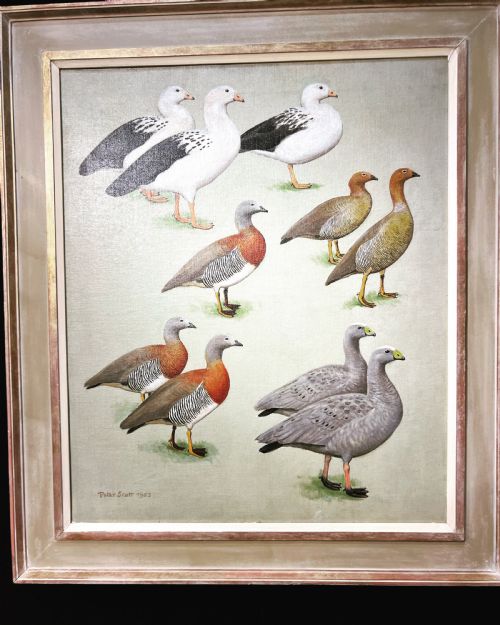
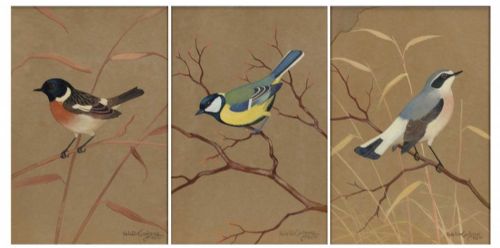
Buyers frequently encounter works from the nineteen-fifties and sixties featuring British natural history, garden birds and raptors rendered in watercolour, gouache or oil paint. The selection also includes earlier nineteenth-century representations, spanning silhouettes, micromosaic plaques and Victorian watercolours alongside impressionist and expressionist interpretations.
Materials and construction
These works rely on traditional painting media applied to paper, canvas and wood panels. Artists utilised watercolour, oil paint and gouache, occasionally incorporating gold leaf to highlight compositional details within framed presentations.
Support structures range from simple paper sheets to stretched canvas and ebonised frames housing delicate micromosaic plaques. Many items retain their original framing, which assists in dating the physical object alongside the depicted subject.
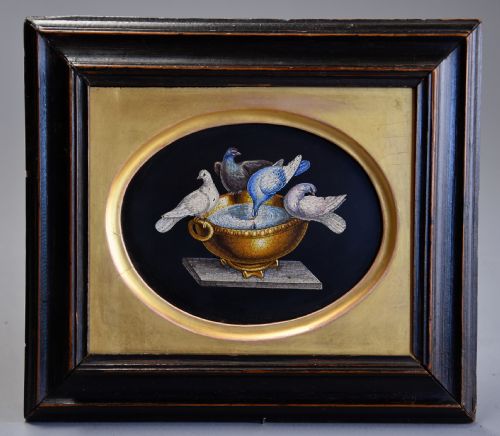
A nineteenth-century Italian micromosaic plaque preserves forever the image of doves sharing a quiet moment inside an ebonised frame.
Distinctions in quality
Quality rests upon the demonstrable skill of the hand behind the brush and the precision of naturalistic observation. Recognised artists whose oeuvres are documented in the art historical record command greater attention than anonymous studies.
The integrity of the medium and the preservation of the paper or canvas surface dictate the longevity of the visual impact. Works that retain vibrant pigment tones without excessive fading or paper degradation demonstrate superior preservation.
Sir Peter Markham Scott·Frederick Tatham·Ralston Gudgeon·Dame Elisabeth Frink·Henri Joseph Pauwels·Charles F Tunnicliffe·Leon Kossoff·Paul-Louis Barruel·Donald Watson
The Mid Century Bird Artwork Glossary
- Watercolour
- A painting method in which the paints are made of pigments suspended in a water-based solution. This technique allows for translucent washes often utilised in detailed bird studies.
- Micromosaic
- A mosaic assembled from tiny opaque glass tesserae to create intricate pictorial scenes. These plaques frequently depict avian motifs such as doves within fitted frames.
- Expressionism
- A modernist style where the artist distorts reality for emotional effect rather than objective representation. Expressive bird paintings use vigorous brushwork to convey movement and atmosphere.
- Chiaroscuro
- The use of strong contrasts between light and dark to give a three-dimensional volume to figures and subjects. This technique shapes the modelling of form in painted compositions.
Mid Century Bird Artwork: Frequently Asked Questions
What periods do these pieces cover?
The selection spans from the nineteenth century through to the mid-twentieth century, with a concentration on works created during the nineteen-forties, fifties and sixties.
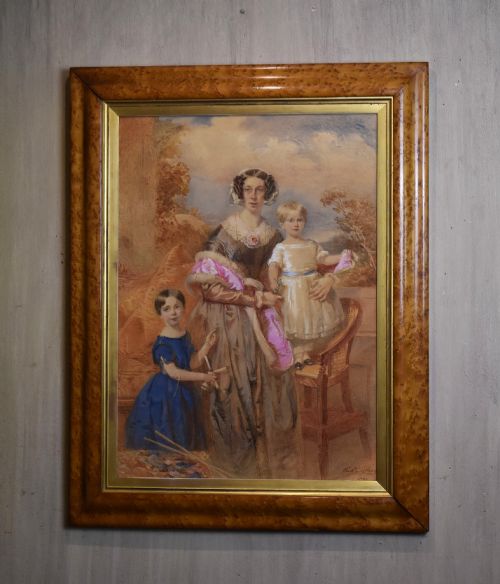
Earlier nineteenth-century examples incorporate silhouettes and Italian micromosaic plaques alongside Victorian family watercolours.
How were these artworks displayed?
Most works are framed for wall display, utilising wood frames or ebonised surrounds to protect the paper or canvas supports.
Watercolours on paper typically require glass protection, while oil paintings on canvas or wood remain open to the room environment.
Are these original paintings?
The listings consist of original paintings, watercolours, and framed art rather than modern mass-produced reproductions.
Signatures from listed artists such as Donald Watson and Charles F Tunnicliffe appear on several individual studies.
What subjects accompany the birds?
Avian subjects range from garden birds and jays to hawks and game, depicted within natural habitats or still life compositions.
Additional figures include human portraits, nudes with doves, and symbolic representations like the doves of Pliny.