


Mercury Wheel Barometer
A mercury wheel barometer brings atmospheric change into focus through silvered dials and polished timber.
Mercury Wheel Barometer
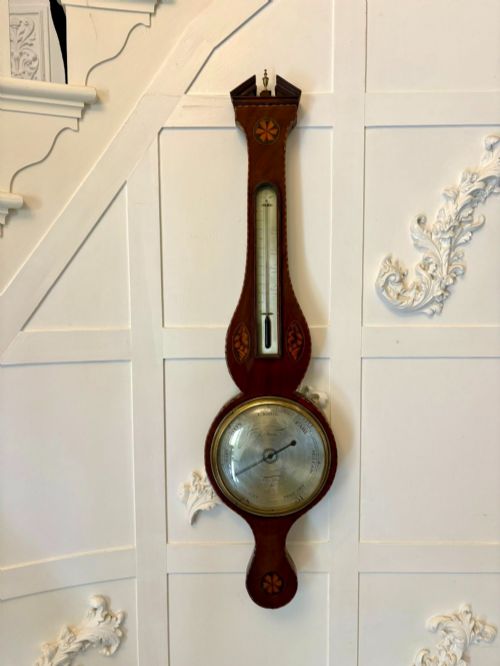
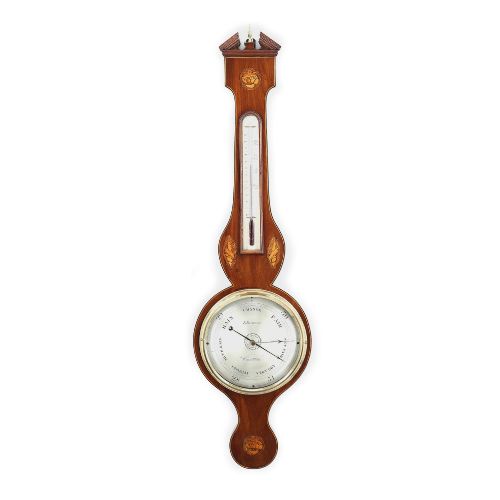
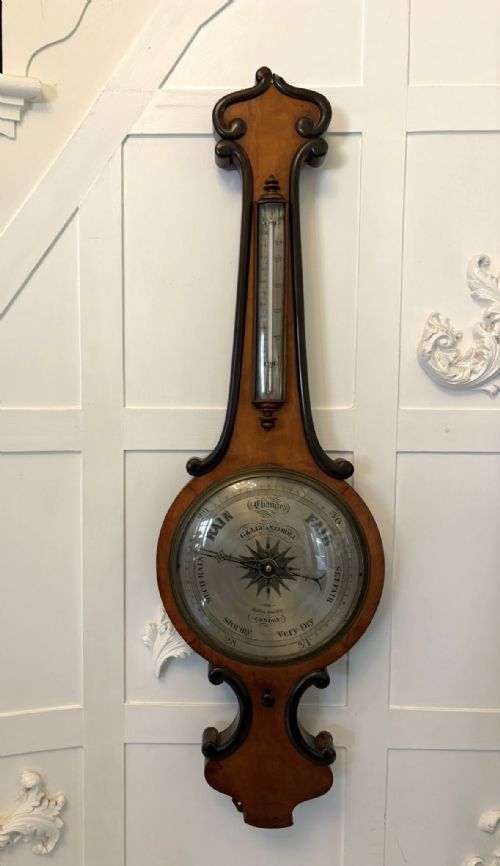
A mercury wheel barometer displays barometric pressure on a circular dial, housed in an expanded wooden case often called a banjo barometer due to its distinctive outline. These instruments record weather patterns through the movement of mercury within a concealed tube, linked to a visible indicator hand.
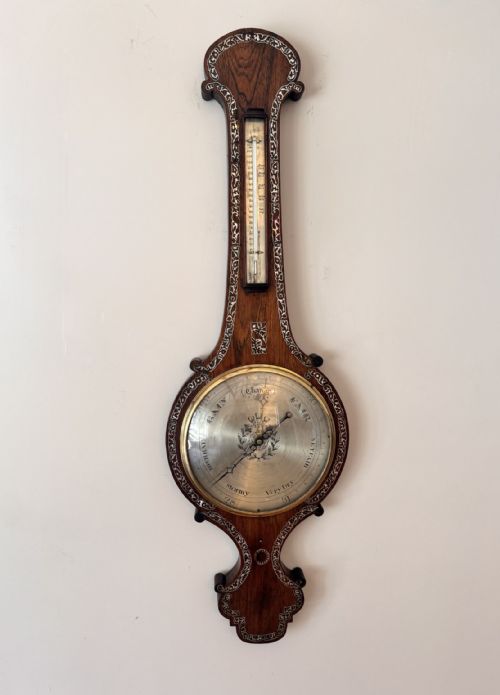
The versions most commonly found here date from the Georgian, Regency and Victorian eras, spanning the late eighteenth century through to the late nineteenth century. Mahogany and rosewood form the primary casework, frequently enhanced with contrasting stringing or shell marquetry.
Makers working across provincial towns and capital cities signed these instruments on the main scale, leaving a record of regional craftsmanship from London to smaller British boroughs.
How they were made
Cabinetmakers constructed the wall cases from dense hardwoods like mahogany, rosewood and walnut, sometimes selecting burr veneers or shaping onion-top pediments. They incorporated brass bezels, bone adjustment knobs and glass dials to protect the delicate interior scales.
Inlaid decoration relied on mother-of-pearl, ebony and boxwood, assembled in geometric lines or floral shell motifs within the throat and base of the instrument. Silvered metal dials received finely engraved calibrations and maker signatures, often paired with auxiliary thermometers or hygrometers.
One Victorian instrument commemorates the life of the Duke of Wellington right on the dial.
What varies in quality
The refinement of the woodwork distinguishes standard production from exceptional pieces, visible in the depth of the mahogany grain, the precision of the mother-of-pearl shell inlay and the elegance of the scrolling pediment. Elaborate marquetry and carved walnut details indicate higher workshop ambition.
The execution of the silvered brass dial influences overall merit, where crisp, deep-cut lettering and intricate floral engraving around the maker's signature elevate the instrument above plainer examples with stamped scales.
B Besozzi of Weymouth·G & L Guanziroli London·Ganthony of London·Prada of High Wycombe·Molton of Norwich·Luisetti of London·Fagioli of Clerkenwell London·Giana Shrewsbury·Jenkins Of Old Swindon·L Casatelli of Liverpool·James H Kelly of Glasgow·Watkins·Roncoroni·W E Pain of Cambridge·H Marks Bloomsbury·Hayward of Ashford·Vecchio & Co Shaftsbury·Bianchi Ipswich·A Rivolta·J Groce York·Luppi & Solcha of Hull·Vanini of Sheffield·Fontana of Exeter·A Corti London·Jasper Salop
The Mercury Wheel Barometer Glossary
- Banjo barometer
- A wall barometer housed in a case with a narrow stem and a circular bulbous base, resembling the shape of a banjo. This form became standard for domestic mercury barometers during the Georgian period.
- Silvered metal
- A brass or copper dial treated with a silver solution to create a matte white metallic surface for engraved numerals. These plates reflect light softly behind the protective glass bezel.
- Thermometer
- An auxiliary temperature scale mounted in the stem of the barometer, usually topped with a convex glass bulb. It provides a secondary reading alongside the main atmospheric pressure dial.
- Marquetry
- Fitted pieces of contrasting wood veneer or shell assembled into pictorial or decorative patterns on the front of the case. Craftsmen utilised this technique to adorn the throat and cistern cover.
- Cistern
- The enclosed lower reservoir that holds the base of the mercury tube within the bulb of the case. Fluctuations in pressure act upon the fluid contained inside this concealed chamber.
Mercury Wheel Barometer: Frequently Asked Questions
How do I read a mercury wheel barometer?
The pointer moves clockwise or anticlockwise across the silvered scale as atmospheric pressure rises or falls. Matching the pointer against engraved weather words indicates general meteorological trends.
Many instruments include a manual set hand, adjusted with an ivory or brass knob on the glass bezel to track daily changes. Comparing the main hand to this marker reveals whether pressure has increased or decreased since the last observation.
Where should I hang a wall barometer?
These instruments require a stable interior wall away from direct sunlight, central heating radiators and damp exterior doors. Sudden temperature shifts can affect the mercury column and wood casework.
A secure fixing is essential because the combination of dense hardwood and glass requires firm support. Hanging the case at eye level ensures easy reading of the dial and auxiliary thermometer.
How do I date a mahogany banjo barometer?
Early examples from the George III period often feature simple architectural pediments, delicate string inlay and damp-proof dampener boxes. The overall proportions tend to be slender and restrained.
Victorian pieces frequently adopt larger scales, carved walnut or rosewood frames, and heavier onion-top pediments. Mother-of-pearl inlay and more elaborate scrollwork also point towards the later nineteenth century.
Did these barometers travel well historically?
Makers designed specific transit mechanisms to secure the mercury during transport, often using a small screw at the base of the cistern. Tightening this screw prevented the fluid from surging up the tube and breaking the glass.
Many antique instruments retain these original brass transit screws on their lower cistern covers. Modern relocation still requires careful handling to keep the mercury column intact.