

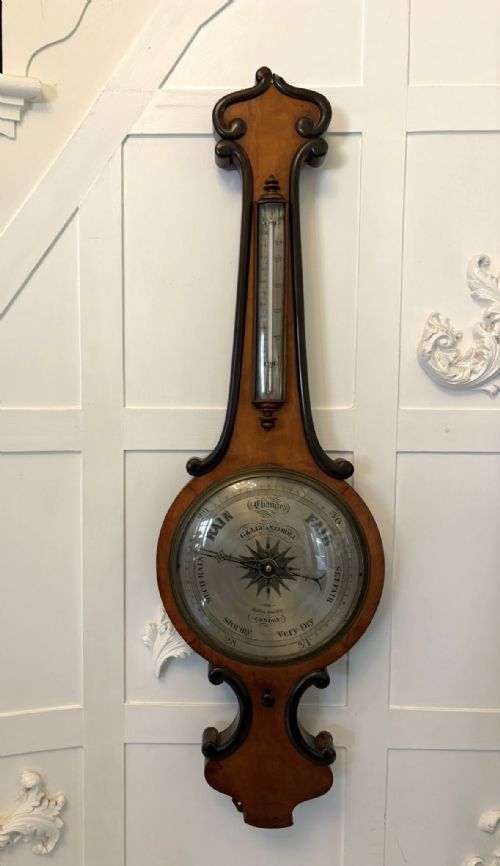


Mercury Banjo Barometer
A mercury banjo barometer hangs with the quiet authority of an instrument that kept a household in touch with the changing skies.
Mercury Banjo Barometer
When you search for a mercury banjo barometer, you are looking at wall-hanging weather glasses shaped like the musical instrument, appearing mostly in Georgian, Regency, and Victorian periods.
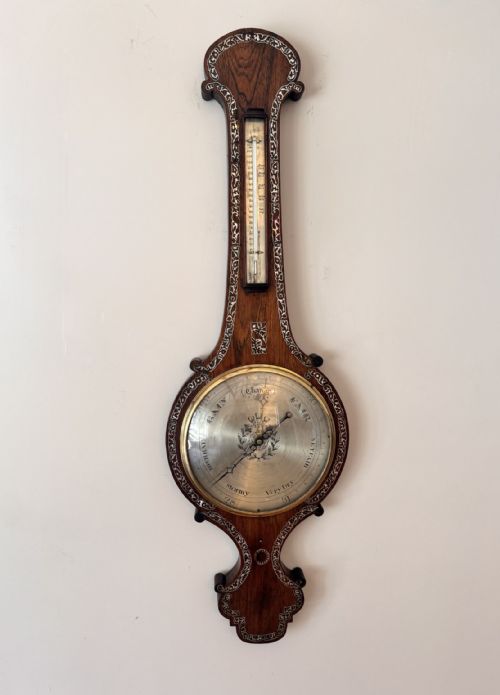
Mahogany and rosewood form the backbone of these pieces, alongside walnut and oak, often decorated with shell inlay or mother-of-pearl.
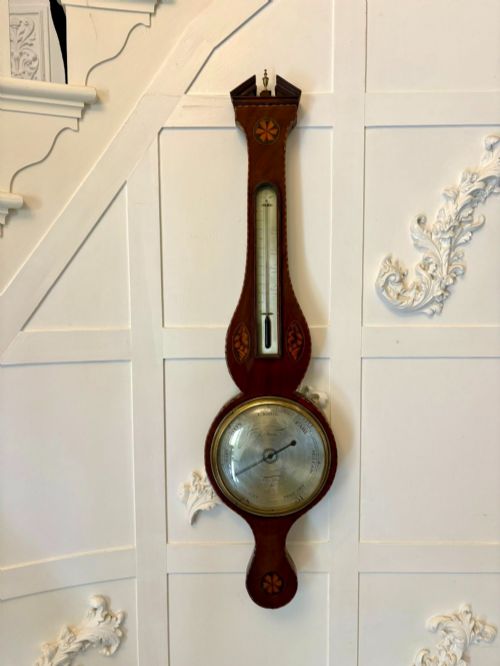
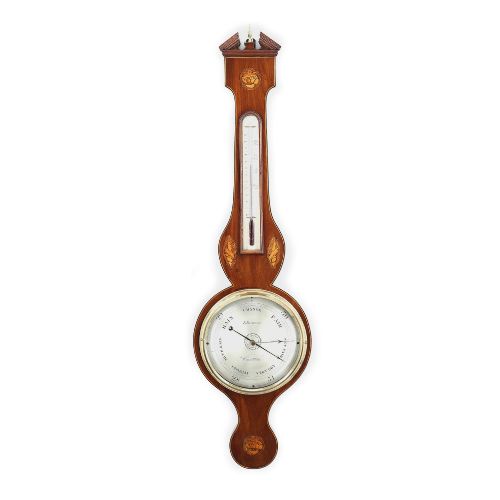
The version you are most likely to meet on this page is a 19th-century wheel barometer housed in a mahogany or rosewood case with a silvered metal dial.
Materials and Construction
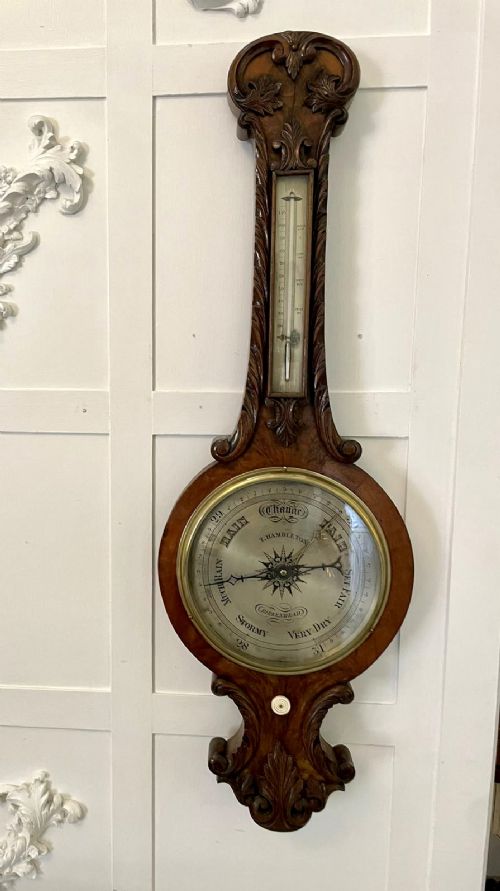
Cabinetmakers shaped dense timbers like mahogany, rosewood, and burr walnut into the distinctive curved banjo outline, frequently incorporating brass bezels and glass dials.
Marquetry and mother-of-pearl inlay embellish the cases of finer examples, while mercury responds inside the concealed tube to atmospheric pressure changes.
Some provincial makers proudly pinned their workshops far from the capital, ensuring barometers arrived bearing the distant air of Norwich, Shrewsbury, and Swindon.
Evaluating the Craft
The crispness of the case carving and the precision of the shell or mother-of-pearl inlay separate standard production from superior workshop output.
Legibility of the engraved silvered metal dial and the integrity of the original glass and brass components indicate the level of care retained over the decades.
B Besozzi of Weymouth·G & L Guanziroli London·Ganthony of London·Prada of High Wycombe·Molton of Norwich·Luisetti of London·Fagioli of Clerkenwell London·Giana Shrewsbury·Jenkins Of Old Swindon·L Casatelli of Liverpool·James H Kelly of Glasgow·Watkins·Roncoroni·W E Pain of Cambridge·H Marks Bloomsbury·Hayward of Ashford·Vecchio & Co·Jasper Salop·Poncia Worcester·Vaughan of Newport
The Mercury Banjo Barometer Glossary
- Banjo barometer
- A wall barometer featuring a circular dial at the base and a long trunk above, resembling the stringed instrument. It gained widespread popularity during the Georgian and Victorian eras.
- Silvered metal
- A brass or copper dial treated to achieve a silvery, matte finish before being engraved with weather scales and maker details. The fine lines hold black pigment for easy reading.
- Aneroid barometer
- A later meteorological instrument that measures air pressure using a flexible metal box rather than liquid mercury. It freed makers from the physical constraints of the traditional tube.
- Thermometer
- A secondary temperature scale mounted on the trunk of the barometer. It provides a complete atmospheric reading alongside the pressure dial.
- Mother-of-pearl
- Iridescent shell material set into the wood case as geometric or floral marquetry. It catches the light against dark timbers like rosewood.
Mercury Banjo Barometer: Frequently Asked Questions
How do I read a mercury banjo barometer?
The pointer moves clockwise as atmospheric pressure rises, indicating fair weather, and anti-clockwise as pressure falls toward rain.
Most dials feature engraved descriptions ranging from stormy and rain to change, set fair, and very dry to help interpret the shift.
Can these barometers still be hung on the wall?
These instruments are designed for wall mounting using the hanging ring or bracket secured to the upper rear of the wooden case.
Care must be taken to hang them plumb so the mercury column and pointer operate without friction against the glass.
How do I tell a Georgian piece from a Victorian one?
Georgian versions tend to feature simple mahogany cases with restrained shell inlay and sharp hygrometer dials at the top.
Victorian examples frequently introduce richer timbers like burr walnut and rosewood, heavier carving, and elaborate mother-of-pearl decoration.
What is the difference between mercury and aneroid?
Mercury barometers rely on an open column of liquid metal responding directly to barometric pressure in a traditional glass tube.
Aneroid barometers use an internal sealed metal capsule that expands and contracts, omitting liquid entirely for a more compact mechanism.