
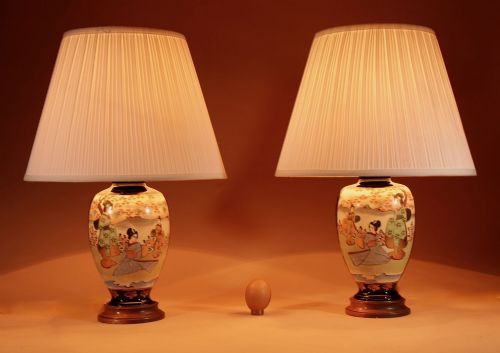
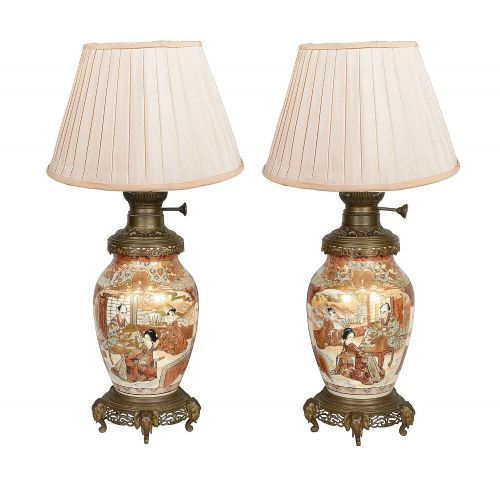


Meiji Porcelain Table Lamps
Meiji porcelain table lamps bring distinct Japanese ceramic artistry into a room, offering both character and warm illumination.
Meiji Porcelain Table Lamps
When you search for meiji porcelain table lamps, you are looking at Japanese vessels from the nineteenth century and the early twentieth century that have been adapted to hold electrical fittings. These pieces originate from historic Japanese periods and styles, including Satsuma, Kutani, Imari, and Yokohama.
The objects themselves are often historic vases or spill vases mounted with lamp components, paired as matching sets or offered individually. They combine traditional East Asian ceramic forms with practical domestic lighting.
The most common versions on this page are pairs of Satsuma and Kutani porcelain vessels dating from the nineteenth century. Blue and white porcelain designs also appear regularly, alongside Imari and Yokohama examples.
Materials and construction
These lamps utilise porcelain, earthenware, and ceramic bodies that were shaped and fired in Japanese kilns before later conversion into lighting. Many incorporate delicate enamel work upon the ceramic surface.
The mounts and fittings frequently employ brass, while the shades are constructed from fabric and silk. Wood elements also support the overall structure of the assembled lamps.
The inventory spans the nineteenth century through to nineteen twenty, covering Satsuma, Kutani, Imari, and Yokohama styles.
Judging quality in Meiji lighting
The distinction between tiers rests in the hand-painted detail upon the porcelain body and the crispness of the enamel work. Stronger examples display finer brushwork and more complex decorative schemes across Satsuma, Kutani, and Imari surfaces.
Proportion and scale also separate the standard from the exceptional, particularly in large pairs of Yokohama or blue and white vases. The integration of the lamp hardware with the historic ceramic body dictates the visual harmony of the piece.
The Meiji Porcelain Table Lamps Glossary
- Satsuma
- A type of Japanese earthenware featuring a crackle glaze and ornate enamel decoration, frequently depicted in these lamp conversions.
- Kutani
- A style of Japanese porcelain known for bold colour palettes and intricate pictorial designs.
- Imari
- A traditional Japanese porcelain style distinguished by underglaze blue and overglaze iron red and gold colouring.
- Japonisme
- A western nineteenth-century artistic movement influenced by Japanese art and design aesthetics.
- Enamel
- A decorative glass-like substance fused to the ceramic surface through firing to create colourful patterns.
Meiji Porcelain Table Lamps: Frequently Asked Questions
Are these original lamps?
The ceramic bodies originate from the nineteenth century or early twentieth century, primarily as vases rather than lighting. They were subsequently converted into table lamps to suit modern domestic use.
This adaptation allows historic Japanese porcelain to serve a practical function in contemporary interiors while retaining its original decorative character.
How do I identify Satsuma ware?
Satsuma ceramics typically display a characteristic ivory-coloured body covered in a fine network of crackled glaze. They are further distinguished by detailed hand-painted scenes often accented with gilt.
These pieces form a significant portion of the available table lamps and bring a warm, textured appearance to a room.
Can I use modern shades?
Modern fabric and silk shades can be paired with these bases provided the harp and fitting dimensions match the proportions of the ceramic vessel. Consideration should be given to the weight and height of the vase.
Selecting a neutral shade often helps balance the intricate patterns present on Imari, Kutani, and Satsuma porcelain.
What is Kutani porcelain?
Kutani porcelain originates from historic Japanese kilns and is recognised for vibrant palettes, frequently incorporating greens, reds, and golds. The surfaces often feature detailed pictorial motifs.
As table lamps, these porcelain pieces introduce strong colour and narrative design to a mantelpiece or side table.