

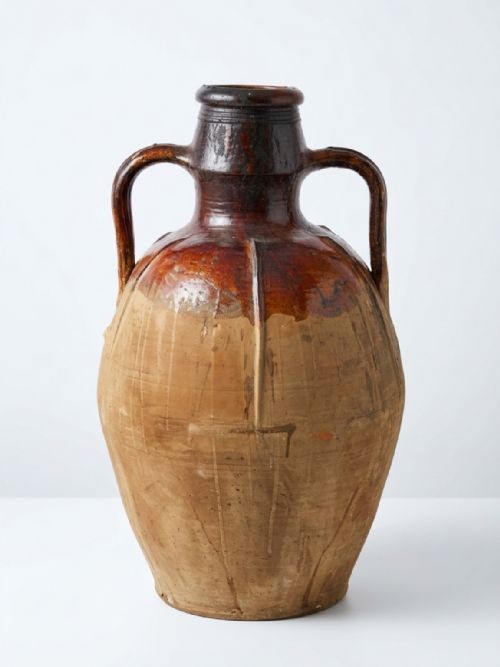


Mediterranean Olive Jars
These Mediterranean olive jars bring tactile warmth to a room, offering robust earthenware forms shaped by centuries of practical use.
Mediterranean Olive Jars
When you search for mediterranean olive jars, you encounter robust vessels designed for storing oil, wine, and water across southern Europe. The pieces listed on this page span the nineteenth century and the early twentieth century, including Victorian examples alongside items dated around eighteen-eighty to nineteen-twenty.
Most items take the form of large terracotta oil jars, amphorae, garden planters, and painted pottery vessels originating from Italy, Turkey, and Portugal. You frequently meet rustic Mediterranean and country Italian styles that function equally well as decorative vessels indoors or garden urns outdoors.
Forms range from simple unadorned clay bodies to pieces featuring lime wash, painted surfaces, and occasional wrought iron stands. These substantial vessels carry the marks of their agricultural origins, serving collectors who appreciate vernacular European folk art.
How they were made
Potters built these vessels using regional clay and terracotta, shaping heavy earthen walls designed to keep contents cool. Many examples show the natural texture of fired earthenware, whilst others carry traces of historic lime wash or surface paint applied over the clay.
Select pieces incorporate applied glaze or sit within wrought iron stands, combining structural utility with decorative appeal. The manufacturing process prioritized pure functionality for agrarian storage, leaving characteristic surface irregularities from traditional kilns and hand-shaping.
Mediterranean Olive Jars Retail Price Guide 2026
Typical asking prices for mediterranean olive jars among the pieces listed under this phrase on Sellingantiques today, from the lower quarter to the upper quarter. They describe what is for sale here now, not the wider market.
The inventory records pieces dated across several decades, including eighteen-eighty, nineteen-hundred, nineteen-ten, and nineteen-twenty.
What varies in quality
Quality rests upon the integrity of the clay body and the character of the surface patination accumulated over time. Superior examples retain their original painted finishes or lime wash intact, showing clear provenance through regional form and material weight.
The visual appeal depends heavily on proportion, scale, and the natural weathering of the terracotta. Pieces paired with period wrought iron stands or featuring intact glazes offer distinct variations that elevate the object beyond basic utilitarian ware.
The Mediterranean Olive Jars Glossary
- Terracotta
- A porous, baked red-brown earthenware clay used extensively for large storage vessels and garden planters. It develops a rich surface patina through exposure to the elements.
- Amphora
- A two-handled jar with a narrow neck used traditionally for transporting and storing oil or wine. These classical forms influenced later Mediterranean utilitarian pottery.
- Lime wash
- A traditional white or tinted coating applied to exterior surfaces of earthen pots for protection and decoration. It often weathers unevenly over decades.
- Earthenware
- Pottery fired at relatively low temperatures, remaining porous unless glazed. It forms the primary material base for the majority of rustic Mediterranean storage vessels.
- Patina
- The surface texture and coloration acquired by clay, paint, and iron through age and handling. This visual depth indicates genuine period use.
Mediterranean Olive Jars: Frequently Asked Questions
How were Mediterranean olive jars originally used?
These large vessels served practical agricultural purposes in southern Europe, primarily storing bulk quantities of olive oil, wine, and water.
Their thick earthenware walls kept contents cool during hot summers, while narrow necks minimised evaporation and spoilage.
Are these jars suitable for outdoor garden use?
Many examples function well as garden planters and urns, provided local winters do not subject the porous terracotta to severe frost damage.
Bringing unglazed earthenware indoors during freezing weather prevents the trapped moisture from expanding and cracking the clay body.
How do you date nineteenth century terracotta?
Dating relies on examining the forming techniques, tool marks left by the potter, and the specific composition of the regional clay.
Surface characteristics such as historic lime wash layers and natural wear patterns also help establish the chronological period.
What is the difference between an oil jar and an amphora?
Oil jars typically feature wide bodies and robust rims designed for dipping and pouring viscous liquids from stationary positions.
Amphorae traditionally incorporate two opposing handles near the neck for lifting and securing transport ropes on merchant vessels.