





Mechanical Silver Barware
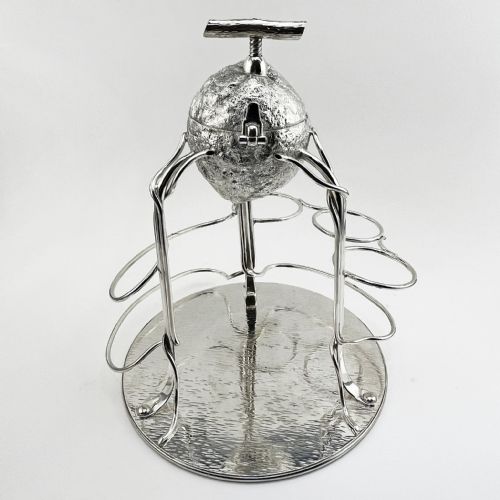
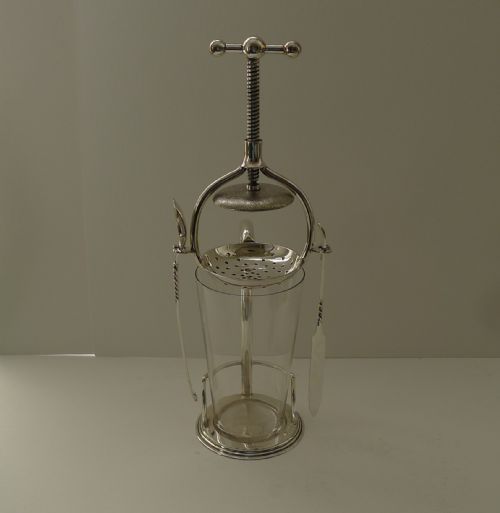
Mechanical silver barware items are ingenious cocktail shakers and lemon squeezers that combine practical drinking preparation with clever moving parts.
Mechanical Silver Barware
Mechanical silver barware brings together functional drink preparation and clever moving mechanisms, spanning the Victorian era through the Art Deco period. When searching for mechanical silver barware, collectors find specialised items designed to ease the hosting of drinks.
Origins stretch from English workshops to Italian makers, presenting diverse interpretations of functional drinking equipment. These objects reflect the changing social habits of their respective decades, prioritising novelty alongside utility.
Materials and construction
Makers utilised silver plate over base metals as the primary exterior finish for these entertaining pieces, combining durability with a bright metallic surface. Structural elements often integrate brass and gilt metal to support the internal moving components.
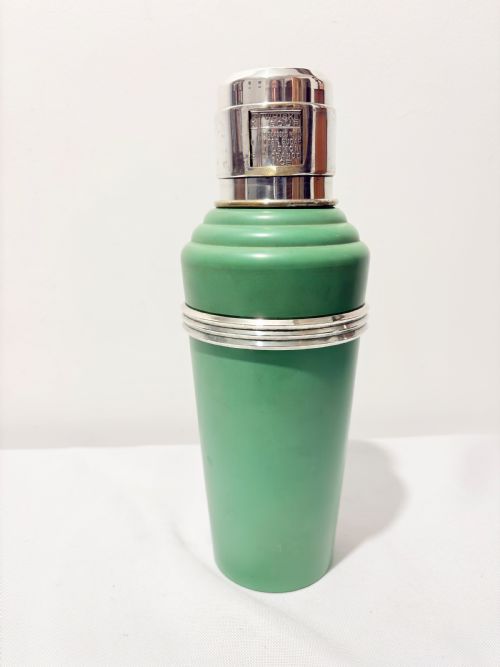
Contrasting materials appear in specific functional parts, such as green Bakelite handles and knobs, alongside fitted glass components. These diverse substances work together to create sturdy vessels capable of handling regular use during cocktail preparation.
Listings span from the Victorian era to nineteen-forties Art Deco, uniting silver plate, brass, Bakelite, and glass.
Judging quality in these pieces
Superior examples demonstrate smooth operation within their mechanical parts, ensuring that rotating recipes, rolling mixers, or squeezer components move without friction or loose joints. The engineering precision of an integral ice breaker or rotating cylinder separates standard production from finer workmanship.
The integrity of the silver-plated surface over the underlying metal dictates visual distinction across the range. Finer pieces retain crisp lettering on recipe bands and clean integration of secondary materials like Bakelite and glass.
Hukin & Heath·C S Green·Mappin & Webb
The Mechanical Silver Barware Glossary
- Silver Plate
- A thin layer of silver fused to a base metal such as brass or copper. This technique allowed manufacturers to produce substantial decorative items at a lower cost than solid silver.
- Art Deco
- A design style spanning the decades between the First and Second World Wars. It is characterised by sleek geometric lines, stylised motifs, and modern industrial materials.
- Bakelite
- An early form of synthetic plastic developed in the early twentieth century. It was frequently utilised for handles, knobs, and decorative accents on barware due to its heat resistance and rich colour.
- Integral Ice Breaker
- A built-in mechanism inside a cocktail shaker designed to break up ice during the shaking process. This feature streamlines drink preparation by removing the need for a separate tool.
Mechanical Silver Barware: Frequently Asked Questions
What periods do these pieces date from?
The selection spans from the Victorian era through the nineteen-forties. Earlier pieces include Victorian lemon squeezers, while the majority of cocktail shakers originate from the Art Deco period of the nineteen-twenties and nineteen-thirties.
Mid-century Italian examples also feature prominently, showing distinct regional variations in design and mechanical function during the nineteen-forties.
How do rotating recipe shakers work?
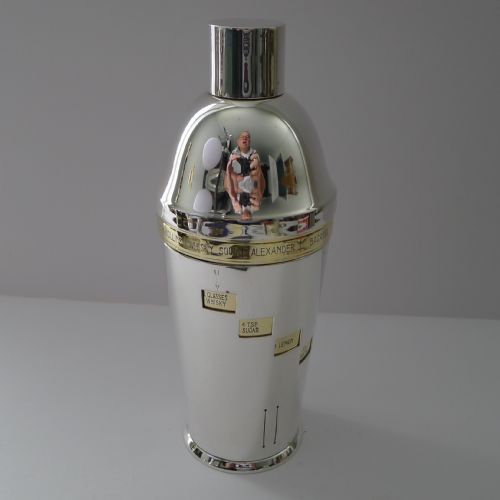
Rotating recipe shakers incorporate movable bands or outer cylinders inscribed with cocktail ingredients. Users spin these mechanical sections to align specific recipes with indicator windows on the shaker body.
This clever design allowed hosts to read proportions directly from the vessel while mixing drinks during gatherings.
What materials are used in these items?
Construction primarily relies on silver-plated metal over a base substrate. Secondary materials such as brass and gilt metal frequently appear in internal mechanisms and structural supports.
Details like handles and knobs often utilise coloured Bakelite, whilst inner chambers occasionally incorporate glass elements to hold liquids.
How should I care for silver-plated barware?
Gentle cleaning with a soft cloth helps preserve the silver-plated surface without wearing away the underlying metal. Avoid abrasive cleaners that can damage engraved recipe text or integral mechanical parts.
Keep moving components dry after use to ensure smooth operation of rotating cylinders and squeezers over time.