
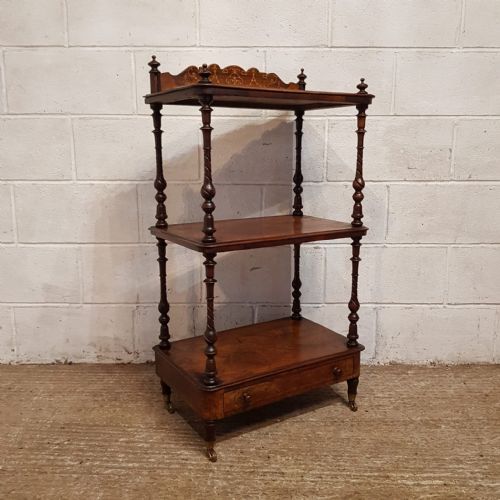


Marquetry Whatnot Stand
These marquetry whatnot stands are multi-tiered display pieces combining rich timber veneers with intricate floral or geometric inlays.
Marquetry Whatnot Stand
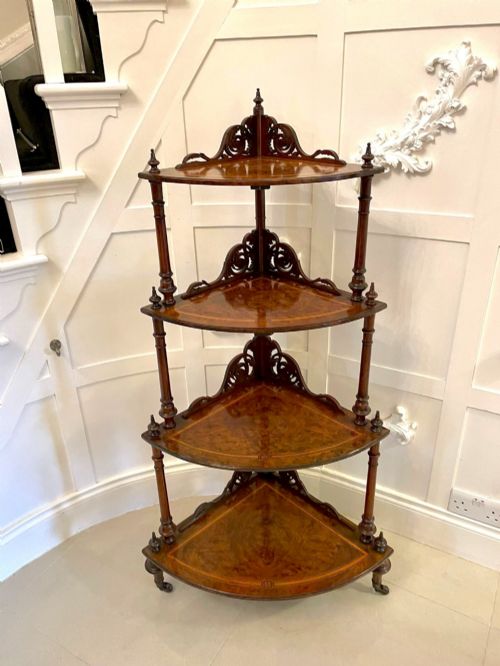
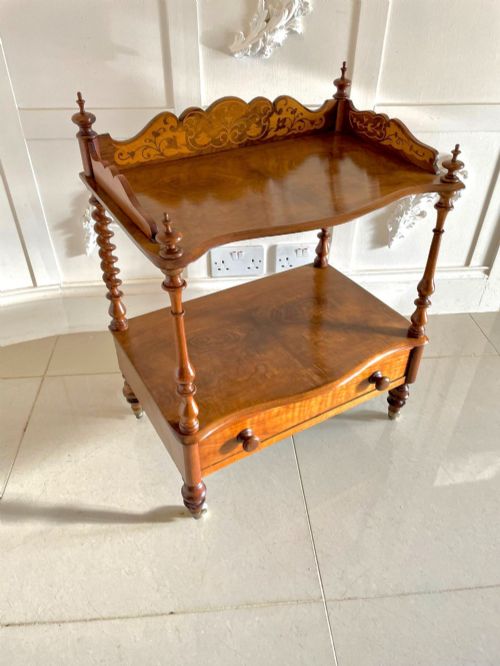
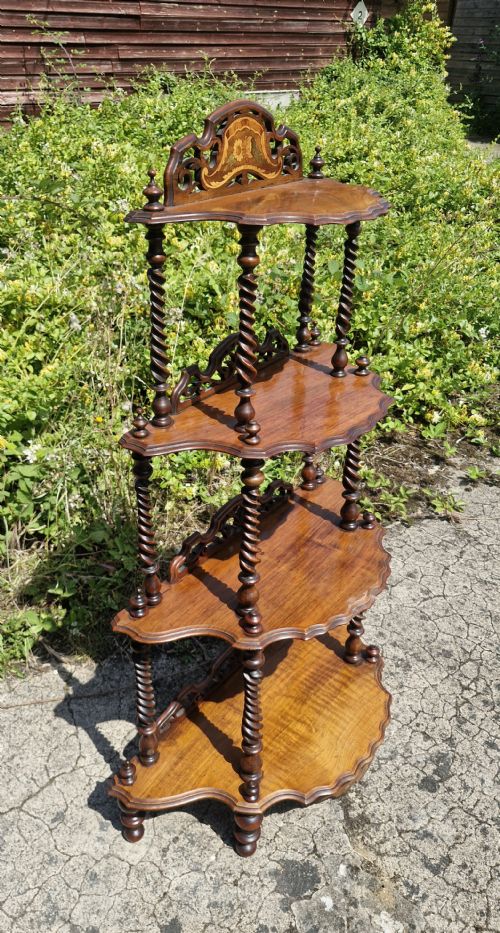
A marquetry whatnot stand serves as an elegant tiered furniture piece designed for displaying ornaments, books, or small collections in a drawing room. The versions most commonly encountered on this page date from the Victorian and Edwardian eras, utilising rich burr walnut and mahogany timbers.
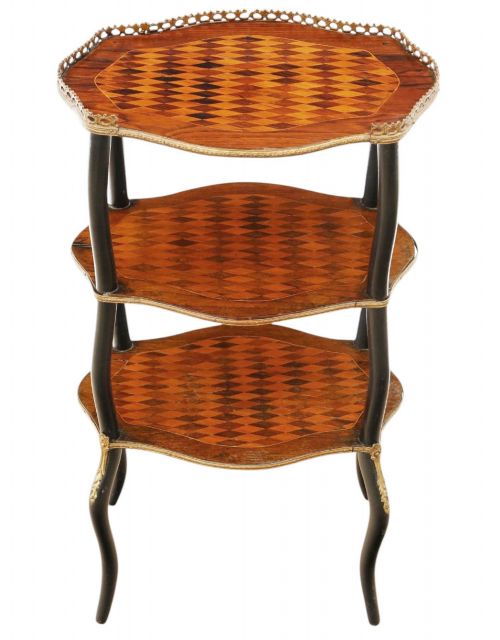
These items typically feature three or four open shelves supported by turned columns or uprights, alongside specialised variations such as corner stands and pieces incorporating jewellery cabinets. The craftsmanship spans distinct stylistic influences, ranging from straightforward British Victorian utility to ornate French Revival and Louis XV designs.
How They Were Made
Cabinet makers constructed the primary framework using walnut, ebonised wood, and mahogany, applying highly figured burr walnut veneers to the visible surfaces to create striking grain patterns. The decorative panels incorporated detailed marquetry and parquetry inlays utilising lighter materials such as boxwood.
Mounts in cast ormolu and delicate brass details frequently adorned the corners and galleries, while structural joints relied on traditional cabinet-making techniques to support multiple tiers of open shelving.
One exceptional Victorian iteration doubles as a jewellery cabinet, proving that Victorians truly expected their display furniture to multitask.
What Varies in Quality
The sophistication of the timber selection largely determines the standard of a piece, with highly figured burr walnut veneers commanding greater visual depth than plain surfaces. Finely cut marquetry with precise boxwood details and crisp brass or ormolu mounts indicates a superior level of workshop output.
Structural integrity across multiple tiers and the subtlety of the turned supports also separate standard utility items from exceptionally finished drawing room display pieces.
The Marquetry Whatnot Stand Glossary
- Marquetry inlay
- Decorative veneer work forming pictorial or geometric patterns by fitting together contrasting pieces of wood. This technique defines the surface ornamentation of the tiers.
- Parquetry
- A geometric mosaic of wood pieces used for floors and furniture surfaces. It appears alongside floral marquetry on several tiered stands.
- Etagere
- A piece of furniture consisting of a set of open shelves for displaying small objects. These forms are frequently catalogued interchangeably with whatnots.
- Ormolu
- Gilded bronze mounts applied to furniture for decorative effect. They frequently accent the corners and edges of French-influenced pieces.
- Burr walnut
- Wood taken from a walnut tree growth, producing intricate and highly swirled grain patterns. It serves as the primary veneer across numerous Victorian examples.
Marquetry Whatnot Stand: Frequently Asked Questions
What rooms suit a whatnot stand?
These tiered stands fit comfortably in reception rooms, studies, or hallways where vertical display space is needed without blocking light.
Their open shelving allows for the arrangement of small ceramics, silver, or books while maintaining an airy profile against a wall or in an empty corner.
How do I care for burr walnut?
Keep these timber pieces away from direct sunlight and steady heat sources to prevent the burr walnut veneer from drying or splitting.
Routine dusting with a soft, dry cloth preserves the polished surface without the need for heavy modern polishes.
Are corner whatnot stands practical?
Corner whatnot stands utilise neglected room angles to provide multiple levels of display surface.
They offer the same tier capacity as standard freestanding models while taking up minimal floor space in smaller rooms.
How do I distinguish Edwardian from Victorian stands?
Victorian stands typically display heavier burr walnut timbers and deeper proportions, reflecting mid-to-late nineteenth-century tastes.
Edwardian and later pieces from around nineteen hundred often lean towards lighter construction and delicate French Revival or Louis XV styling.