




Marquetry Secretary Cabinet
A marquetry secretary cabinet combines a fitted writing desk with elaborate wood inlay, offering a substantial surface for correspondence alongside concealed storage.

Marquetry Secretary Cabinet
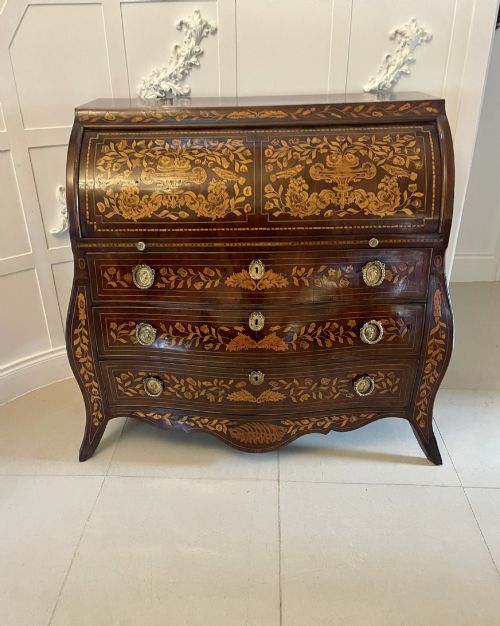
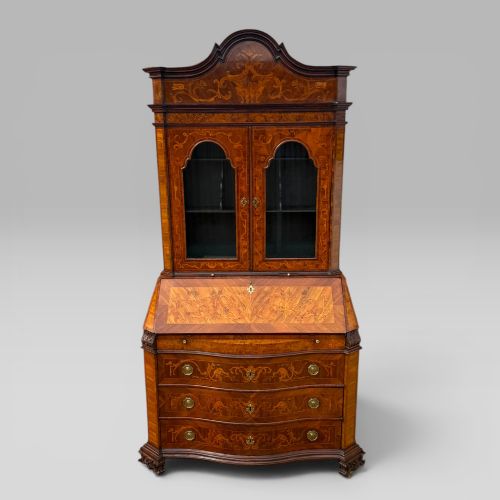
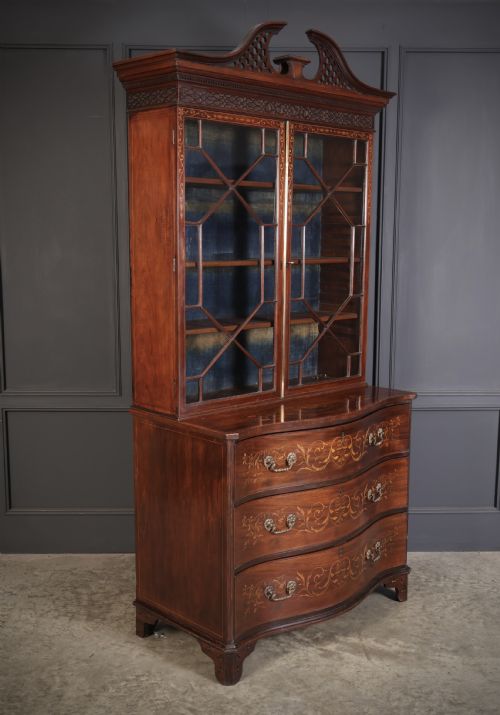
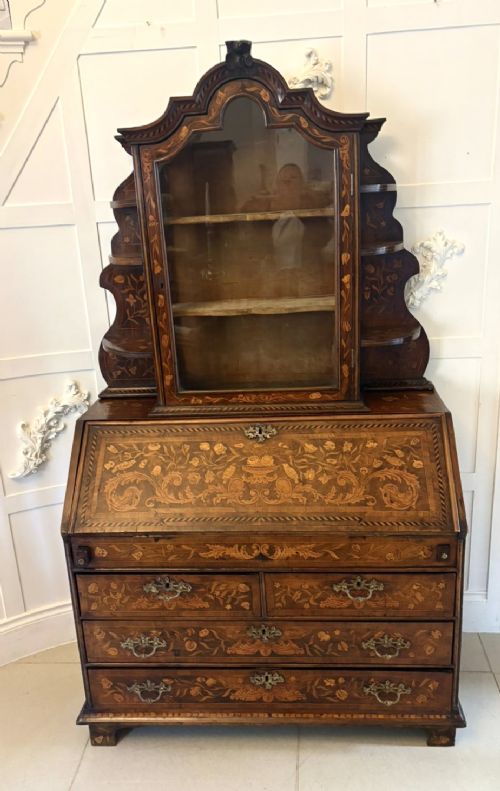
A marquetry secretary cabinet is a dual-purpose piece of furniture that pairs a fall-front desk or drop-leaf writing surface with upper shelving or enclosed bookcase compartments, often appearing in Dutch Baroque, Georgian, and French revival styles.
The versions most commonly found here include eighteenth-century Dutch burr walnut and mahogany bureau bookcases decorated with floral or architectural floral inlay, alongside nineteenth-century French secretaire abattants and smaller bonheur du jour writing cabinets.
These pieces range from tall double-dome bureau bookcases to compact writing desks with fitted interiors, reflecting the various domestic requirements for correspondence and display across the seventeenth, eighteenth, and nineteenth centuries.
Materials and construction methods
Cabinet makers built these pieces using native and exotic timbers such as walnut, mahogany, satinwood, kingwood, and rosewood, often laying fine veneers over solid oak or pine carcases to provide a stable foundation for intricate decorative schemes.
Marquetry and parquetry patterns were hand-cut from contrasting wood veneers, fruitwoods, and brass, then pieced together to form floral sprays, urns, or geometric arrangements before being glued into recessed channels on the fall-fronts and drawer faces.
Higher-status examples incorporated cast gilt bronze mounts, ormolu, marble tops, and fitted interior compartments featuring secret drawers and pigeonholes accessed behind sliding panels.
Primary timbers appearing across these cabinet designs include walnut, burr walnut, mahogany, satinwood, rosewood, kingwood, and tulipwood.
Distinguishing quality and craftsmanship
The standard of a marquetry secretary cabinet is determined by the precision of the veneer work, the natural grain matching across the panels, and the complexity of the floral or pictorial inlay rather than the mere presence of decoration.
Structural integrity reveals itself in the smooth operation of the fall-front writing surface, the snug fit of internal drawers, and the retention of original brass hardware, locks, and internal pigeonhole dividers.
The finest pieces exhibit meticulous hand-cut shading within the wood veneers to create three-dimensional depth, combined with robust secondary woods and careful dovetailing in the drawer construction.
Edwards and Roberts
The Marquetry Secretary Cabinet Glossary
- Marquetry
- Decorative veneer work arranged in pictorial or floral patterns across the surface of furniture. It differs from parquetry by forming organic or figurative designs rather than geometric grids.
- Secrétaire abattant
- A tall cabinet featuring a vertical fall-front panel that drops down to create a writing desk. This French form conceals a fitted interior of small drawers and pigeonholes.
- Bureau bookcase
- A two-part piece comprising a lower writing desk with a sloping lid or fall-front and an upper glazed or panelled bookcase section. It serves both storage and writing functions.
- Bonheur du jour
- A light, small ladies writing desk with an enclosed cabinet or tiered shelving unit on top. These cabinets gained popularity during the eighteenth and nineteenth centuries.
- Ormolu
- Gilded bronze mounts and decorative trimmings applied to furniture. It provides ornamental accents on French revival pieces.
Marquetry Secretary Cabinet: Frequently Asked Questions
What is a marquetry secretary cabinet used for?
These pieces functioned primarily as private writing desks where owners could write letters, manage accounts, and store important documents within secure, lockable compartments. The upper cabinet or bookcase sections provided display space for valuable books or porcelain.
Over time, they adapted to various household roles, moving from formal libraries and drawing rooms into private parlours and boudoirs as domestic habits changed.
How do I date a marquetry secretary cabinet?
Dating relies on observing structural characteristics, timber choices, and stylistic markers such as the shift from heavy walnut and oak in the seventeenth century to lighter satinwood and mahogany during the Georgian era. Regional traits also help, such as the distinct floral marquetry associated with Dutch workshops.
Secondary woods inside the drawers and the construction techniques of the carcase provide further physical evidence to narrow down the decade of production.
Where should I place one in my home?
A marquetry secretary cabinet suits studies, living rooms, or hallways where its decorative front panel can be viewed without obstruction. Because sunlight can fade delicate fruitwood and rosewood veneers, positioning away from direct south-facing windows is recommended.
Allowing sufficient clearance in front of the cabinet ensures the fall-front writing surface can open fully without crowding the room.
How do I care for antique wood inlay?
Maintaining wood inlay involves keeping the cabinet away from extreme temperature shifts and dry heat sources like radiators, which can cause the thin veneers to lift or crack. Occasional application of appropriate furniture wax helps nourish the timber and protect the surface.
Dusting should be done gently with a soft, dry cloth to avoid catching delicate edges where different wood species meet.