

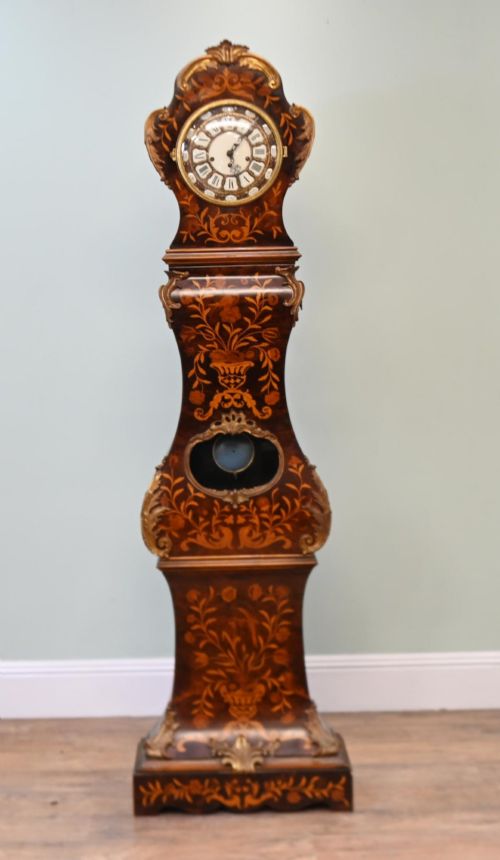
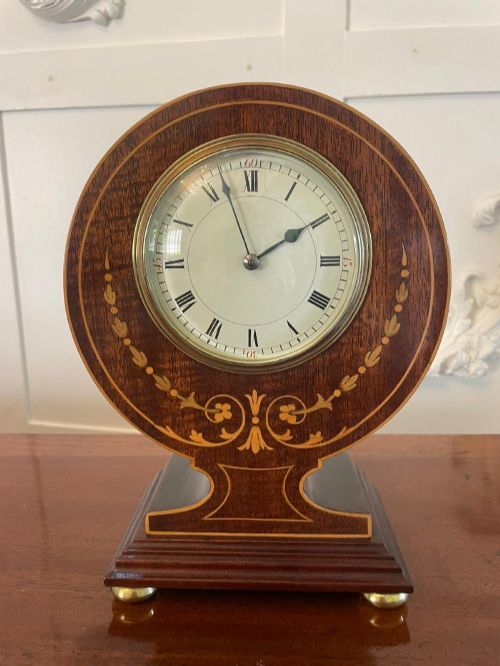

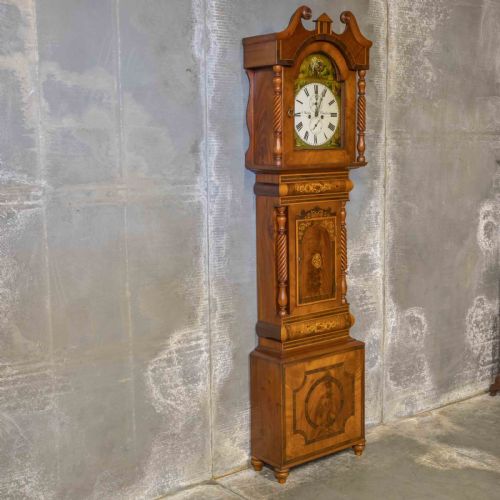


Marquetry Clock Case
A marquetry clock case houses a precision movement inside a wooden chassis decorated with intricate veneer patterns.
Marquetry Clock Case
A marquetry clock case is typically encountered as the tall timber housing for a longcase or grandfather clock, designed to protect the pendulum and weights while serving as a prominent furnishing. The selection includes seventeenth-century examples up to Edwardian and Victorian interpretations, reflecting changes in domestic taste over centuries.
The dominant forms are longcase clocks, though mantel clocks and display domes also appear alongside the primary tall clock housings. These vertical enclosures often integrate functional elements like silvered dials and glass panels with decorative woodworking.
Origins span English, Scottish, and continental workshops, with significant representation from London makers working in walnut, mahogany, and oak. Buyers encounter pieces ranging from early seventeenth-century floral designs to later nineteenth-century musical movements.
What varies in quality
The precision and complexity of the marquetry inlay separate standard production from exceptional work, particularly in the density of the floral or seaweed patterns and the tightness of the veneer joints. Early examples often demonstrate superior depth in the contrast of the woods.
The choice of primary timber influences the character and standing of the piece, with figured walnut and rich mahogany commanding greater attention than simpler oak structures. The integrity of the original surfaces and the preservation of the carved or moulded details dictate the overall refinement of the case.
Marquetry Clock Case Retail Price Guide 2026
Typical asking prices for marquetry clock case among the pieces listed under this phrase on Sellingantiques today, from the lower quarter to the upper quarter. They describe what is for sale here now, not the wider market.
The archive and active listings span multiple centuries, including seventeenth-century William and Mary pieces alongside Edwardian interpretations.
Nathaniel Pyne·David Morice·Edward East·Edward Stanton·Peter Wise·Henry Massy·John Lestourgeon·John Clowns·John Hudson·John Martin·Cornelius Harbert·John Ebsworth·Rowntree·Solomon Bouquet·Samuel Barrow·Thomas Stubbs·Edward Crouch·Isaac Penton
The Marquetry Clock Case Glossary
- Marquetry inlay
- Decorative woodwork where small pieces of veneer are fitted together to form pictorial or geometric patterns on the surface of the clock case.
- Longcase clock
- A tall pendulum clock enclosed in a wooden case, commonly known as a grandfather clock.
- Silvered dial
- A metal clock face treated with a silver solution to create a matte, reflective finish for the engraved numbers and inscriptions.
- Single fusee
- A mechanism using a conical pulley and chain or cord to maintain even tension on the clock movement as the mainspring unwinds.
- Display dome
- A clear glass cover placed over a base to protect delicate objects and clock mechanisms from dust.
Marquetry Clock Case: Frequently Asked Questions
How do I set up a longcase clock?
Position the case on a level floor against a sturdy wall to ensure the pendulum swings evenly without catching on the interior sides.
Hang the weights carefully on their lines and start the pendulum with a gentle nudge to the side.
What is seaweed marquetry?
Seaweed marquetry refers to a delicate, intricate style of two-colour veneer work resembling seaweed or fine lace, popular in the late seventeenth century.
Craftsmen cut interlocking patterns from dark walnut and lighter woods to cover large flat surfaces of the clock trunk.
Where should I place a tall clock?
Choose a room with stable temperature and humidity away from direct sunlight and heating vents to protect the wooden veneer.
Ensure the floor is solid enough to prevent vibrations from disrupting the pendulum timing.