
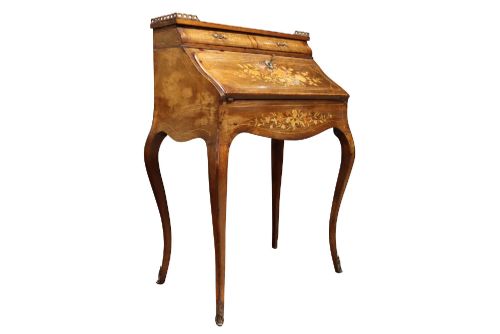
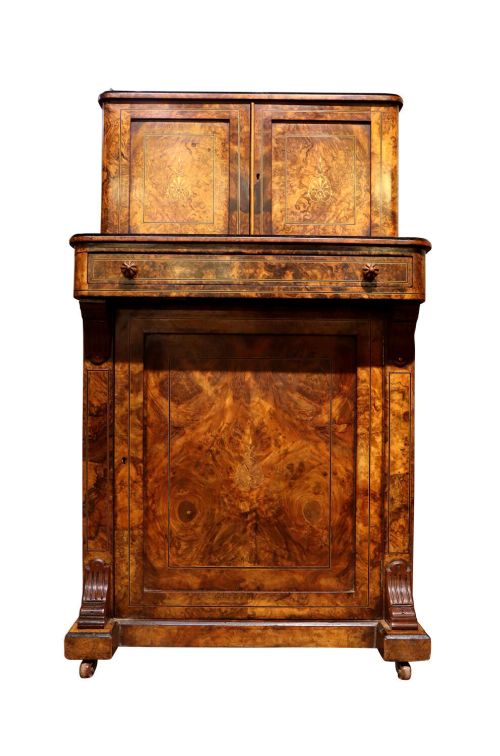


Marquetry Bonheur De Jour
A marquetry bonheur de jour is a refined ladies' writing desk that brings elegant compartmentalised storage and a compact writing surface to a room.
Marquetry Bonheur De Jour
A marquetry bonheur de jour is a small, freestanding ladies writing desk typically fitted with an upper tier of compartments, shelves, or small cupboards above the writing surface. These pieces serve primarily as ornamental writing furniture rather than heavy study desks, designed for private correspondence and the display of small decorative objects.
The versions most commonly found here belong to the nineteenth century, spanning Victorian interpretations and French revival movements. They combine traditional cabinet-making forms with the delicate proportions required for intimate domestic spaces.
Makers often drew upon eighteenth-century French precedents, resulting in pieces that incorporate Louis XV and Louis XVI revival vocabulary alongside Victorian English interpretations.
Materials and construction
Cabinet-makers built these desks using a variety of decorative timbers, employing burr walnut, walnut, kingwood, rosewood, satinwood, and amboyna as foundational surfaces. Marquetry inlay was carefully composed from contrasting veneers to create floral, geometric, or pictorial scenes across the flaps, drawers, and upright tiers.
Metal mounts in ormolu and brass provide structural reinforcement and decorative framing around corners, legs, and panel borders. Glass is occasionally integrated into small cabinet doors within the upper superstructure, while internal compartments utilise matching secondary timbers.
Listings feature eighteenth and nineteenth-century pieces spanning Louis XV, Louis XVI, and Victorian revival styles.
Assessing the work
Quality in a bonheur de jour rests on the crispness of the marquetry cutting and the choice of Burr walnut or satinwood veneers. Superior examples display intricate, multi-toned pictorial inlay without shrinkage cracks or poorly matched grain across the joints.
The standard of metalwork distinguishes baseline furniture from exhibition pieces, where heavy ormolu mounts are chiselled and fire-gilt rather than simply cast and lacquered. Internal fittings, secondary woods, and the integration of the upper superstructure reveal the original maker's investment of labour.
Paul Sormani·Druce and Co
The Marquetry Bonheur De Jour Glossary
- Marquetry
- The art of applying decorative pieces of veneer to a structure to form ornamental designs. Artisans cut various coloured woods to fit together precisely before gluing them to the carcass.
- Bonheur de jour
- A small ladies writing desk developed in France during the eighteenth century. The name translates directly as day's delight.
- Ormolu
- Gilded bronze used for decorative mounts and furniture feet. The technique involves applying a mercury and gold amalgam to shaped bronze before heating.
- Bureau de dame
- A lady's writing desk or bureau. These items often feature a sloping writing flap or a flat surface combined with small drawers.
- Kingwood
- A dense, heavily figured timber prized for its rich dark violet-brown colour with lighter golden streaks. It was widely used in high-status French and English revival cabinet-making.
Marquetry Bonheur De Jour: Frequently Asked Questions
What is a bonheur de jour used for?
These desks were designed for writing letters, keeping personal accounts, and storing small stationery items in the upper tiers. The surface provided an intimate space for correspondence in a private boudoir or drawing room.
Over time, their decorative presence meant they functioned as much for display as for practical writing tasks, holding small ornaments and trinkets.
How do I date a Victorian piece?
Dating relies on combining the recorded period markers with construction methods, timber choices, and stylistic revivals. Nineteenth-century pieces frequently emulate earlier French monarchical styles while utilising Victorian framing techniques.
Examining secondary timbers and the style of the brass or ormolu mounts helps narrow down the decade of production within the nineteenth century.
Are these desks suitable for daily writing?
The writing surfaces are generally smaller and lighter than standard office desks, built to accommodate a notebook or writing paper rather than modern equipment.
Care must be taken to protect delicate marquetry veneers and polished wood surfaces from moisture and heavy wear during everyday use.
What is the difference between French and English styles?
French revival models often incorporate heavier ormolu mounts and elaborate Louis XV or Louis XVI curves, alongside intricate floral marquetry. English Victorian interpretations tend toward burr walnut surfaces with more restrained brass inlay and simpler proportions.
Both traditions share the core layout of an upper cabinet structure combined with a pull-out or hinged writing platform.