
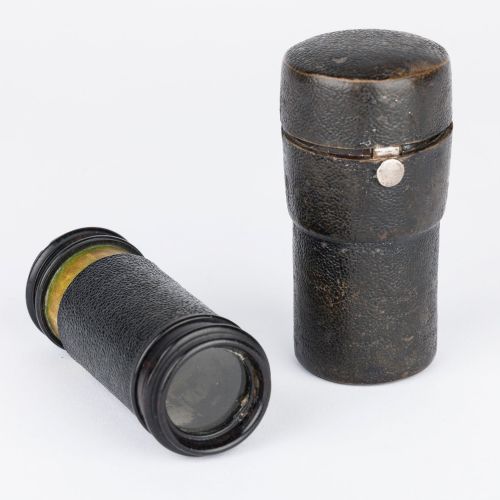


Maritime Brass Telescope
A maritime brass telescope brings practical optics and heavy metal into a room, offering the chance to hold a working piece of naval history.
Maritime Brass Telescope
A maritime brass telescope is an optical instrument designed for use at sea, typically taking the form of a collapsible draw telescope or spyglass. These items surface most frequently from the Victorian, Edwardian, and Regency periods, spanning the eighteenth to the early twentieth centuries.
The inventory on this page ranges from pocket spyglasses and single-draw hexagonal marine models to three-draw and four-draw terrestrial instruments. Buyers encounter navigational tools signed by notable London makers alongside naval officer watches and cased apparatus.
Distinctions in quality and execution
The grade of an instrument is defined by the precision of its optical clarity and the crispness of its maker signature engraved on the draw tubes. Signed pieces from established London workshops demonstrate superior mechanical tolerances in the sliding draws compared to unsigned equivalents.
Materials also dictate the tier of a piece, with fine leather wrappings, polished hardwoods, and robust brass gauges marking the higher end of the range. The complexity of multiple draws, such as three or four extending sections, requires exact engineering to maintain alignment.
Some nineteenth-century captains clearly preferred a snug leather grip when peering through the fog at passing French frigates.
Ross of London·Voigtländer & Sohn AG·W. & T. Gilbert·Clarkson·Richardson·Newton & Co·Broadhurst Clarkson & Co·Cary London·Negretti & Zambra·L. Casella·Davis of London·John Gilbert·J. Sewill
The Maritime Brass Telescope Glossary
- Draw
- An extending section of a telescope barrel. Multiple draws allow the instrument to collapse into a compact size.
- Spyglass
- A small, portable handheld refracting telescope. These compact optics were widely utilised for quick scouting at sea.
- Officer of the watch
- A specific marine telescope configuration used by naval personnel on duty. These instruments were built for durability and clear maritime viewing.
- Terrestrial
- An optical system designed for viewing land objects rather than stars. It includes correcting lenses to ensure the image appears upright.
Maritime Brass Telescope: Frequently Asked Questions
How do I date a brass telescope?
Examine the style of the signatures, the number of draw sections, and the materials used for the barrel dressings. Victorian and Edwardian examples often feature specific maker scripts and patent stamps.
Material choices like nickel plating or specific woods help narrow the decade of production alongside the optical configuration.
Were these used on actual ships?
Many of these instruments served as navigational tools for naval officers and ship captains. Officer of the watch and marine telescopes were built specifically for maritime conditions.
Signatures from naval outfitters confirm their practical deployment at sea during the eighteenth and nineteenth centuries.
How do I care for a brass telescope?
Keep the metal clean with a soft dry cloth and avoid harsh chemical polishes that remove historical patination. Store the instrument in a dry environment to protect the internal glass lenses and leather grips.
Extend the draws gently to prevent friction damage on the sliding brass tubes.
What is the difference between a spyglass and a telescope?
A spyglass generally refers to a smaller, single-draw or multi-draw portable handheld unit designed for rapid deployment. Telescopes can encompass larger tabletop models and more complex optical arrays.
Both terms appear across Georgian and Victorian inventories to describe handheld magnification tools.