





Mantel Piece Clock
A mantel piece clock anchors a room with mechanical precision and decorative presence, ranging from modest Edwardian timber cases to grand multi-piece French garnitures.
Mantel Piece Clock
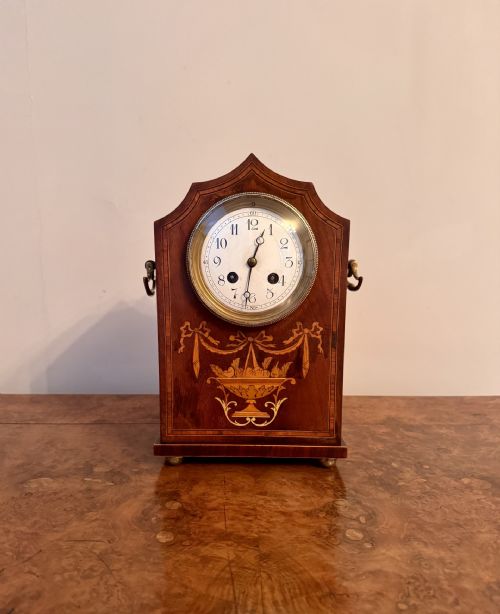
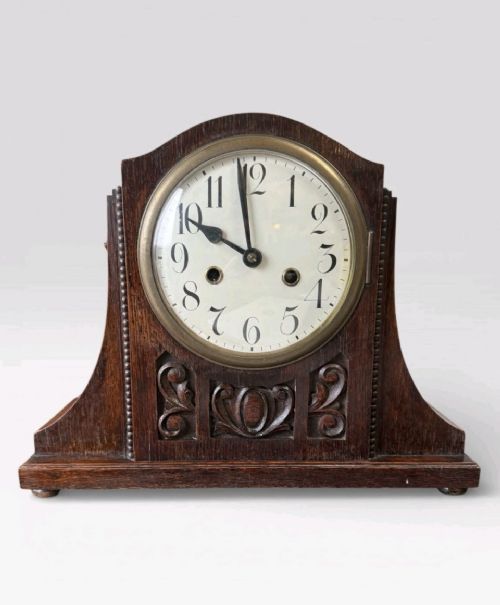
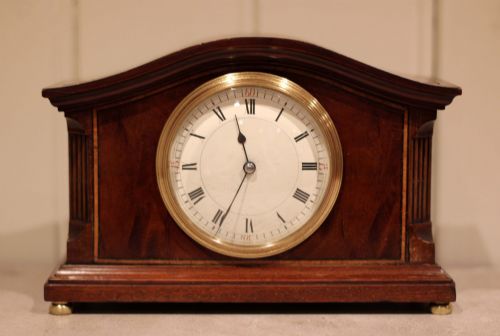
A search for mantel piece clock reveals a diverse selection of domestic timekeepers and matched garniture sets spanning the nineteenth and early twentieth centuries. These objects combine functional horology with the prevailing decorative arts of their period, from heavy marble and bronze assemblies to sleek geometric Art Deco designs.
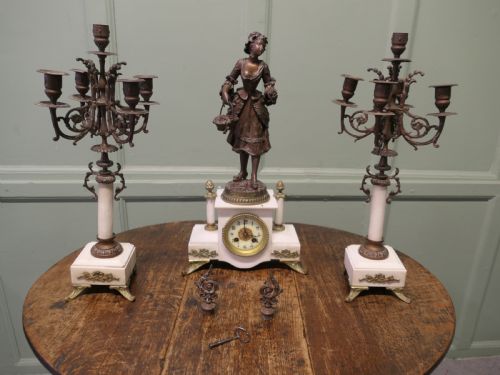
The most common formats on this page are French clock garnitures, often comprising a central timepiece flanked by matching candelabras or urns, alongside standalone English bracket and carriage clocks. Materials shift from the classical white and rouge marbles of the Victorian era to the rich onyx, green onyx, and contrasting woods favoured by later makers.
Materials and construction methods
Cases combine heavy structural elements of marble, slate, alabaster, or hardwoods like mahogany, rosewood, and oak. Metal components utilise cast bronze, brass, or gilded ormolu, frequently paired with hand-painted porcelain panels or cloisonné enamel dials.
Movements rely on mechanical gear trains driven by springs or weights, incorporating escapements such as the fusee or platform balance. Many examples feature striking mechanisms that chime the hours and half-hours on bells or gongs.
Mantel Piece Clock Retail Price Guide 2026
Typical asking prices for mantel piece clock among the pieces listed under this phrase on Sellingantiques today, from the lower quarter to the upper quarter. They describe what is for sale here now, not the wider market.
Listings feature periods spanning from the eighteenth century to the Art Deco era, encompassing French, English, and German origins.
Distinctions in craftsmanship and design
Quality reveals itself in the crispness of the bronze casting and the depth of the hand-chasing on ormolu mounts, where superior pieces retain sharp relief and clean lines. The integrity of the stone cases, the weight of the metals, and the finesse of painted porcelain faces separate standard production items from masterworks.
The sophistication of the internal movement dictates functional merit, with fusee movements and signed maker plates indicating higher standards of horology. Completeness also matters, particularly in multi-piece garnitures where matching side urns or candelabras must share the exact patination and decorative vocabulary of the central clock.
Payne and Co London·Henry Marc·KPM Berlin·Finnigan Manchester·Le Roy et Fils·Osborn of Bognor Regis·Garrards·Ferdinand Berthoud
The Mantel Piece Clock Glossary
- Garniture
- A matched set of decorative objects for the mantel, typically consisting of a central clock flanked by two urns, vases, or candelabras. These sets were designed to create a balanced symmetrical display on a fireplace shelf.
- Ormolu
- Finely ground high-carat gold applied to a bronze base through a mercury amalgamation process, or cast brass finished to simulate gold. This technique imparts a durable, warm metallic lustre to decorative mounts.
- Fusee
- A conical pulley used in mechanical clocks to maintain an even pull on the gear train as the mainspring unwinds. It ensures consistent timekeeping accuracy throughout the running period of the clock.
- Cloisonne
- An enamelling technique where metal wire is soldered to a metal base to form compartments filled with vitreous paste and fired. The resulting patterned surface often adorns clock dials and case panels.
- Cartouche
- An oval or oblong ornamental frame, often used on clock dials to enclose individual enamel numeral plaques. It provides a distinct separation for each hour marker.
Mantel Piece Clock: Frequently Asked Questions
What is a mantel piece clock garniture?
A garniture consists of a central clock accompanied by matching side pieces such as urns, vases, or candelabras. They were designed as a unified decorative scheme for the drawing room.
These matching sets created visual balance on the mantelpiece and reflected the formal interior design tastes of the nineteenth century.
How do I wind a mechanical clock?
Mechanical clocks require a specific winding key inserted into the winding holes on the dial face or movement backplate. Turning the key tensions the mainspring inside the movement barrel.
Care must be taken not to over-wind the spring, stopping as soon as firm resistance is felt to protect the internal components.
Where should I place a heavy marble clock?
Heavy marble and slate clocks require a sturdy, level surface capable of supporting considerable weight, such as a strong mantel shelf or a dedicated console table.
A stable foundation prevents vibrations that can disrupt the pendulum beat and ensures the case remains plumb for accurate timekeeping.
How do I tell an Art Deco clock from a Victorian one?
Victorian clocks favour classical revival styles, ornate ormolu mounts, heavy marbles, and elaborate bronze figures. They display traditional symmetry and ornate surface detailing.
Art Deco clocks embrace geometric forms, stepped outlines, and materials like green onyx or contrasting woods with minimal, streamlined ornamentation.