
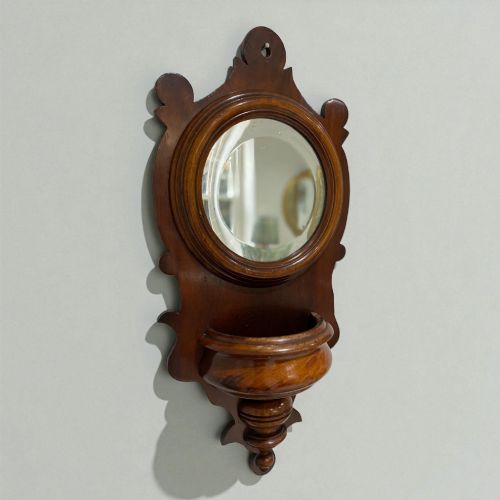
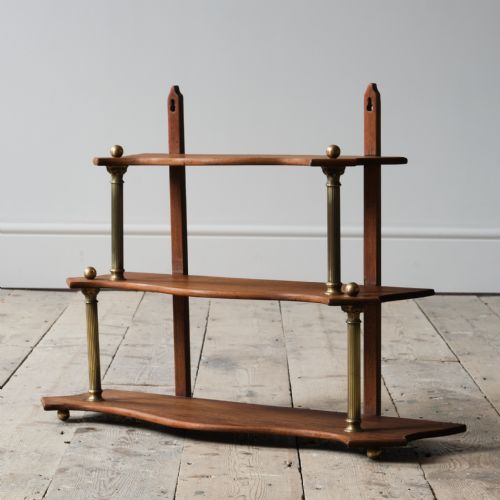


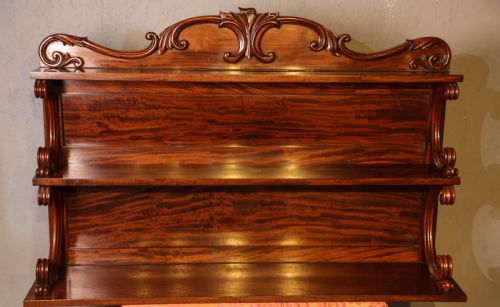


Mahogany Wall Bracket
A mahogany wall bracket holds ornaments, clocks or display items with architectural presence, originating mainly in Georgian, Regency and Victorian workshops.
Mahogany Wall Bracket
When you search for a mahogany wall bracket, you encounter architectural ledges, corner shelves and support corbels designed to mount directly onto vertical surfaces. The items on this page span Georgian, Regency and Victorian periods, appearing either as single display ledges or as matched pairs.
Many examples take the form of wall-mounted clock brackets or hanging shelves, whilst others function purely as display platforms for porcelain and decorative objects. These pieces bring timber warmth and classical geometry into smaller interior spaces without occupying floor area.
Makers utilised solid timber and timber veneers shaped into architectural profiles, ranging from plain functional ledges to ornate neo-classical or Gothic carvings. The selection demonstrates how domestic joinery evolved across the nineteenth century to serve both utility and ornament.
Judging quality and execution
Quality rests upon the depth and crispness of the carving, where hand-tooled details on acanthus leaves and lion heads remain sharp rather than softened by excessive sanding. Timber selection dictates visual appeal, with figured mahogany and flame veneer offering greater grain movement than plain stock.
Construction integrity separates standard workshop output from superior items, visible in tight joints at corner mitres and the substantial weight of solid timber brackets. The inclusion of original brass mounts or integrated clock supports adds technical complexity to the joinery.
Listings demonstrate that mahogany wall brackets span the Georgian, Regency, and Victorian periods, utilising brass inlay and flame mahogany veneer.
Cording of London·Thomas Connold of Alysham·J. A. Wheatley Carlisle·Valiant Paris·J.W.Benson
The Mahogany Wall Bracket Glossary
- Mahogany
- A durable tropical hardwood known for its reddish-brown colour and stability in furniture construction. It provides the primary structural medium for these wall brackets.
- Flame Mahogany
- A wood veneer cut from the fork of the tree where the branch meets the trunk. This cutting method produces a distinctive flickering flame pattern across the surface.
- Corbel
- A structural piece of stone, timber or metal jutting from a wall to carry a superincumbent weight. In these listings, carved wooden corbels function as decorative wall brackets.
- Fusee Clock
- A clock driven by a spring connected to a conical pulley via a chain or cord. Several fusee movements appear mounted on dedicated wall brackets in the inventory.
- Neoclassical
- A style reviving classical architectural forms from ancient Greece and Rome. This design influence appears in the swags and symmetry of nineteenth-century brackets.
- Pinwheel Escapement
- A specialised clock escapement utilising a wheel with pin-shaped teeth. This mechanism improves timekeeping precision in wall-mounted timepieces.
Mahogany Wall Bracket: Frequently Asked Questions
How were mahogany wall brackets used originally?
These brackets served as elevated display surfaces for porcelain, decorative urns and small sculptures within domestic parlours and libraries. They also functioned as specialised wall-mounted supports for fusee clock movements and dial clocks.
Placing objects at eye level protected delicate ornaments from household traffic while utilising vertical wall space effectively.
How do I identify a Victorian mahogany wall bracket?
Victorian pieces often display heavier proportions, deeper relief carving, and darker timber finishes compared to their Georgian predecessors. They frequently incorporate stylistic motifs such as stylized lion heads, Gothic tracery, or applied architectural mouldings.
Checking the backplate and fixing points reveals the original mounting methods used during the nineteenth century.
Are these brackets sold as pairs or singles?
The inventory includes both individual wall brackets and matched pairs intended for symmetrical placement on either side of a fireplace, mirror or window. Pairs are typically carved from the same timber stock to ensure grain continuity.
Single brackets usually functioned as standalone corner shelves or clock supports rather than matched decorative sets.
What is flame mahogany veneer?
Flame mahogany veneer is a thin decorative slice of wood cut from the branch junction of a mahogany tree. This specific cut creates dramatic, flame-like grain patterns across the display surface of the bracket.
Cabinet makers applied these figured veneers over secondary timber foundations to achieve a high-status appearance without using solid expensive logs.
How do I hang a heavy wooden wall bracket safely?
Wall brackets require secure mechanical fastening directly into wall studs or masonry using appropriate screws and rawlplugs. The weight of solid mahogany or integrated clock movements demands robust load-bearing fixings.
Checking the original suspension loops or screw holes on the back timber ensures the bracket hangs flush against the vertical surface.