




Mahogany Triform Centre Table
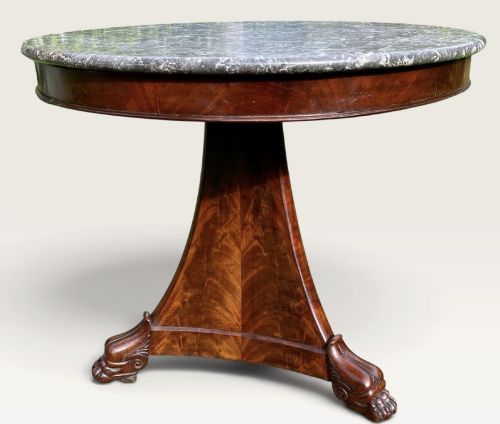
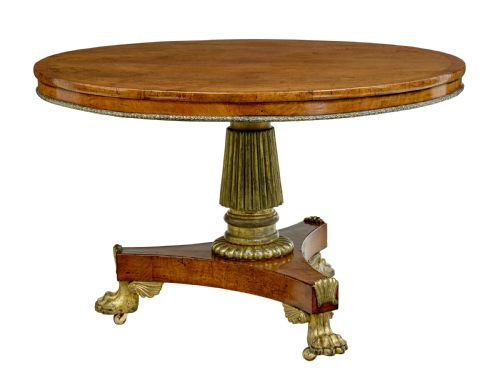
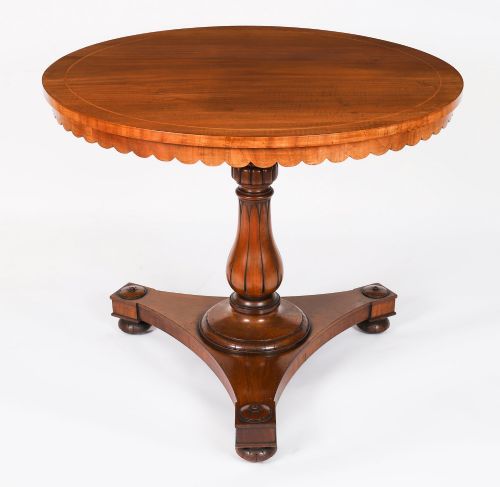
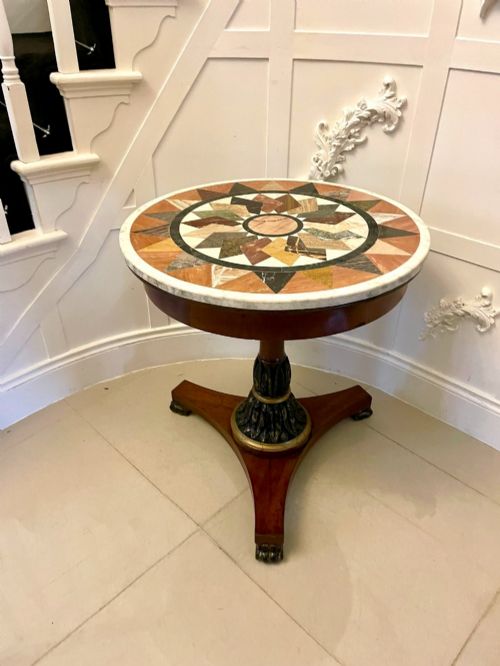
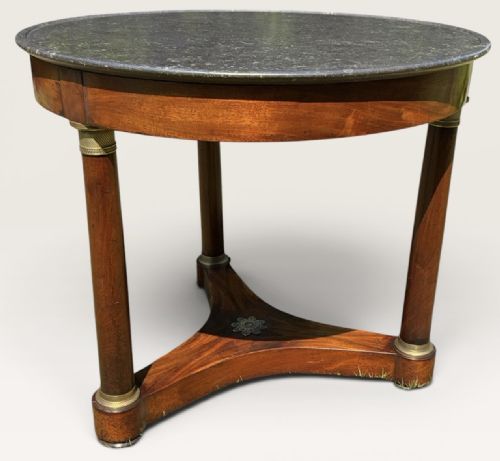
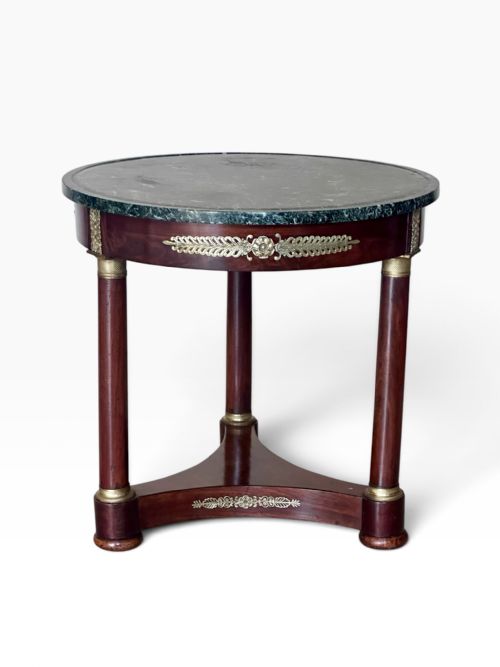
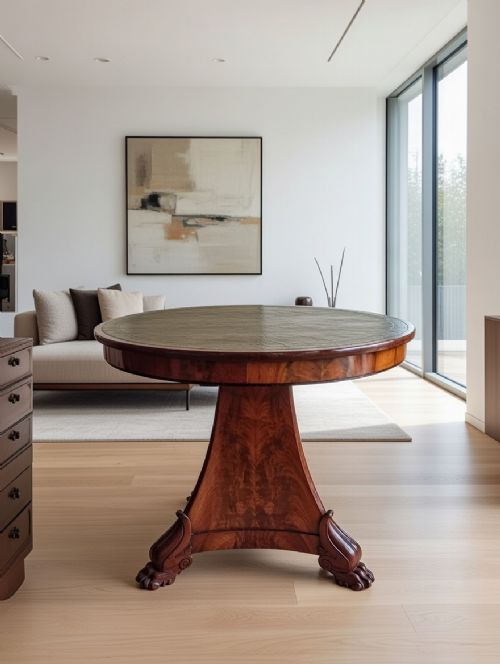
These mahogany triform centre tables stand on three-way pedestal bases, offering a striking centrepiece for a hall or principal room.
Mahogany Triform Centre Table
A mahogany triform centre table is a freestanding circular table supported by a three-sided or tripod pillar base, designed to occupy the middle of a room rather than sit against a wall. The listings show these pieces emerging primarily from the Regency, George III, and Victorian periods, alongside French Empire Gueridon forms.
While most examples function as full-scale hall or breakfast tables, the evidence also includes miniature furniture versions. These variations span styles from William IV and French Empire to Victorian revival, each retaining the characteristic three-way structural geometry.
How they were made
Cabinetmakers constructed the circular tops using dense cuts of mahogany and mahogany veneer, sometimes framing inserts of green marble, specimen marble, or leather. These tops required stable sub-frames to prevent warping across the wide diameter.
The distinctive triform bases relied on heavy central pedestals diverging into three stable feet, often enriched with brass, ormolu mounts, or carved wooden supports such as swans. Joinery had to bear considerable downward weight, particularly on examples fitted with heavy stone or marble tops.
Mahogany Triform Centre Table Retail Price Guide 2026
Typical asking prices for mahogany triform centre table among the pieces listed under this phrase on Sellingantiques today, from the lower quarter to the upper quarter. They describe what is for sale here now, not the wider market.
Materials recorded across the inventory include solid mahogany, mahogany veneer, rosewood, white marble, green marble, specimen marble, brass, and ormolu.
What varies in quality
Quality rests in the choice of timber figure, the crispness of the carving on the triform base, and the integration of secondary materials like ormolu or specimen marble. Finer examples display carefully selected mahogany grain patterns that wrap symmetrically across the circular top.
The architectural proportion between the central pillar and the three supporting feet dictates the visual balance of the piece. Better workshops executed these junctions with hidden internal bracing and refined turnings, avoiding clumsy transitions where the pillar meets the platform.
Walker-Lancaster·Gillows
The Mahogany Triform Centre Table Glossary
- Gueridon
- A small French table, often round and supported by a single central pillar. Many examples on this page adopt this form alongside traditional British styles.
- Specimen marble
- A table top composed of various coloured marbles arranged in geometric or mosaic patterns. It provides a hard, decorative surface often found on mid-nineteenth-century pieces.
- Ormolu
- Gilded bronze ornamentation applied to furniture mounts. It is frequently seen on French Empire interpretations of the form.
Mahogany Triform Centre Table: Frequently Asked Questions
Where do you put a triform centre table?
These pieces are designed to stand free in the middle of a room, such as an entrance hall or a spacious drawing room, where they can be walked around entirely.
Because the base extends outward in three directions, ensure there is sufficient floor clearance around the perimeter to allow comfortable movement.
Can these tables be used for dining?
Certain larger variations function adequately as breakfast or supper tables, depending on the stability and height of the top.
Heavier marble-topped versions are better suited for display use, holding lamps or decorative objects rather than serving heavy meals.
How do I care for a mahogany top?
Mahogany responds best to occasional waxing and careful dusting with a soft, dry cloth to preserve the natural lustre of the timber.
Keep the wood away from direct heat sources and strong sunlight to prevent the veneer from drying or fading over time.
What is the difference between Regency and Victorian examples?
Regency and Georgian pieces generally favor restrained classical lines, architectural proportions, and subtle brass accents.
Victorian and later revival pieces often introduce heavier proportions, bolder carving, or contrasting materials like specimen marble and elaborate ormolu mounts.