

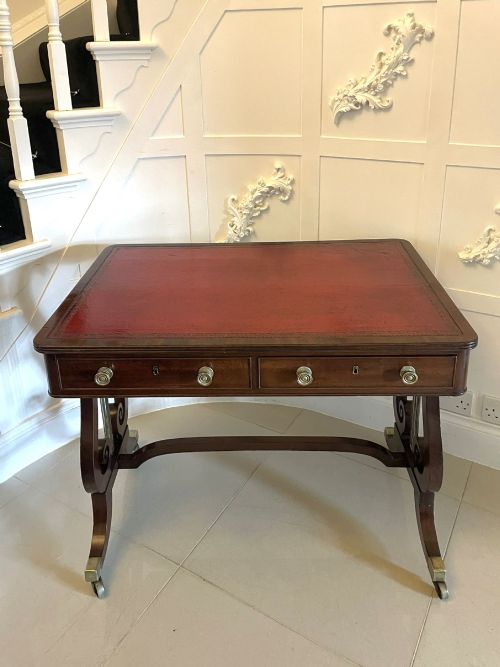
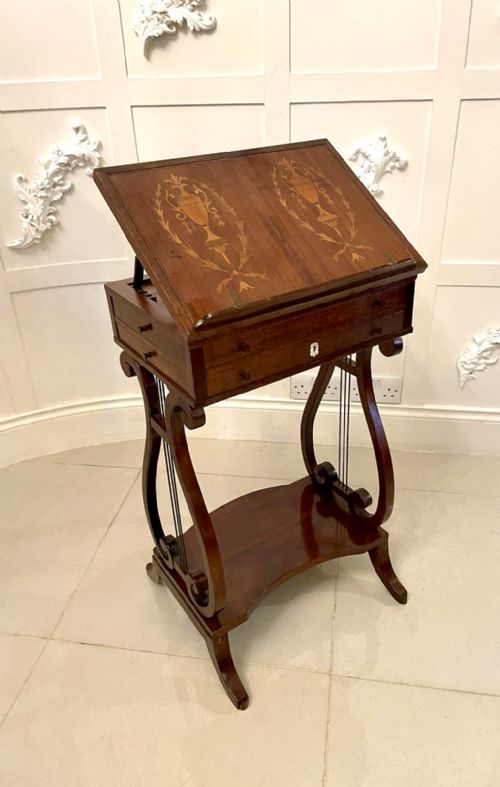
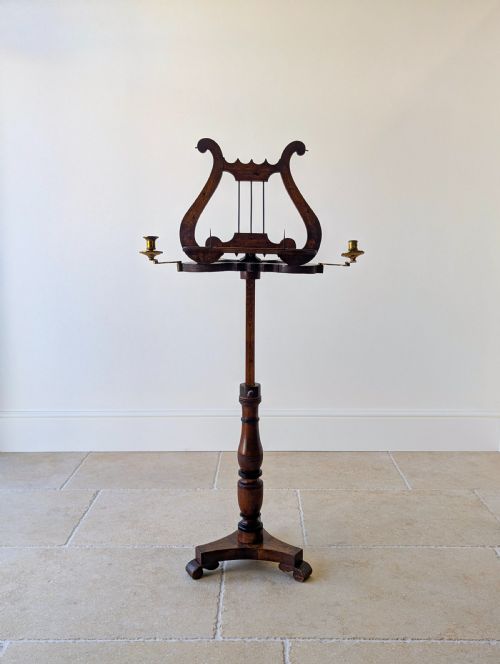


Mahogany Lyre Stand
A mahogany lyre stand brings classical grace to a room, holding sheet music or books with slender, curved uprights shaped like ancient stringed instruments.
Mahogany Lyre Stand
When you search for a mahogany lyre stand, you are looking at functional furnishings designed to hold music scores or reading matter, built with distinct harp-shaped supports. These pieces emerge in various forms across the nineteenth and early twentieth centuries, spanning the Regency, Victorian, and Edwardian eras.
The versions you are most likely to meet on this page take the form of dedicated music stands, including duet formats, alongside related library and salon pieces such as reading tables and canterburys that incorporate the characteristic lyre motif. They reflect the domestic musical pursuits of past eras.
Origins stretch from the robust styling of the Regency and William IV periods through to the lighter inlaid Edwardian interpretations. Each piece demonstrates how cabinetmakers adapted classical motifs for practical household use.
How they were made
Cabinetmakers utilised rich mahogany timber for the primary structure, often selecting figured stock to highlight the grain on columns, shelves, and music rests. This durable wood provided the necessary strength for slender turned shafts and curved lyre frames.
Detailing frequently involved contrasting stringing and banding in satinwood and boxwood, alongside polished brass hardware and occasional leather inserts. These decorative elements define the visual hierarchy of the piece, distinguishing simpler domestic items from more ornate parlour furnishings.
Some Victorian examples feature patented leaf-turning mechanisms, proving that musicians have long sought to avoid fumbling with stubborn paper.
What varies in quality
The refinement of the timber selection and the precision of the joinery set the standard across these pieces. Better examples display carefully matched flame mahogany veneers and crisp turning on the central columns.
Artistry in the execution of the lyre motif itself separates standard production from superior work, seen in the fluid sweep of the arms and the delicate integration of inlay. The balance between decorative ambition and structural stability dictates the standing of each piece.
The Mahogany Lyre Stand Glossary
- Lyre-form
- A decorative shape mimicking an ancient Greek lyre, utilised for the central support or music rest of the stand.
- Canterbury
- A low stand with partitions for holding sheet music, books, or portfolios, frequently sharing design traits with music stands.
- Satinwood inlay
- Contrasting light-coloured wood inserted into the mahogany surface in geometric or floral patterns.
- Duet stand
- A wider music stand designed to accommodate two musicians reading from the same sheet simultaneously.
Mahogany Lyre Stand: Frequently Asked Questions
What is a mahogany lyre stand used for?
These stands were originally built to hold sheet music at a convenient height for musicians playing instruments or singing in a parlour.
Today, they function equally well as book stands, display pieces, or freestanding furniture that introduces classical form into a modern interior.
How do I date a mahogany lyre stand?
Dating relies on observing the secondary woods, cabinetmaking techniques, and stylistic markers associated with periods such as Regency, Victorian, and Edwardian.
Heavier proportions and bold turned elements usually point to earlier nineteenth-century manufacture, while lighter inlaid frames often indicate Edwardian work.
How should I care for mahogany furniture?
Mahogany responds best to stable room temperatures away from direct heat sources and strong sunlight, which can fade the rich reddish-brown tone.
Occasional dusting with a soft, dry cloth preserves the polished surface without the need for heavy chemical polishes.