



Mahogany Lattice Back Chairs
Mahogany lattice back chairs are classic dining seats defined by open fretwork splats, offering timeless style and sturdy timber construction for period interiors.
Mahogany Lattice Back Chairs
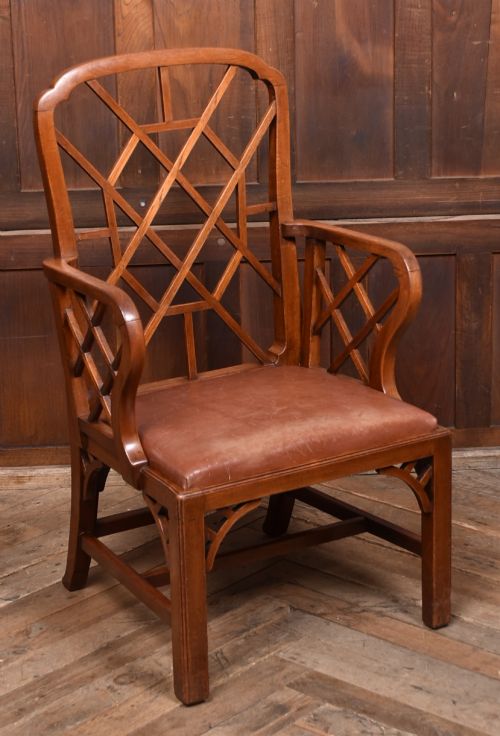
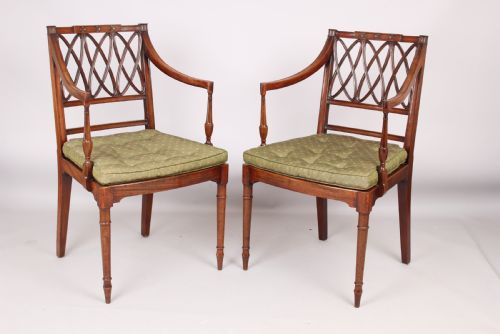
The core design centres on open fretwork and pierced slat backs, drawing heavily on Chippendale and Sheraton traditions. Buyers most frequently meet George III period examples alongside later revival pieces featuring inlaid satinwood or boxwood details.
How they were made
Cabinetmakers utilised dense mahogany timber for the structural frames, applying boxwood and satinwood inlay to enrich the surface appearance. Joinery techniques ensured stable dining chairs and large armchairs capable of withstanding daily use.
Drop-in or fixed seats were traditionally upholstered in fabric, leather, tapestry, or wool textiles. Craftspeople also incorporated carved Chinese pagoda motifs and reeded woodwork on specific regional and revival commissions.
Listings feature mahogany, fabric, leather, boxwood inlay, and satinwood across Georgian, Edwardian, and nineteenth-century periods.
What varies in quality
Proportion and scale dictate the visual success of each piece, distinguishing large or grand armchairs from standard dining seats. Crisp execution of the pierced lattice splats reveals the carver's original skill and precision.
The integrity of the timber and the preservation of original inlay work determine historical value. Matching sets spanning ten or twelve chairs command greater consideration than assembled groups or single examples.
Thomas Chippendale·Brights of Nettlebed
The Mahogany Lattice Back Chairs Glossary
- Lattice back
- A chair back featuring intersecting strips of wood forming an open, geometric pattern. This design lightens the visual weight of the timber.
- Splat
- The vertical central strip of wood in the back of a chair. In these pieces, it is pierced and carved into intricate lattice designs.
- Carver
- An armchair, traditionally used at the head of a dining table, designed to match a set of single dining chairs. These often feature more substantial proportions.
- Inlay
- A technique where contrasting woods such as boxwood and satinwood are inserted into recesses within the mahogany surface to create decorative motifs.
- Reeded
- Ornamentation consisting of parallel convex moulding strips carved directly into the wooden legs or frame. It provides a textured contrast to flat mahogany surfaces.
Mahogany Lattice Back Chairs: Frequently Asked Questions
Are these chairs comfortable for daily dining?
Most period dining chairs feature supportive upright backs and upholstered drop-in pads. Their ergonomic shape suits formal meals rather than deep lounging.
Upholstered seat pads can be re-covered in modern or traditional fabrics like wool and leather to match contemporary dining room interiors.
How do I spot a Chippendale revival chair?
Revival pieces generally date from around nineteen hundred and emulate eighteenth-century aesthetics. They often display crisply cut fretwork and rich mahogany tones.
Examination of the timber underside and joint construction helps differentiate nineteenth-century revival work from genuine Georgian pieces.
Can I mix armchairs with single dining chairs?
Sets frequently combine matching single dining chairs with a pair of larger carver armchairs intended for the table ends. This traditional arrangement balances seating capacity with formal symmetry.
Matching the mahogany tone and lattice back pattern ensures a cohesive look across mixed dining sets.
What maintenance do mahogany dining chairs require?
Routine care involves dusting the timber with a dry cloth and occasionally applying suitable furniture wax to nourish the mahogany. Direct sunlight should be avoided to prevent fading.
Upholstery elements benefit from professional cleaning depending on whether the seat pads are finished in fabric, tapestry, or leather.