
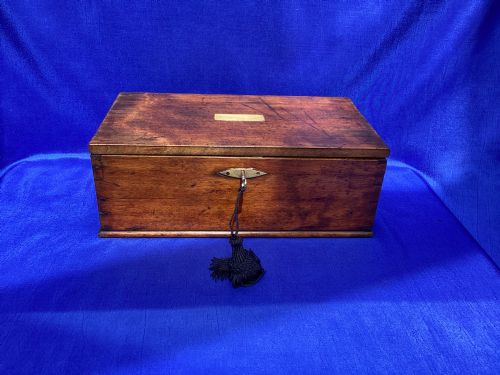


Mahogany Fitted Case
When you search for a mahogany fitted case, you encounter purpose-built containers housing instruments, firearms, toiletries, and retail goods.
Mahogany Fitted Case
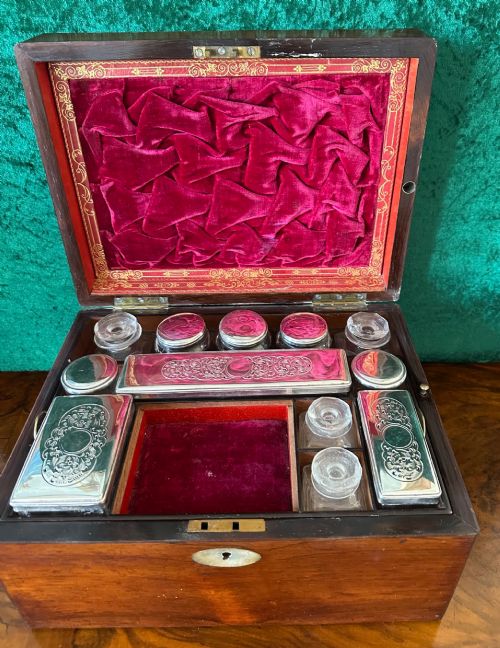
A mahogany fitted case serves as a secure enclosure designed for specific contents, ranging from scientific instruments and medical sets to duelling pistols and apothecary bottles. The form adapts entirely to its purpose, dividing internal spaces with tailored compartments, lift-out trays, and recessed brass lifting handles.
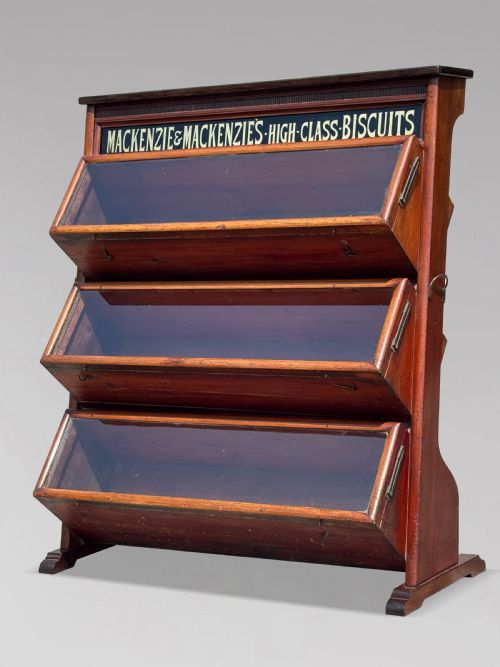
You meet a variety of versions on this page, spanning Georgian, Victorian, and Edwardian eras. Domestic examples include gentlemen's vanity boxes and dressing cases lined in velvet, while commercial pieces take the form of shop display cabinets and haberdashery counters.
Scientific and military applications also appear frequently among the listings, encompassing surveyor levels, microscopes, and cased firearms alongside campaign chests and toolboxes. Each piece reflects the functional requirements of its original owner, constructed from durable timber to withstand travel or display.
Materials and construction
Makers utilised solid mahogany and flame mahogany veneers over secondary timbers, building carcass structures designed to protect sensitive contents from transit damage and environmental changes. External surfaces often display characteristic grain patterns, finished with hand-applied polish that highlights the warm tone of the wood.
Internal fittings rely on precision carpentry, incorporating custom slots, dividers, and compartments lined with velvet or leather to secure glass bottles, steel tools, and brass instruments. Metalwork components, including brass hinges, locking escutcheons, and campaign handles, are countersunk into the timber for flush alignment.
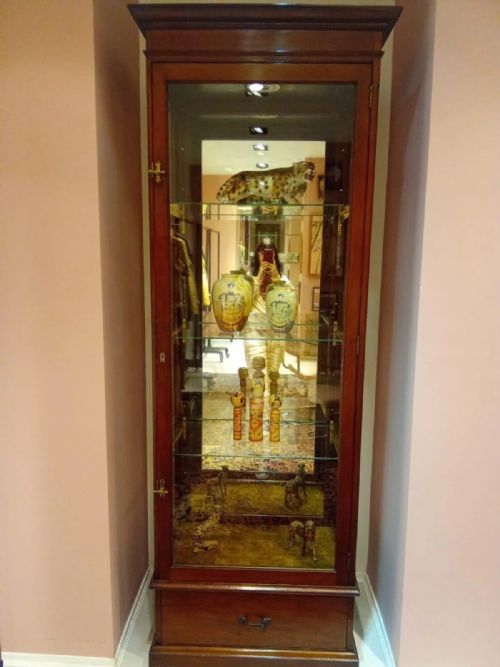
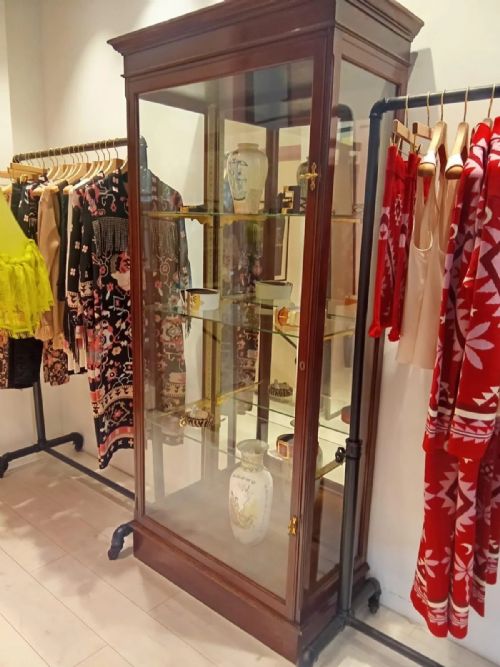
Glazed display variants integrate wooden framing with glass panels and adjustable shelving, occasionally featuring mirrored interiors to reflect light across commercial goods. Structural joints employ traditional techniques such as dovetailing on drawers and secure corner bracing on travel boxes.
Listings feature items spanning the Georgian, Victorian, and Edwardian periods, constructed from mahogany, brass, glass, and velvet.
What separates the grades
The degree of customisation and internal complexity determines the standard of a piece, with bespoke boxes featuring intricately partitioned trays, concealed secret drawers, and complete sets of matching original accessories. Simpler utilitarian chests lack these refinements, offering robust storage without the nuanced joinery found in higher-tier commissions.
The selection of timber grain on exterior surfaces contributes to the visual merit of an object, where well-figured mahogany contrasts with plain utility boards. Surviving hardware, such as signed brass makers' plates and functional original locks with working keys, elevates the standing of a specimen.
The integrity of the internal lining and the presence of undamaged glass components or complete instrument suites indicate how carefully an item has been preserved over time. Restorations that respect the original finish maintain historical character more effectively than heavy interventions.
Holtzapffel and Co·L Casella and Co·John Millikin·Joseph Egg·John Stow Ltd·H W Mortimer and Son·Winsor and Newton·Swift and Son·E Pollard and Co Ltd·A Hurlimann
The Mahogany Fitted Case Glossary
- Apothecary box
- A portable wooden chest fitted with internal partitions to hold glass medicine bottles, scales, and mortars for medical practitioners.
- Campaign case
- A piece of furniture or container built for travel, featuring recessed brass handles and robust construction to endure military deployment.
- Escutcheon
- A protective metal plate surrounding a keyhole, usually fashioned from brass on these wooden cases.
- Fitted interior
- An internal layout organised with specific slots, blocks, or compartments designed to hold tools, instruments, or bottles securely.
- Flame mahogany
- Timber cut from the fork of the mahogany tree, displaying a distinctive feather-like grain pattern used for decorative veneer.
Mahogany Fitted Case: Frequently Asked Questions
What were apothecary boxes used for?
These portable chests allowed doctors and travellers to carry essential medicines, powders, and scales safely while on the move.
Internal tiers and dedicated slots kept glass bottles upright and separated during transit across rough terrain.
How do I care for a mahogany case?
Keep the wood away from direct heat sources and sudden humidity shifts to prevent the timber and veneer from splitting.
Apply a light application of traditional wax polish occasionally to maintain the sheen of the surface.
Are the instruments inside original?
Many cased scientific instruments and duelling pistols retain their matching period accessories, though components were occasionally replaced during active service.
Check the fit of tools within their designated compartments to assess whether they belong to the initial ensemble.
How can I tell a Victorian box from a Georgian one?
Georgian examples often display simpler, robust lines with heavy brass carrying hardware intended for travel and campaign use.
Victorian pieces frequently introduce more elaborate internal velvet linings, satinwood stringing, and specialised compartments for vanity items.