



Mahogany Empire Centre Table
A mahogany empire centre table anchors a room with classical balance, bringing bold French design and fine timber to the floor.
Mahogany Empire Centre Table
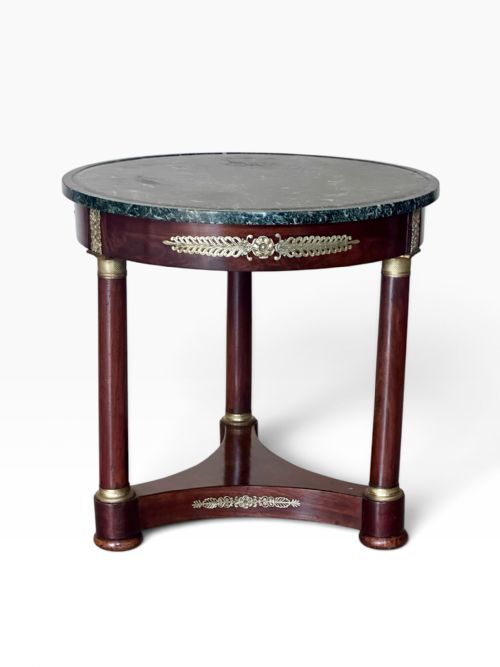
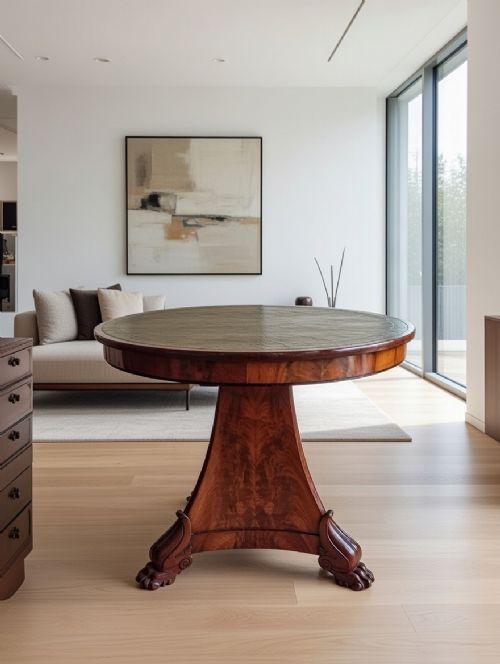
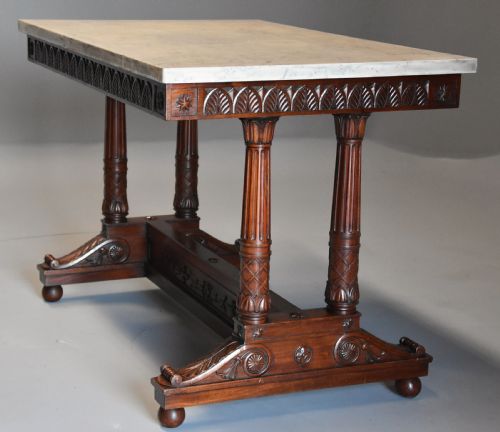
A mahogany empire centre table typically takes the form of a round gueridon or a pedestal table designed to stand free in a room rather than against a wall. These pieces emerge predominantly from nineteenth century French workshops, spanning the Empire, Charles X, Restauration and Victorian revival periods. Alongside round pedestal formats, the evidence includes occasional tables, side tables and sofa tables.
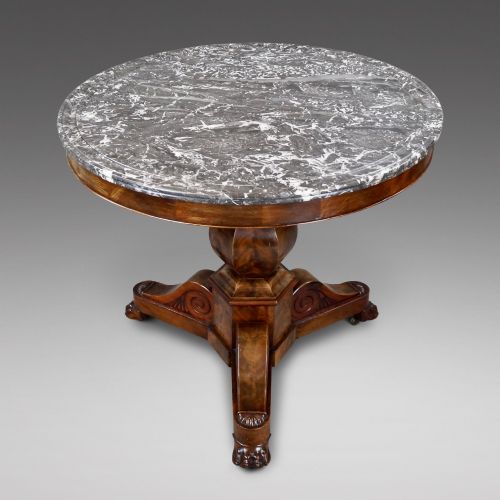
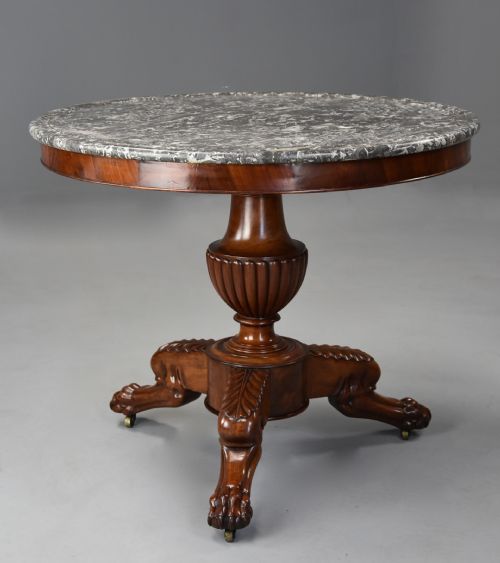
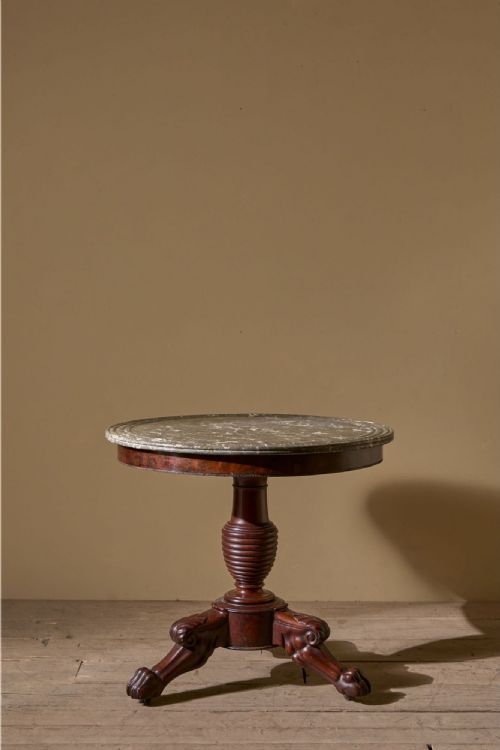
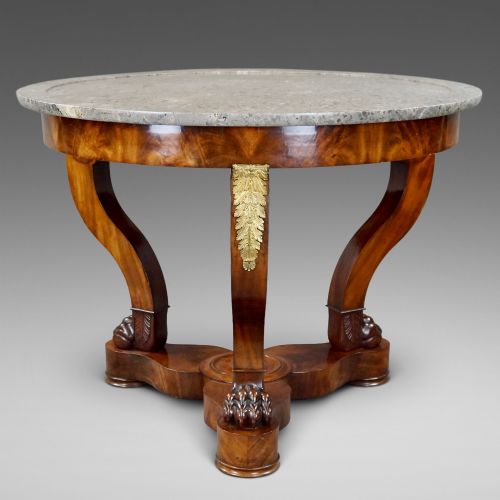
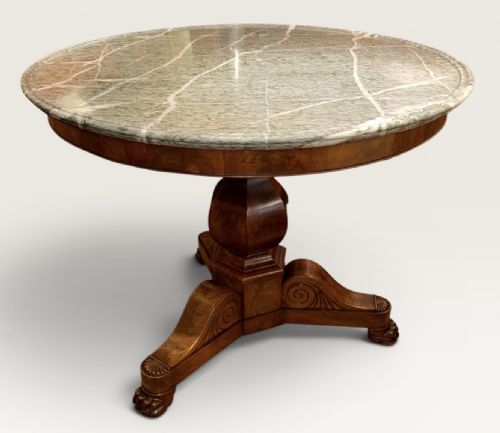
The most common version met on this page is the French mahogany gueridon featuring a circular marble top resting on a central column and a tripartite platform base. Buyers also encounter rectangular or oval variants, sometimes supported by figural mounts such as swans or rams heads. The architectural proportions draw directly on classical antiquity, adapted for nineteenth century domestic interiors.
Materials and Construction
Cabinetmakers constructed these tables using solid mahogany and flame mahogany veneer applied to a stable secondary timber carcass. Flame mahogany veneer provides rich, figured grain patterns across the circular tops and frieze drawers, showcasing the natural depth of the timber. Walnut and giltwood appear occasionally as secondary woods or decorative accents.
Heavy stone inserts form an integral part of the construction, with original veined marble or black marble tops fitted securely into the mahogany framing. Ormolu, brass and gilt bronze mounts embellish the structural points of the base, column and frieze, while specific examples incorporate leather writing surfaces or specialised specimen marble inlays.
Several tables feature carved wooden swans gazing downward into the room as if inspecting their own reflections in the polished floor.
Judging Quality
Quality rests heavily on the selection of timber and the execution of decorative mounts, where highly figured flame mahogany veneers and crisp, fire-gilded ormolu distinguish superior examples. The weight and quality of the marble top, along with its precise integration into the timber rim, indicate the standard of craftsmanship.
Structural integrity of the central pedestal and its connection to the base platform separate workshop tiers. Master pieces show refined carving on sculptural details like swans or rams heads and carry maker signatures, whereas simpler interpretations rely purely on veneered surfaces without cast metal enrichment.
JACOB·Linke
The Mahogany Empire Centre Table Glossary
- Gueridon
- A small circular table on a central pillar, originating in seventeenth century France and widely produced during the Empire period. These tables serve as independent centre pieces within a room.
- Ormolu
- Gilt bronze decorative mounts applied to furniture, created by treating cast bronze with a mercury and gold amalgam. This technique gives metalwork a rich golden lustre.
- Flame mahogany
- A veneer cut from the fork of the mahogany tree where the branch joins the trunk. The resulting grain creates a distinctive repeating flame-like pattern.
- Specimen marble
- A top composed of various coloured marbles cut and fitted together in geometric or pictorial patterns. This technique demands exceptional stone-cutting skill.
Mahogany Empire Centre Table: Frequently Asked Questions
What is a mahogany empire centre table?
A mahogany empire centre table is a freestanding nineteenth century table designed to sit in the middle of a room rather than against a wall. They are typically circular gueridon tables featuring mahogany or flame mahogany veneer and a stone top.
These pieces reflect classical architectural styles popular in France during the early nineteenth century and later revival periods. Their substantial presence and sculptural bases make them natural focal points for principal reception rooms.
How were gueridon tables used historically?
Gueridons served as versatile small tables for holding lighting, decorative objects, books or tea services within grand interiors. Because they stand on a single central pedestal, people could walk entirely around them without obstruction.
Placed centrally under a chandelier or ceiling rose, they displayed porcelain, bronzes or floral arrangements. Their mobile nature also allowed them to be repositioned easily for different domestic activities.
How do I style a centre table today?
A centre table works best when placed in an open space where it can be appreciated from all sides. It functions effectively in the middle of a large entrance hall, a drawing room or a library.
Keep the surface styling restrained to honour the timber grain and marble top. A single large bronze, a heavy ceramic bowl or a stack of art books provides sufficient weight without cluttering the classical proportions.
How can I tell the French Empire period?
French Empire pieces display strict symmetry, heavy architectural forms, and strong classical references inspired by ancient Rome and Greece. The mahogany timber is often unadorned or framed by striking gilt bronze mounts.
Look for structural motifs such as columns, paw feet, swans, or rams heads integrated into the base. Later nineteenth century revival pieces replicate these motifs but often employ softer carving and different secondary timbers.