
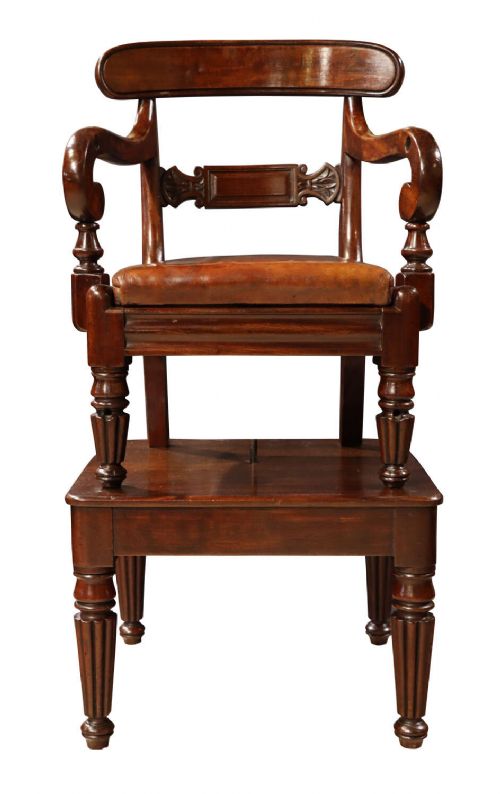


Mahogany Child High Chair
A mahogany child high chair is a traditional piece of juvenile seating designed to elevate young diners to table height.

Mahogany Child High Chair
A mahogany child high chair bridges domestic furniture and nursery history, appearing in forms ranging from simple highchairs to metamorphic designs that convert into play tables. Buyers searching for a mahogany child high chair encounter pieces spanning the Georgian, Regency, William IV and Victorian periods, often constructed with sturdy stands.
Many examples utilise convertible frames where the upper chair separates from its lower base to form a standalone low chair and table combination. The surviving inventory demonstrates that these items were built to withstand active daily use while maintaining the formal domestic styling of adult furniture of the same eras.
Materials and construction methods
Makers utilised solid mahogany timber for the primary framework, sometimes incorporating secondary woods for internal framing or hidden supports. Turned wooden spindles and shaped arms provide structural rigidity while maintaining a domestic aesthetic suited to dining rooms.
Seating surfaces often feature woven cane, known locally as bergere, or simple wooden panels designed to accept squab cushions in various fabrics. Brass fittings, including hinges and locking pins on metamorphic models, secure the chair when transformed into a low table.
Mahogany Child High Chair Retail Price Guide 2026
Typical asking prices for mahogany child high chair among the pieces listed under this phrase on Sellingantiques today, from the lower quarter to the upper quarter. They describe what is for sale here now, not the wider market.
A tiny footrest dangling beneath a towering mahogany frame reminds us that even Victorian toddlers needed somewhere to dangle their toes.
Assessing quality and craftsmanship
The distinction between standard examples and superior pieces rests upon the complexity of the joinery and the presence of functional conversion mechanisms. Metamorphic versions that transition smoothly between a high chair and a table demonstrate advanced cabinetmaking skills compared to fixed designs.
Originality of components, particularly the matching base stands and early cane panels, dictates the integrity of the piece. Subtle details such as finely turned legs, harmonious proportions, and intact brass hardware separate utilitarian nursery furniture from high-status commissions.
The Mahogany Child High Chair Glossary
- Metamorphic
- Furniture designed to transform into an alternative form, such as a high chair converting into a table and chair combination. This clever engineering allows dual functionality from a single item.
- Bergere
- A type of wicker or cane work used for seats and backs, woven in a tight pattern. It provides a supportive yet flexible surface for seating.
- Stand
- A separate lower framework or base that elevates the child's chair to dining table height. Many Georgian and Regency examples use this two-part construction.
- Tub chair
- An armchair with a continuous curved back and arms forming a single rounded enclosure. This shape offers secure containment for younger occupants.
Mahogany Child High Chair: Frequently Asked Questions
How do metamorphic high chairs work?
Metamorphic high chairs operate through a system of pivoting frames or detachable locking joints that allow the upper seat section to separate from the lower support stand. When rearranged, the components form a low nursery chair paired with a small activity table.
Cabinetmakers engineered these joints to be operated smoothly by adults while remaining secure against the movements of a child. Surviving examples rely on original wooden pegs, brass hinges or sliding grooves to facilitate the transformation.
Were these chairs used daily?
These pieces served as practical nursery furniture intended for daily family meals rather than purely decorative display objects. Their robust construction reflects the demanding environment of domestic households.
Evidence of wear on footrests, arms and seat edges typically confirms active employment across generations. Many retain traces of traditional upholstery or replacement squab cushions used to ensure infant comfort.
How can I date a mahogany high chair?
Dating relies upon stylistic markers shared with adult seating of the same decades, such as leg turning, arm shapes and overall proportions. Georgian and Regency pieces often feature simpler rectilinear stands or slender columnar legs, whereas Victorian models introduce heavier moulded details.
Construction techniques also provide clues, as hand-cut dovetails and early fixings point towards 18th-century or early 19th-century workshop practices. Comparing the primary timber grain and patination helps corroborate the period of manufacture.
Are high chairs and chairs on stand different?
Chairs on stand consist of a removable upper seat unit placed atop a separate taller base frame, whereas traditional high chairs are built as a single fixed tall structure. The two-part design allowed families to utilise the seating at standard floor level once the child outgrew the elevated height.
This modular approach is particularly common in Georgian and Regency examples found within the archive. Both configurations served the same domestic purpose in the dining room.