

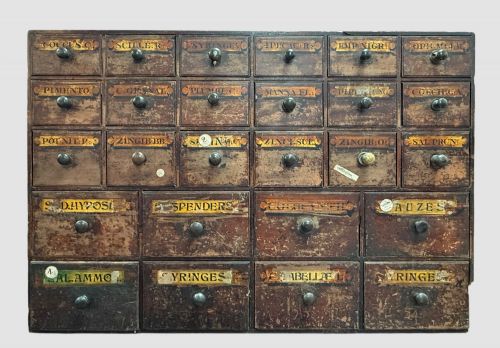


Mahogany Chemist Cabinet
A mahogany chemist cabinet brings heavy utilitarian charm and rich timber tones into a modern interior.
Mahogany Chemist Cabinet
When you search for a mahogany chemist cabinet, you are looking at functional storage pieces built for apothecary shops, pharmacies, and commercial dispensaries during the Georgian, Victorian, and Edwardian eras. These items range from large shop counters and multi-tiered banks of drawers to wall-hung cupboards and compact travelling apothecary boxes.
The version you are most likely to meet on this page is a Victorian mahogany bank of drawers or a pharmacy storage chest, constructed to hold medicines and dry goods behind numerous small compartments. Many pieces bear the original lettering or configuration of old chemist shops, combining solid wood construction with glass doors and brass hardware.
How They Were Made
These cabinets rely primarily on solid mahogany for structural durability and panel construction, often supplemented by secondary woods such as pine within internal framing and drawer construction. Timber surfaces were polished or painted depending on whether the piece served as a high-status retail display counter or a utilitarian storage bank.
Mahogany Chemist Cabinet Retail Price Guide 2026
Typical asking prices for mahogany chemist cabinet among the pieces listed under this phrase on Sellingantiques today, from the lower quarter to the upper quarter. They describe what is for sale here now, not the wider market.
Listings feature mahogany chemist cabinets spanning the Georgian, Victorian, and Edwardian periods, utilising brass, glass, and pine alongside solid mahogany.
What Varies in Quality
The standard of a mahogany chemist cabinet depends on the integrity of its original configuration, particularly whether multiple drawer banks and glazed doors remain intact without extensive timber replacement. Finer examples retain their original glass shelves, brass hardware, and painted commercial lettering rather than later restorations.
Construction methods also distinguish output, with precision dovetail joinery in the numerous small drawers separating superior cabinet-making from simpler workshop production. The depth of grain and rich natural patina of the polished mahogany further mark the upper tier of surviving shop fittings.
The Mahogany Chemist Cabinet Glossary
- Apothecary cabinet
- A specialised storage chest containing numerous small drawers or compartments designed for holding medicinal herbs, powders, and remedies. These pieces typically originate from nineteenth-century chemist shops and dispensaries.
- Bank of drawers
- A large assembly of multiple small drawers arranged in vertical and horizontal tiers for organised inventory storage. Such units formed the backbone of traditional pharmacy shop fittings.
- Shop counter
- A substantial retail display and service fixture incorporating glazed upper sections or heavy wooden surfaces. These items stood at the heart of Victorian and Edwardian commercial interiors.
- Apothecary box
- A portable wooden chest fitted with internal partitions and glass bottles for transporting medical preparations. They date from the Georgian period through to the late nineteenth century.
- Wall hanging cabinet
- A compact storage cupboard designed to mount directly onto a dispensary wall to save floor space. They frequently feature glazed doors to display contents while keeping medicines secure.
Mahogany Chemist Cabinet: Frequently Asked Questions
What is a mahogany chemist cabinet?
A mahogany chemist cabinet is a piece of commercial pharmacy furniture built during the eighteenth, nineteenth, or early twentieth centuries to store medicines, powders, and shop inventory. They comprise banks of small drawers, glazed display counters, wall-hung cupboards, and portable apothecary boxes.
These utilitarian items were constructed from solid mahogany with brass hardware and glass panels to withstand heavy daily use in busy dispensaries. Today, they survive as practical storage units and striking decorative antiques for contemporary interiors.
How were apothecary cabinets used?
Apothecary cabinets served as the central storage and dispensing hubs for pharmacists, chemists, and medical practitioners. The numerous small drawers kept specific herbs, dry ingredients, and prepared remedies organised and accessible behind closed fronts.
Larger shop fittings incorporated glazed display sections and counters to showcase bottled goods and interact directly with retail customers. Portable boxes allowed physicians to transport essential medicines securely while travelling.
How do I style a chemist cabinet at home?
A mahogany chemist cabinet functions well as a statement storage piece in a kitchen, dining room, or hallway. The numerous small drawers provide practical organisation for everyday items, while glazed display sections let you exhibit glassware or collections.
Allow the rich timber tones and original brass hardware to anchor the room by keeping surrounding decor simple. Placing the cabinet against a plain wall highlights its architectural presence and commercial heritage.
How do I tell Victorian from Georgian cabinets?
Georgian chemist cabinets and apothecary boxes, dating from the mid-eighteenth century, typically display simpler, more restrained proportions and simpler internal fittings. They are often smaller portable travel chests rather than the large commercial shop fittings seen later.
Victorian and Edwardian pieces, produced from the mid-nineteenth century onwards, tend to be much larger multi-drawer banks, wall cupboards, and glazed shop counters. They frequently feature more elaborate commercial lettering, heavier brass pulls, and extensive glass display shelving.