


Mahogany Canterbury on Castors
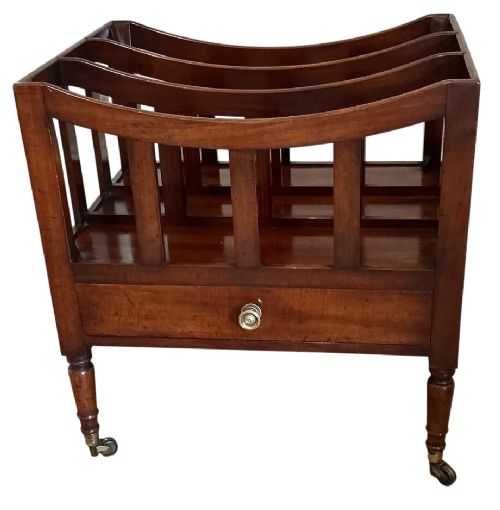
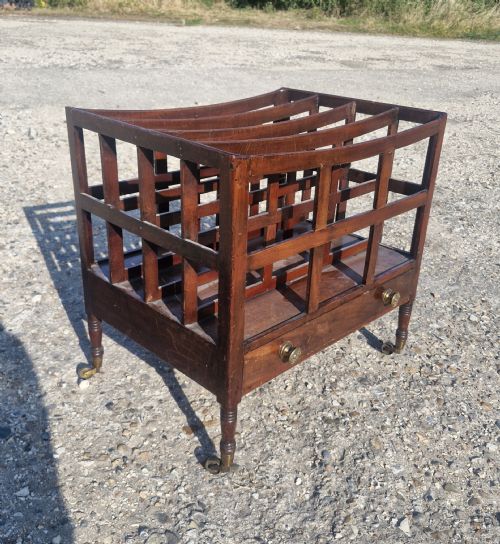
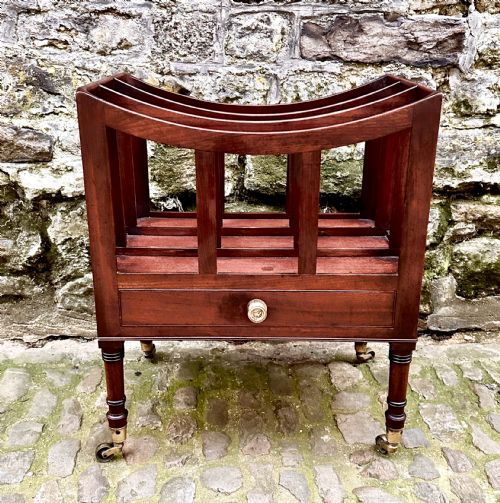
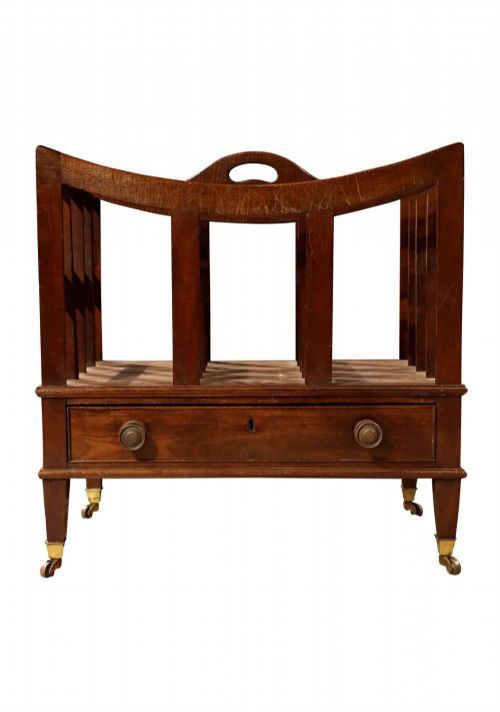
These mahogany canterbury on castors pieces are practical nineteenth-century stand furniture designed to hold sheet music, newspapers and books.
Mahogany Canterbury on Castors
On this page, pieces span the Georgian, Regency, William IV, Victorian, and Edwardian periods. Examples range from boat-shaped designs to oversized George III variants and ebonised what-not combinations.
Makers and designers referenced in the evidence include Gillows of Lancaster and J.C. Loudon. These items function equally well today as freestanding magazine racks or bookstands in a study or living room.
Materials and construction
Makers utilised solid and veneered mahogany as the primary timber, occasionally accented with contrasting inlays of ebony, rosewood, and satinwood. Brass components appear primarily on the castors that support the legs.
Construction techniques include finely turned legs, wreath carving, and precise joinery to create the vertical slatted divisions. Ebonised finishes and delicate stringing are also recorded across the selection.
A archbishop allegedly inspired the very first one by asking for a stand to hold loose music sheets.
Quality variations in the range
Quality is determined by the crispness of the turning on the legs and the finesse of any carved detailing, such as wreath work. Finer examples display thoughtful proportions and careful timber selection for the divisions and base.
The integration of secondary timbers and contrasting stringing, such as ebony banding, distinguishes more ambitious cabinet work from simpler utility pieces. Original brass castors and intact drawer construction further elevate a piece.
Gillows of Lancaster·J.C. Loudon
The Mahogany Canterbury on Castors Glossary
- Canterbury
- A low stand with vertical divisions used for holding music sheets, newspapers, and books. The name is traditionally associated with the Archbishop of Canterbury, who is said to have commissioned the first such piece.
- Castors
- Small wheel attachments fitted to the feet of furniture to allow easy movement across floor surfaces. They are frequently cast in brass on nineteenth-century pieces.
- Boat-shaped
- A curved hull-like profile adopted by cabinet makers for the overarching rails of certain Regency canterburys. This silhouette softens the linear geometry of the vertical divisions.
- Ebonised
- Timber treated with a dark stain or finish to imitate ebony. This technique was popular in Victorian furniture design for creating sharp contrast.
- Stringing
- Thin inlaid lines of contrasting wood used to edge panels and surfaces. It frames the grain of the primary mahogany timber.
Mahogany Canterbury on Castors: Frequently Asked Questions
What is a canterbury used for?
A canterbury was originally designed to hold sheet music near a piano or music stand. Over time, it became a popular household accessory for organising newspapers, periodicals, and books.
Today, they serve the exact same purpose in modern interiors. They keep reading material tidy while remaining easily movable on their castors.
How do I date a mahogany canterbury?
Dating relies on observing stylistic markers such as turned leg profiles, timber selection, and decorative inlays. Georgian and Regency pieces tend to show clean classical lines, whereas Edwardian variants often incorporate delicate stringing and inlaid bookstand formats.
Castor design and construction methods also offer clues. Examining the joinery inside any lower drawer helps confirm the period of manufacture.
Are all canterburys fitted with castors?
Most traditional examples feature castors to allow the stand to be repositioned easily around a room. The presence of original brass castors is a notable detail when assessing a piece.
Some variations, particularly certain Edwardian bookstands or what-not hybrids, may stand on fixed feet rather than rolling supports.
Where should I place a canterbury at home?
A canterbury sits well beside a sofa, armchair, or desk where reading materials accumulate. Because they are finished on all sides as freestanding items, they do not need to be pushed flat against a wall.
Their mobility on castors makes them adaptable for repositioning between rooms as required.