

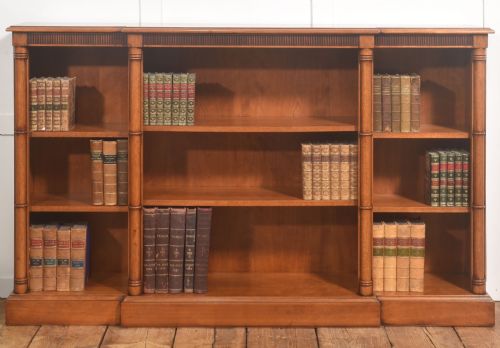
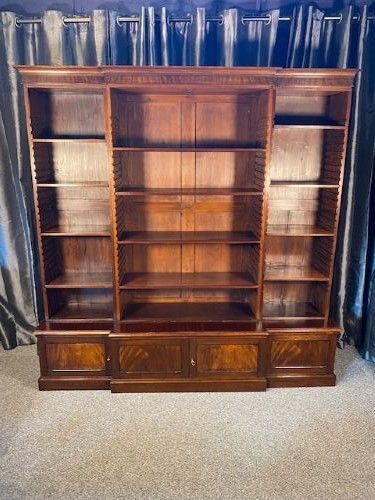
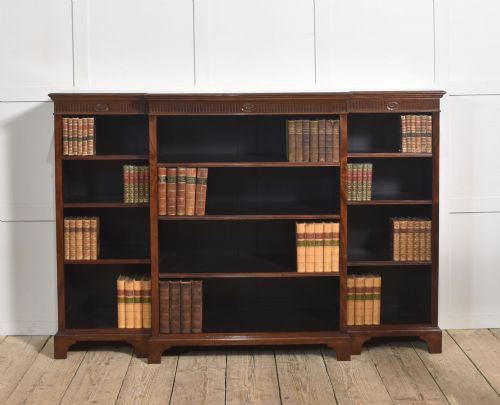


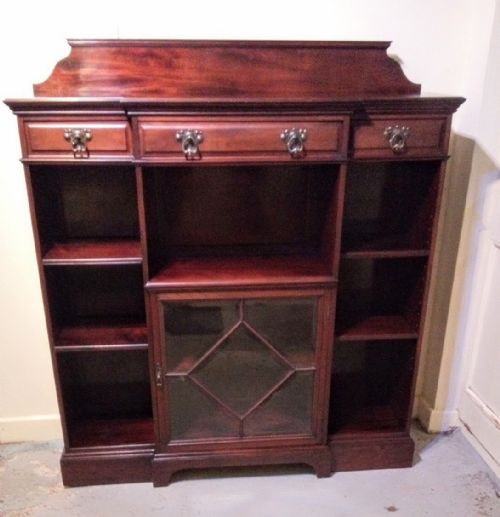


Mahogany Breakfront Shelving Unit
A mahogany breakfront shelving unit brings imposing scale and rich timber grain to any room, offering serious storage with architectural presence.
Mahogany Breakfront Shelving Unit
A mahogany breakfront shelving unit is a large piece of furniture designed primarily for books and display, characterised by its projecting central section. These pieces appear in forms ranging from enclosed library bookcases with glazed doors to open shelving configurations.
The pieces on this page span the nineteenth century, the Victorian era, and the early twentieth century, including Edwardian and nineteen-thirties examples. Buyers will frequently encounter open bookcase variants alongside grander library bookcases bearing classical styling cues like the Neoclassical, Regency, and Georgian traditions.
How they were made
Cabinet makers utilised solid mahogany and flame mahogany veneer over secondary timbers such as oak, softwood, and general wood to construct these substantial units. The application of flame veneer required skilled hand-selection of timber to achieve striking grain patterns across the broad surfaces of the breakfront facade.
Structural hardware relied on brass fittings, while internal elements sometimes incorporated glass and fabric linings. Traditional joinery methods secured the heavy breakfront carcase and supported heavy tiers of shelving without sagging over time.
Mahogany Breakfront Shelving Unit Retail Price Guide 2026
Typical asking prices for mahogany breakfront shelving unit among the pieces listed under this phrase on Sellingantiques today, from the lower quarter to the upper quarter. They describe what is for sale here now, not the wider market.
Listings feature mahogany breakfront shelving units spanning the Victorian era, the Edwardian period, and the early twentieth century up to nineteen-thirty.
What varies in quality
Quality in a mahogany breakfront shelving unit rests upon the choice of timber and the ambition of its architectural proportions. Pieces utilising highly figured flame mahogany veneer demonstrate a higher tier of craftsmanship than those built with plain or secondary woods.
The integrity of the original finish and the subtlety of period stylistic details, such as Regency or Neoclassical carving, separate standard production from superior cabinet work. The scale and presence of the breakfront form itself dictate the visual impact within a room.
Robert Strahan
The Mahogany Breakfront Shelving Unit Glossary
- Breakfront
- An architectural furniture design where the central section projects forward from the flanking wings. This configuration creates dynamic shadow lines and visual depth.
- Flame mahogany veneer
- A thin slice of mahogany timber cut from the fork of the tree where branches meet the trunk. It produces a distinctive flickering flame-like pattern.
- Neoclassical style
- A decorative movement drawing inspiration from classical antiquity. It manifests in clean architectural lines and restrained classical ornamentation.
- Regency
- A British design period spanning the early nineteenth century. It is known for archaeological inspiration, bold forms, and classical restraint.
- Glazed doors
- Fitted glass panels set into wooden frames to protect books from dust while maintaining visibility. They are typical of enclosed library bookcases.
Mahogany Breakfront Shelving Unit: Frequently Asked Questions
What is a breakfront shelving unit?
A breakfront shelving unit is a large storage furniture piece featuring a central section that projects further forward than the left and right sides. This architectural layout breaks up the flat facade of a traditional long bookcase.
Such units were traditionally designed for grand domestic libraries and formal reception rooms. They provide substantial capacity for organising large book collections while serving as a primary focal point in the interior.
How do I date a mahogany bookcase?
Dating a mahogany bookcase involves examining the construction methods, timber selection, and stylistic vocabulary present in the piece. Pieces spanning the nineteenth century often display heavier proportions and distinct period revival motifs.
Later Edwardian and early twentieth-century examples frequently exhibit lighter scaling or refined open shelving formats. Comparing the secondary timbers and the character of the mahogany veneer helps clarify the era of manufacture.
Are these units open or enclosed?
These units appear in both open shelving formats and enclosed library bookcase configurations with doors. Open versions provide immediate access to volumes and display items.
Enclosed variants often feature glass panels to safeguard valuable bindings from dust and environmental wear. Both formats retain the defining projecting central section characteristic of the breakfront silhouette.
How should I care for mahogany furniture?
Mahogany furniture benefits from stable indoor humidity and protection from direct sunlight to preserve the rich colour of the timber. Regular dusting with a soft, dry cloth prevents particulate accumulation on the polished surfaces.
Harsh chemical cleaners should be avoided in favour of traditional wax polishes that nourish the wood grain. Maintaining consistent room temperatures prevents the timber and veneer from experiencing stress.