
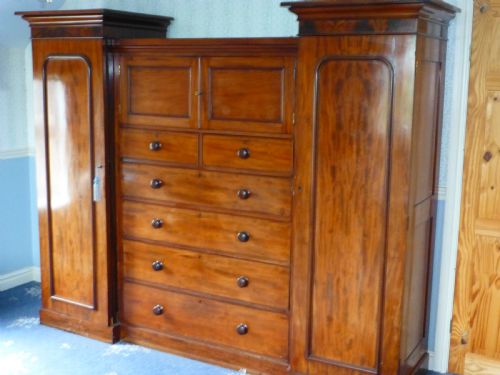

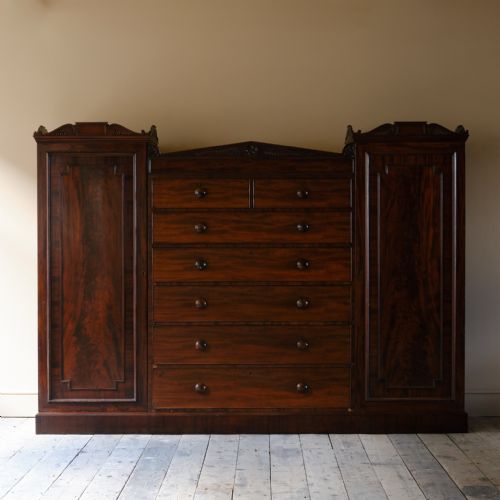


Mahogany Breakfront Clothes Press
A mahogany breakfront clothes press is a grand storage piece that anchors a bedroom with rich timber and architectural presence.
Mahogany Breakfront Clothes Press
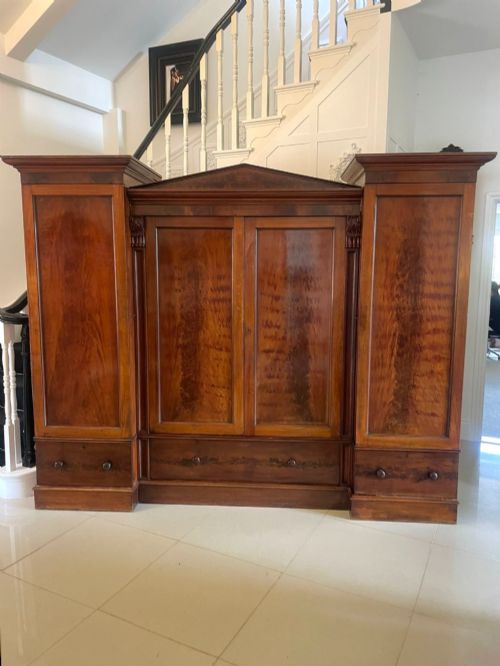
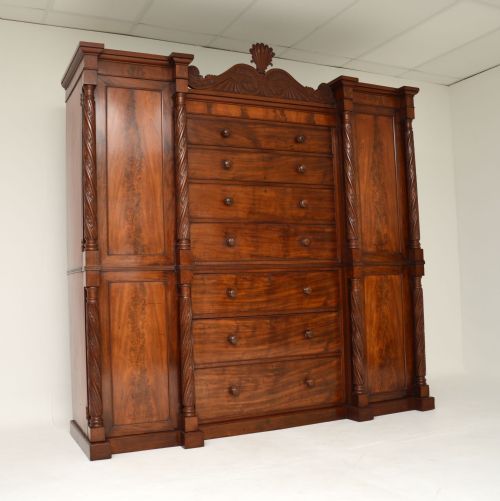
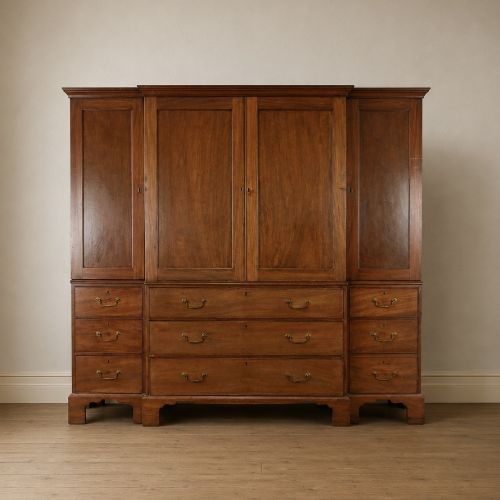
A mahogany breakfront clothes press is a substantial wardrobe or linen press featuring a central section that projects forward from the flanking wings. These pieces span several major eras, appearing in George III, William IV, Victorian, and Edwardian guises.
Most examples seen here are large multi-door wardrobes or compactum combinations designed for serious garment storage. They combine hanging space with linen shelves and interior drawers behind architectural panelled or glazed doors.
Origins range from Georgian cabinet makers to Victorian workshops, with occasional Irish and London pieces showing regional timber choices and decorative flourishes.
Materials and construction
Makers relied primarily on solid mahogany and figured mahogany veneer, often selecting flame mahogany or curl mahogany for dramatic grain patterns on the principal doors. Secondary timbers provide structural stability within the expansive carcass.
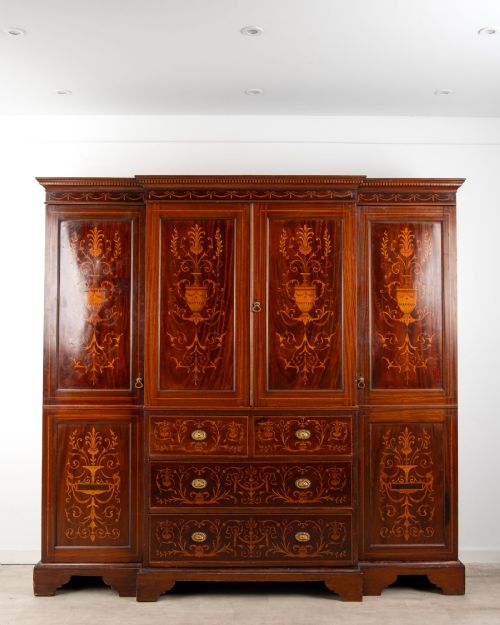
Inlay work in satinwood adds contrasting linear detail on later pieces, whilst brass handles and fittings provide functional contrast to the dark polished wood surfaces.
Listings feature mahogany, flame mahogany veneer, satinwood inlay, and brass across Victorian and Georgian periods.
Assessing quality
Quality rests in the selection of the mahogany veneers and the crispness of any inlaid satinwood details or carved mouldings. Pieces with book-matched flame mahogany panels show greater ambition from the workshop.
Interior configuration also dictates distinction, as fitted linen slides, sliding trays, and original internal drawer arrangements demonstrate superior utility and original craftsmanship.
Gillows·Robert Strahan of Dublin·Edwards & Roberts·Maples & Son
The Mahogany Breakfront Clothes Press Glossary
- Breakfront
- A cabinet design where the central section projects forward past the flanking sections. This creates a distinct architectural rhythm across the front elevation.
- Compactum
- A multi-functional wardrobe combining hanging space, shelving, and internal drawers within a single unit. It maximises storage efficiency for a gentleman's or lady's attire.
- Flame mahogany
- A veneer cut from timber where the branch meets the trunk, producing a rippling flame-like pattern. Cabinet makers used it to create striking visual movement on door panels.
- Linen press
- A tall piece of furniture traditionally used for storing folded linens on internal sliding trays. Lower sections often house larger drawers for bulky garments.
- Satinwood inlay
- Contrasting pale timber inserted into recesses within the darker mahogany surface. It creates fine geometric or floral borders characteristic of later revival styles.
Mahogany Breakfront Clothes Press: Frequently Asked Questions
What is a breakfront clothes press?
A breakfront clothes press is a large wardrobe featuring a projecting central section flanked by recessed wings. It provides substantial hanging and shelving capacity.
These pieces were constructed from mahogany during the Georgian, Victorian, and Edwardian periods for major domestic bedrooms.
How do I date a mahogany wardrobe?
Dating relies on stylistic clues such as architectural cornices from the Georgian era or heavier proportions from the Victorian period. Inlaid satinwood often points towards Edwardian revival pieces.
Construction methods inside the piece, including drawer linings and backboards, help confirm the manufacturing era.
Will a large wardrobe dismantle?
Many large wardrobes and compactums are designed to dismantle into modular sections for transport and installation. The cornice, base, central section, and side wings often separate.
Checking the construction reveals whether the piece uses knock-down bolt systems intended for room placement.
What is the difference between a wardrobe and a clothes press?
A traditional clothes press specifically incorporates internal sliding trays designed for storing folded linens rather than full-length hanging space. Wardrobes focus primarily on vertical garment hanging.
Many surviving pieces combine both functions within a multi-door layout.