
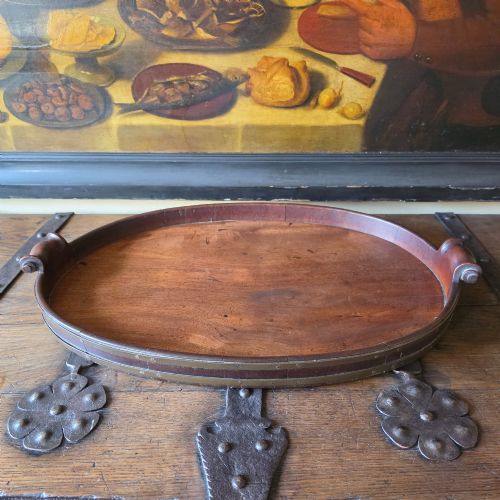


Mahogany Brass Gallery Sideboard
These mahogany brass gallery sideboards combine rich timbers with practical metal rails, offering both display space and serving utility for a formal dining room.
Mahogany Brass Gallery Sideboard
A mahogany brass gallery sideboard represents a refined class of dining room furniture developed primarily across the Georgian and Regency periods. These substantial serving pieces provide a flat timber surface for food presentation, accompanied by an upstanding brass rail at the rear to prevent items from sliding off.
The versions most commonly met in this selection range from strict 18th Century George III designs to later 19th Century interpretations and Edwardian revivals. Alongside traditional sideboards, the evidence shows related forms such as serving tables, pedestal sideboards, and chiffoniers incorporating similar brass gallery details.
Materials and Construction Methods
Makers utilised solid mahogany and flame mahogany veneer as the primary timber, often enhanced with contrasting stringing and inlay work in satinwood and boxwood. The structural warmth of the wood grain contrasts directly with the polished metal components.
The characteristic brass gallery rail is securely fitted to the rear upper surface of the timber top, frequently supported by slender metal uprights or spindles. Joinery techniques from these eras ensure robust construction across pedestals, bow fronts, and serving tables.
Early dining arrangements demanded metal rails simply to stop rolling lemons from hitting the floor.
Distinctions in Quality and Execution
Superior examples display exceptional selection of figured mahogany veneer and precise inlay work, whereas simpler pieces rely on plain timber surfaces. The density of the grain and the depth of the hand-finished polish set the finer specimens apart.
The weight, casting detail, and secure fixing of the brass gallery rail indicate the original workshop standards. Well-preserved original mounts and drawer linings signal higher craftsmanship than later replacements or crude repairs.
Mack Williams And Gibton·Edwards and Roberts·Howard And Sons·H Mower And Stephenson
The Mahogany Brass Gallery Sideboard Glossary
- Mahogany
- A durable tropical hardwood valued for its deep reddish-brown colour and stable grain. It forms the structural and surface foundation for the vast majority of these pieces.
- Brass Gallery
- An upstanding metal rail mounted to the rear of a serving surface. It provides both structural definition and a practical barrier for tableware.
- Bow Front
- A convex curved front section popular in Regency and Georgian cabinet work. This shape softens the profile of a heavy dining room sideboard.
- Chiffonier
- A compact cabinet or sideboard featuring shelving above the main surface. These smaller pieces often include enclosed storage and display tiers.
- Pedestal Sideboard
- A heavy form consisting of two distinct pedestals joined by a central serving table or recess. They dominate larger dining spaces from the Georgian era onwards.
Mahogany Brass Gallery Sideboard: Frequently Asked Questions
What is a brass gallery sideboard?
A brass gallery sideboard is a timber serving piece featuring a metal rail attached to the rear edge. This rail held serving dishes securely during bustling dining events.
Today, these pieces serve as focal points in dining rooms or large hallways, offering surface display alongside hidden storage.
How do I date a mahogany sideboard?
Dating relies on observing construction methods, timber choice, and stylistic details such as leg shapes and brass mount designs. Georgian and Regency pieces show different proportions compared to Edwardian revival models.
Examining drawer linings, backboards, and secondary timbers helps confirm the period of manufacture.
Were brass galleries always original?
Most brass galleries on period sideboards were integrated during manufacture to assist with serving duties. However, rails and uprights were sometimes added or replaced later.
Looking at the fit and screw types around the mounting points helps determine if the gallery belongs to the original construction.
How should I care for mahogany furniture?
Mahogany requires stable indoor humidity away from direct heat sources to prevent timber movement and cracking. Regular dusting with a soft cloth maintains the polished finish.
Occasional application of appropriate wax feeds the grain without building up heavy chemical residues over time.