



Mahogany Bowfront Desk
A mahogany bowfront desk brings warmth and a curved profile to a room, offering practical workspace through centuries of cabinet-making.
Mahogany Bowfront Desk
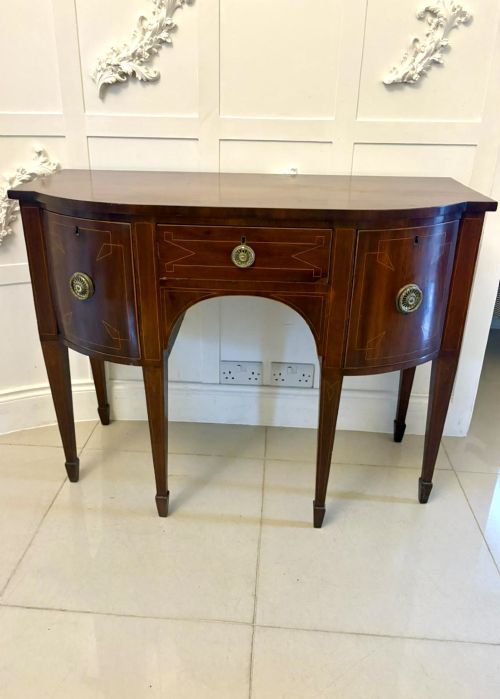
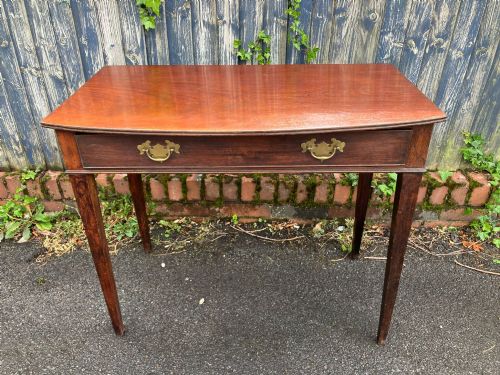
A mahogany bowfront desk presents a curved facade that softens the lines of a room while providing a dedicated writing surface. These pieces appear across Georgian, Regency, and Victorian periods, alongside later twentieth-century interpretations.
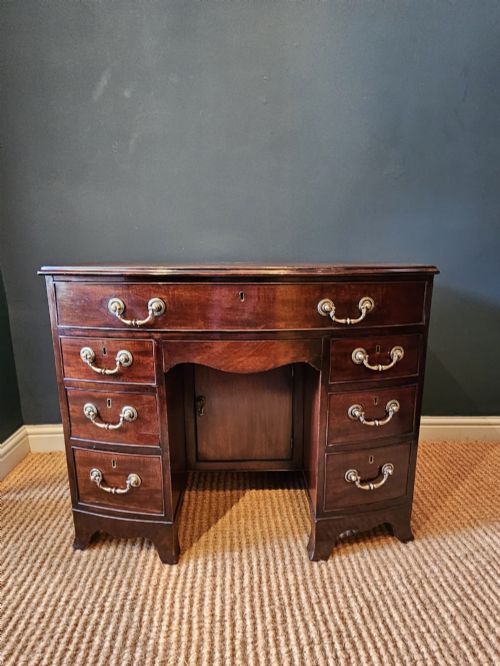
The selection here leans heavily towards side tables, writing tables, and sideboards adapted for daily use, alongside dedicated kneehole desks and dressing chests. Georgian and Regency examples predominate, bringing substantial timber and classic proportions to domestic settings.
How they were made
Cabinet-makers relied on solid mahogany and flame mahogany veneers laid over secondary timbers such as oak, building curved fronts that required precise cutting and steam-bending. Boxwood stringing and delicate wood inlay often define the borders and drawer edges of the finer pieces.
Brass handles and escutcheons punctuate the polished timber surfaces, while leather inserts frequently line the writing tops. Drawers move on side-runners within robust carcases designed to withstand heavy daily use.
Listings feature Georgian, Regency, and Victorian periods alongside Edwardian revivals, constructed in mahogany, oak, and boxwood.
What varies in quality
The grade of mahogany timber and the choice of veneer set the visual standard, with highly figured flame grain commanding attention over plain stock. Crispness in the boxwood inlay and precision in the drawer dovetailing reveal the hand of a skilled workshop.
Proportion and the handling of the curved bowfront dictate the architectural success of each piece, distinguishing utilitarian items from masterworks. Original brassware and well-preserved leather writing surfaces further elevate the standing of an individual table.
George Hepplewhite·Maples
The Mahogany Bowfront Desk Glossary
- Bowfront
- A convex curved front that projects outward in a smooth arc. This shape reduces sharp corners in smaller rooms.
- Stringing
- Thin inlaid lines of contrasting wood, such as boxwood, set flush into the mahogany surface. It creates delicate borders around drawers and panels.
- Secretaire
- A desk fitted with a pull-down front that conceals small drawers and pigeonholes. It combines the storage of a chest with a writing surface.
- Kneehole
- A desk or table featuring a central recess for the user's legs, flanked by banks of drawers. This layout became popular during the eighteenth century.
- Flame mahogany
- A veneer cut from the branch junction of the tree, producing a swirling flame-like pattern. Cabinet-makers reserved this timber for principal drawer fronts.
Mahogany Bowfront Desk: Frequently Asked Questions
How do I date a mahogany bowfront desk?
Examine the construction of the drawer linings and the style of the brass hardware. Hand-cut dovetails and secondary woods like oak typically point to Georgian or Regency origins.
Later Victorian and Edwardian pieces often display machine-sawn components and different interior arrangements. Comparing the timber grain and inlay patterns helps confirm the period of manufacture.
Can I use this desk for daily work?
Many of these pieces were built for writing and administrative tasks, making them suitable for modern laptop use. Leather inserts and pull-out writing slides provide durable surfaces for daily writing.
Care should be taken with modern liquids and unpadded writing implements to protect the polished mahogany and veneer. Placing the desk out of direct sunlight preserves both the wood colour and the leather.
What is the difference between a side table and a desk?
Side tables offer a flat surface with shallow drawers primarily intended for display or occasional writing. Desks and kneehole tables feature deeper drawer configurations and specific provisions for sitting comfortably underneath.
Many pieces listed as side tables or sideboards in period records also functioned as writing surfaces. Evaluating the knee clearance and drawer depth clarifies the original intended use.
How should I care for antique mahogany?
Maintain the finish by dusting with a soft, dry cloth and applying traditional beeswax sparingly to nourish the timber. Avoid silicone-based polishes that build up a hazy film over the original polish.
Keep the piece away from direct heat sources and dramatic humidity fluctuations to prevent the mahogany veneer from lifting. Stable indoor conditions ensure the wood joints remain tight and secure.