


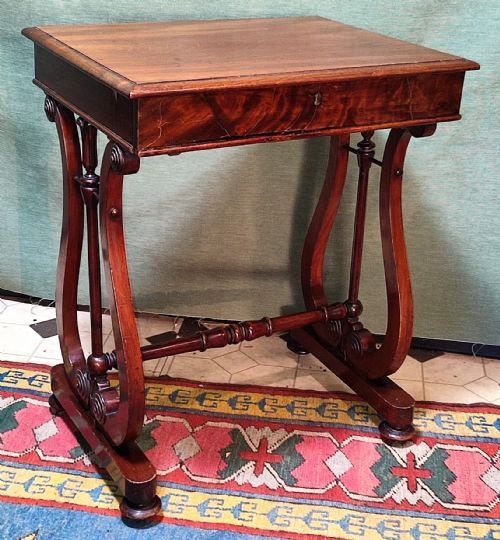


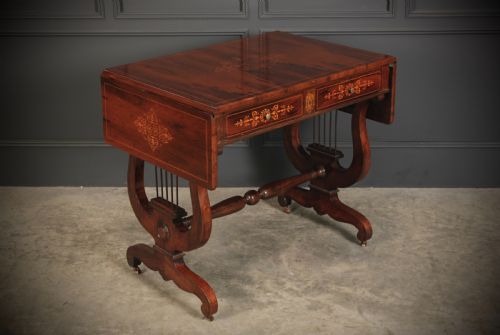


Lyre End Side Table
A lyre end side table brings sculptural grace to a room with its distinctive harp-shaped supports.

Lyre End Side Table
A lyre end side table is a form defined by its distinctive harp-shaped supports, appearing across the Regency, Georgian, and Victorian periods alongside later revivals. Buyers looking at this page encounter various incarnations, including sofa tables, occasional tables, work tables, and standard side tables.
Mahogany dominates the evidence, frequently rendered as flame mahogany veneer, alongside walnut, kingwood, rosewood, and pollard or burr oak. Pieces emerge from historical eras such as the nineteenth century and Georgian period, as well as Edwardian and later revivals from nineteen ten and nineteen twenty.
Materials and construction
Timbers are selected for their rich grain patterns, utilising mahogany, walnut, and exotic woods like kingwood and rosewood, often enhanced with boxwood stringing or marquetry inlay. Many incorporate functional elements such as drop leaves, single drawers, or silk-lined compartments for sewing and work purposes.
Structural flourishes include brass mounts and details on the lyre supports, which anchor the design firmly within the Regency, William IV, and Italian Renaissance Revival traditions.
Lyre End Side Table Retail Price Guide 2026
Typical asking prices for lyre end side table among the pieces listed under this phrase on Sellingantiques today, from the lower quarter to the upper quarter. They describe what is for sale here now, not the wider market.
Mahogany and walnut appear across multiple centuries in these listings, alongside rarer timbers like kingwood, rosewood, and boxwood.
Judging quality in lyre end side tables
Quality rests in the depth of timber selection, visible in figured mahogany or burr oak veneers, and the crispness of the carving on the lyre supports. Better examples display refined proportions and cohesive detailing, such as precise marquetry inlay or well-integrated brass accents, rather than heavy or plain secondary woods.
The Lyre End Side Table Glossary
- Lyre
- A harp-shaped support carved or formed into the end pedestals of a table. This classical motif originates from ancient stringed instruments.
- Sofa table
- A rectangular occasional table traditionally designed to stand in front of a sofa. These often feature drop leaves on either side.
- Work table
- A small table equipped with drawers or silk bags for sewing and needlework. These domestic pieces date predominantly from the Regency and nineteenth-century periods.
- Marquetry
- Decorative veneer work forming geometric or pictorial patterns using various coloured woods. This technique enhances the visual weight of tabletops.
- Drop leaf
- A hinged flap on the side of a table that folds down to save space or lifts up to expand the surface area.
Lyre End Side Table: Frequently Asked Questions
What is a lyre end side table used for?
These tables function as versatile surface furniture in living rooms, bedrooms, or hallways. Their compact footprint makes them suitable for holding lamps, books, or decorative objects.
Historically, specific variants like work tables accommodated sewing implements, while sofa tables sat directly before seating arrangements.
How do I identify a Regency lyre end table?
Regency pieces often feature rich mahogany timbers, architectural lines, and classical motifs like the harp-shaped lyre support. Brass inlays, paw feet, and robust central stretchers frequently accompany this style.
Later revival pieces from the Edwardian era or nineteen twenty imitate these characteristics but typically show lighter construction and different secondary woods.
Are these tables solid mahogany?
Most pieces utilise a combination of solid timber for structural elements and fine veneers for expansive surfaces like tabletops. Materials such as flame mahogany veneer or burr oak provide striking grain patterns that solid wood alone rarely achieves.
Secondary woods are often hidden beneath these decorative outer layers.
How do I care for antique wood tables?
Keep wooden furniture away from direct sunlight and extreme temperature fluctuations to prevent the veneer from lifting or cracking. Regular dusting with a soft, dry cloth preserves the finish without requiring harsh chemical polishes.
Occasional application of appropriate wax maintains the natural lustre of the timber.