
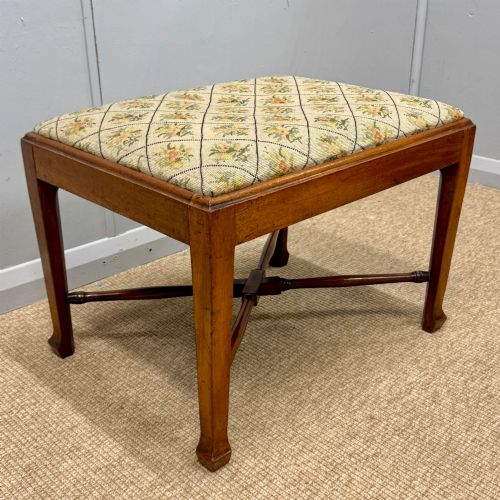
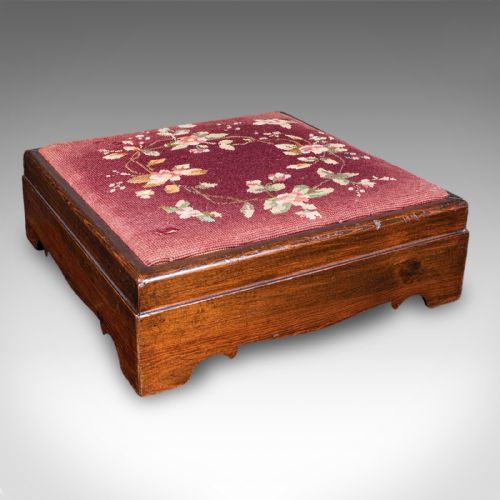

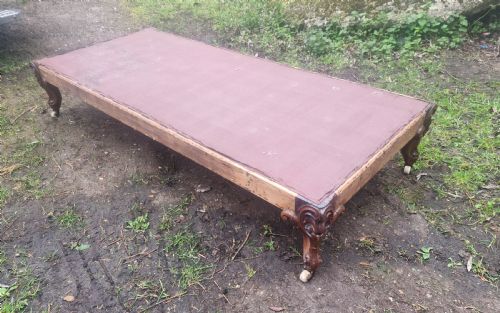


Low Rectangular Footstool
A low rectangular footstool offers simple comfort and solid construction, making it an essential piece for traditional fireside and salon settings.
Low Rectangular Footstool
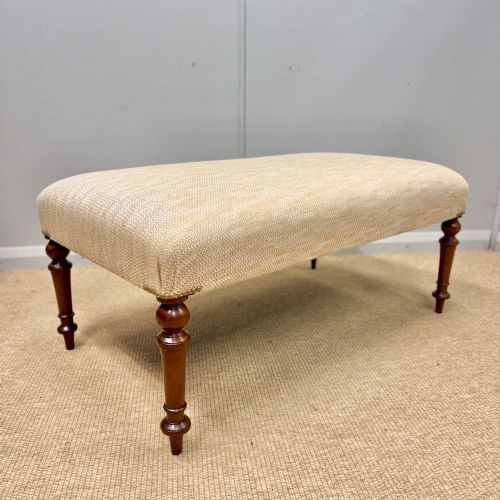
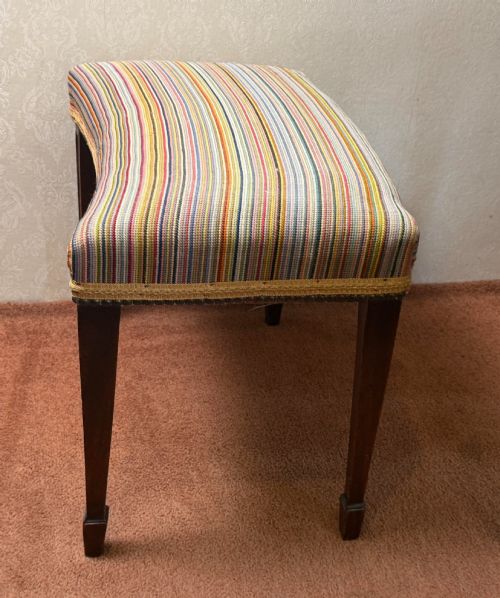
A low rectangular footstool is a compact seating form designed to support the feet or serve as a low seat by a hearth or dressing table. These pieces span the eighteenth century, the Victorian era, and the early twentieth century, reflecting shifting domestic habits.
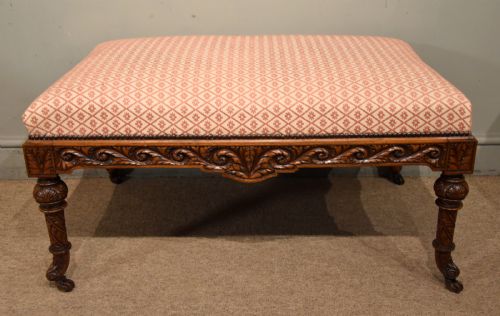
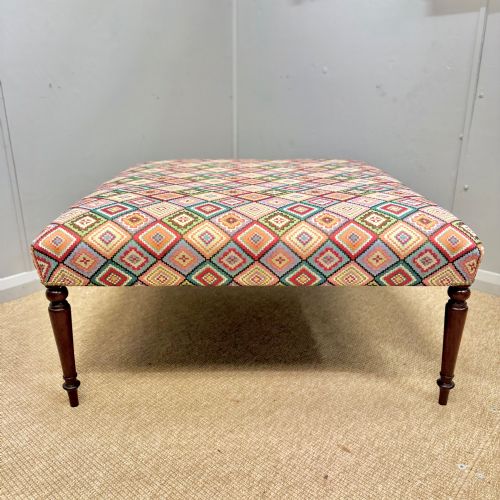
The versions most commonly met on this page are nineteenth-century and Victorian examples framed in mahogany, walnut, or rosewood, often upholstered in contemporary or period textiles. They appear in various proportions, from small fireside stools to large salon and country house ottomans.
Makers and designers produced these stools for specific domestic tasks, such as dressing or resting by the fire, resulting in forms that range from plain utilitarian timber frames to heavily carved revival styles.
Materials and construction
Timbers like mahogany, rosewood, oak, and walnut form the structural skeletons of these stools, providing durable frames that frequently feature turned or tapered legs. Joinery methods of the period ensure stability, while secondary woods are typically employed for internal framing.
Upholstery relies on traditional textiles, wool, tapestry, and fabric, often supported by webbing or cane seating surfaces. Brass castors and brass hardware appear on heavier pieces to assist movement across floor coverings.
Some nineteenth-century stools hide wheels beneath their feet, proving that Victorians took resting their ankles very seriously indeed.
Assessing quality in construction and material
The distinction between ordinary and superior pieces rests on the selection of timber, the crispness of any carved ornamentation, and the integrity of the frame joints. Denser hardwoods and finely figured veneers indicate a higher grade of production.
Carved details, cross stretchers, and the quality of brass castors separate standard utilitarian items from sophisticated salon furnishings produced by skilled workshops.
Howard and Sons
The Low Rectangular Footstool Glossary
- Cross stretcher
- An X-shaped or H-shaped wooden brace connecting the legs of a stool to provide structural rigidity. This feature is frequently found on dressing table and salon stools.
- Cane seated
- A seating surface woven from rattan or cane strips. This technique appears on light wooden frames intended for informal or Anglo-Indian interior schemes.
- Fireside stool
- A low stool positioned near a hearth for warming feet. These pieces often feature durable wool or tapestry upholstery.
- Salon stool
- A decorative seating piece designed for formal reception rooms. They often display carved rosewood or walnut frames.
- Lift-out seat
- A drop-in upholstered seat frame that can be removed independently from the main structure. This construction simplifies reupholstering.
Low Rectangular Footstool: Frequently Asked Questions
What is a low rectangular footstool used for?
These stools served primarily as footrests by the hearth or as low seating before dressing tables and in reception rooms.
Their compact proportions allowed them to be moved easily around a room as domestic needs required.
How do I date a low rectangular footstool?
Dating relies on examining the timber species, leg profiles, and construction methods characteristic of specific periods like the Georgian era or Victorian times.
Stylistic cues such as square tapering legs or heavy rosewood carvings point directly to the prevailing tastes of their decade of manufacture.
Are these stools sturdy enough for daily use?
Solid hardwood frames built with traditional joinery remain robust and capable of supporting regular weight.
Checking the stability of the frame joints ensures the piece functions safely in a modern household.
What upholstery fabrics are typical?
Original and period upholstery frequently consists of wool, tapestry, woven fabric, or cane panels.
Many pieces are reupholstered over time to suit contemporary decorative schemes while retaining the antique frame.