

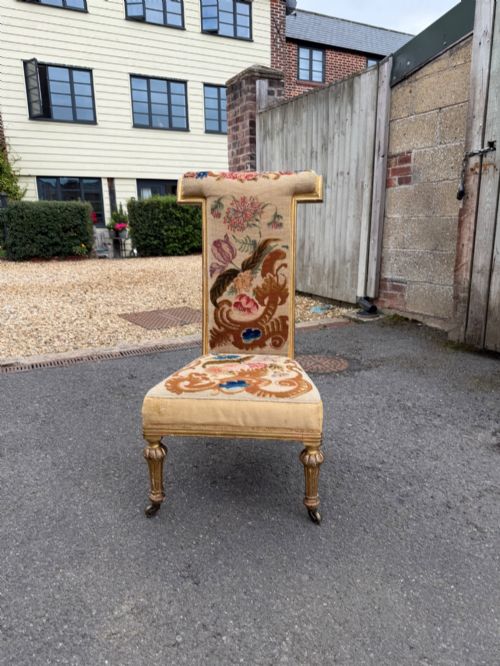


Low Prayer Chair
These low prayer chair examples are intimate Victorian devotional seats designed with characteristic low seats and high backs.
Low Prayer Chair
Most pieces seen here belong to the Victorian period, spanning the middle decades of the nineteenth century from roughly eighteen forty to eighteen sixty. These range from plain walnut or mahogany frames to elaborate Gothic Revival and French Rococo Revival interpretations.
Makers and workshops across Britain and France produced these occasional chairs in various woods, including rosewood, walnut, mahogany, and ebonised timber. They serve well today as accent chairs in bedrooms or sitting rooms where compact seating is required.
Construction and materials
Cabinetmakers constructed these frames using dense hardwoods such as rosewood, walnut, mahogany, and ebonised wood, sometimes accented with giltwood details or brass fittings. These timbers were turned, carved, or scrolled to match prevailing Victorian and Gothic Revival tastes.
Upholstery forms an essential part of the construction, utilising period textiles like green velvet, tapestry, and various decorative fabrics. The padding and textile work support the characteristic high, narrow back profile unique to prie-dieu seating.
Low Prayer Chair Retail Price Guide 2026
Typical asking prices for low prayer chair among the pieces listed under this phrase on Sellingantiques today, from the lower quarter to the upper quarter. They describe what is for sale here now, not the wider market.
Victorian churchgoers knelt in earnest, yet these plush velvet seats ensured their devotion remained thoroughly comfortable.
Assessing quality and character
Quality in a low prayer chair rests upon the choice of timber and the crispness of the frame's carving or turning. Finer examples employ richly figured rosewood or walnut with deep, detailed mouldings rather than simple turned supports.
The sophistication of the upholstery also distinguishes the range, with original or period-appropriate velvet and tapestry work adding considerable character. Pairs and matching sets demonstrate a higher level of original commission than isolated pieces.
R Whytock of Edinburgh·Angerstein
The Low Prayer Chair Glossary
- Prie-dieu
- A French term meaning pray to God, denoting a chair designed specifically for private prayer with a low seat and high back. These forms became popular in British domestic interiors during the Victorian era.
- Gothic Revival
- An architectural and decorative style drawing inspiration from medieval design. Pieces in this manner often display pointed arches and heavy ecclesiastical details.
- Rosewood
- A heavy, durable timber with distinctive dark grain patterns favoured for high-end Victorian cabinet work. It takes a high polish and appears on several finer chairs.
- Ebonised wood
- Timber treated to imitate ebony, creating a dense black finish. This technique was frequently used in nineteenth-century seating to achieve a dramatic, formal contrast with bright upholstery.
Low Prayer Chair: Frequently Asked Questions
What is a low prayer chair?
A low prayer chair is a nineteenth-century seat built with a very low seat frame and an elevated back rail. It was originally designed to accommodate kneeling during private devotions.
Today, these pieces function as compact occasional or accent seating in domestic interiors, valued for their distinct silhouette and historical charm.
Where should I place one at home?
These compact seats fit well in bedrooms, hallways, or quiet corners of a living room as accent chairs. Their narrow profile allows them to occupy minimal floor space.
They pair effectively with low tables or desks, functioning much like standard occasional chairs while offering unique Victorian character.
Are pairs common for these chairs?
Matching pairs do occasionally appear, particularly from mid-nineteenth-century British and French workshops. Single chairs are more frequently encountered.
Finding a matched pair in rosewood or walnut suggests a more substantial original household commission.