



Louis XVI Style Credenza
A louis xvi style credenza brings architectural symmetry and gilt mounts to a room, offering grand surface display alongside enclosed storage.
Louis XVI Style Credenza
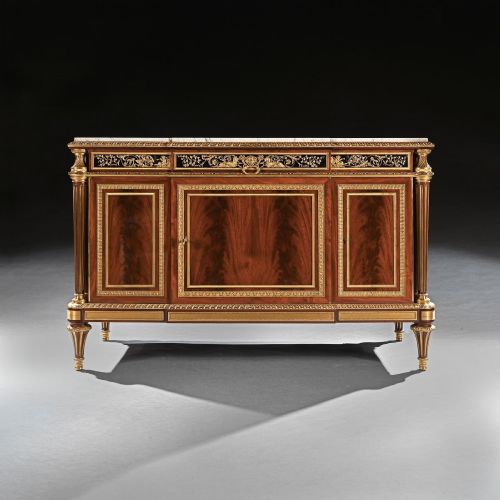
A louis xvi style credenza encompasses formal side cabinets, commodes and pier cabinets produced across the nineteenth and early twentieth centuries. These works draw directly from eighteenth-century French neoclassical design, favouring straight lines and architectural proportion over curving rococo forms.
The versions most commonly met on this page date from the nineteenth century, particularly the eighteen-eighties and eighteen-nineties, often featuring crisp ormolu mounts and marble tops. Makers working in this idiom frequently referenced master cabinetmakers of the ancien régime, producing pieces that function as both furniture and decorative art.
How they were made
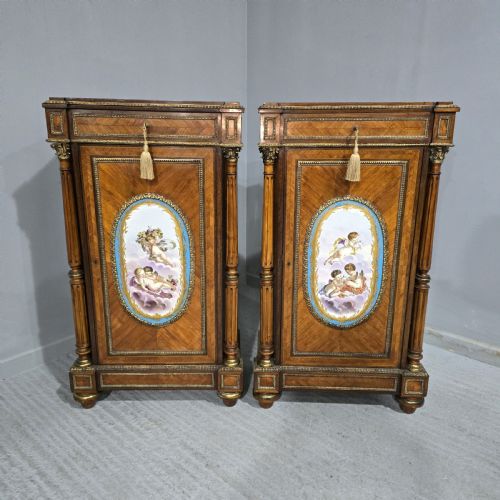
Construction relies on solid foundational timbers such as mahogany, walnut or ebonised wood, overlaid with intricate veneers including kingwood, satinwood and burr elm arranged in geometric marquetry and parquetry patterns. Many examples incorporate specialised surface details like hand-painted porcelain plaques, pietra dura panels or Boulle brass and tortoiseshell marquetry.
Ornate cast ormolu and gilt bronze mounts define the aesthetic, framing panels, outlining corners and accentuating structural rhythms. Marble slabs, frequently white or veined, finish the tops of these cabinets to provide durable, polished display surfaces.
Listings feature periods spanning from the eighteenth century through the nineteenth and twentieth centuries, employing materials like kingwood, porcelain and ormolu.
What varies in quality
Quality rests upon the precision of the cabinetwork and the crispness of the gilt bronze mounts. Finer examples display meticulously fitted parquetry where grain patterns align seamlessly across doors and drawers, alongside chased ormolu mounts that retain sharp, defined details rather than soft, commercial casting.
The integration of secondary materials dictates the upper tier of the range. Cabinets incorporating Sevres style porcelain plaques, pietra dura inlay or documented workshop attributions demonstrate superior craftsmanship compared to simpler commercial output.
Henry Dasson·Joseph Zwiener·Beurdeley·Jean-Henri Riesener·Paul Sormani
The Louis XVI Style Credenza Glossary
- Ormolu
- Gilded bronze used for decorative mounts and furniture hardware. The technique involves applying a finely ground mercury and gold amalgam to cast bronze before heating.
- Marquetry
- Decorative veneer work forming pictorial or geometric patterns using various coloured woods. Craftsmen cut thin sheets of wood and fit them together precisely into a backing layer.
- Meuble d'appui
- A French term for a sideboard or standing cabinet used for support or display. These pieces usually feature a marble top and enclosed shelving.
- Pietra dura
- An inlay technique using cut and fitted polished coloured stones to create formal designs. It appears on luxury cabinet panels.
- Parquetry
- Geometric wood veneer patterns such as cubes or chequers. It creates a structured, textured surface across cabinet doors and tops.
Louis XVI Style Credenza: Frequently Asked Questions
Where did people put a louis xvi style credenza?
These large cabinets stood principally in formal dining rooms, drawing rooms or grand reception halls. They served to display porcelain, silver and decorative objects on their marble tops while concealing linens or tableware within.
Their architectural symmetry allowed them to anchor long walls or sit beneath large mirrors and paintings. The flat tops also functioned as serving surfaces during formal gatherings.
How do I care for marble and ormolu?
Marble surfaces require regular dusting and immediate wiping of acidic liquids like wine or citrus to prevent staining. A neutral soap and warm water solution cleans the stone safely without stripping seals.
Ormolu mounts need only gentle dusting with a soft, dry cloth. Avoid chemical metal cleaners entirely, as abrasive substances can strip the original gilding from the bronze.
How can I tell a nineteenth-century revival piece from an original eighteenth-century work?
Nineteenth-century revival pieces often display machine-sawn veneer thicknesses and nineteenth-century secondary woods inside the carcase. Examination of screw heads, hinge types and timber seasoning reveals the later production period.
Makers working in the nineteenth century frequently signed their mounts or locks, and their stylistic interpretations tended to combine multiple neoclassical motifs with high manufacturing precision.
What is the difference between a credenza and a commode?
A credenza is typically a long, low cabinet featuring doors enclosing central shelving, often designed for display and storage combined. Commodes are traditionally lower drawer units intended for bedroom or formal parlour use.
In nineteenth-century French furniture, the terminology sometimes overlaps when makers produced large side cabinets with mixed drawer and cupboard configurations.