




Louis XVI Painted Bench
These louis xvi painted bench examples bring refined neoclassical lines and muted painted wood into a room, offering seating with authentic period character.
Louis XVI Painted Bench
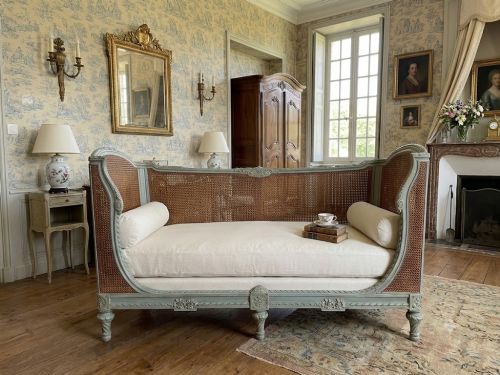
A louis xvi painted bench typically manifests as a French settee, daybed, window seat, or stool created in the neoclassical taste. Buyers seeking this phrase encounter seating that shares the geometric restraint, straight fluted legs, and structural symmetry of the late eighteenth century.
The pieces appearing on this page span several eras, reaching from eighteenth-century originals to later nineteenth-century revivals and early twentieth-century interpretations. French Louis XVI style and Swedish Gustavian examples dominate the selection, bringing lighter painted finishes and cane or upholstered elements into domestic interiors.
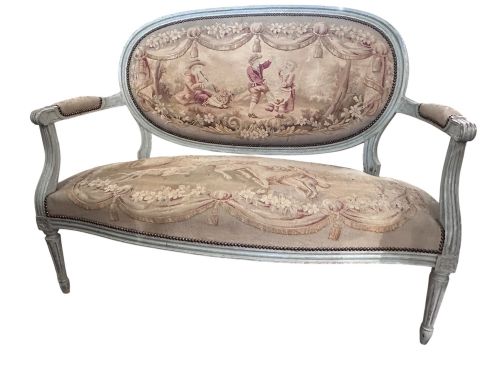
Forms vary widely across the inventory, ranging from small window seats and oval stools to triple-back settees and daybeds. Most surviving examples rely on beech wood frames finished with applied paint, often paired with cane panels or traditional textile upholstery.
How they were made
Makers constructed these frames predominantly from beech and other dense hardwoods suited to fine carving and weight-bearing structures. Painted finishes were applied directly to the timber, sometimes layered over gesso to create a smooth surface that accepted gentle distressing over time.
Caning was woven by hand directly into drilled holes along the seat rails, providing a resilient yet flexible surface that required skilled labour. Upholstered variants utilised natural textile coverings such as linen and traditional stuffing materials fixed to internal webbing.
The listings here feature painted wood, beech, and cane across pieces dating from the eighteenth century through the Edwardian era.
What varies in quality
The crispness of the carved ornamentation on the wooden frame dictates much of the visual distinction. Finer pieces display sharply chiselled fluting on the legs and carefully proportioned rosette blocks at the corners, while simpler versions rely on softer, more generalised moulding.
The integrity of the painted surface and the survival of original or early paint layers heavily influence the character of each piece. Retaining the original layered paintwork without excessive modern overpainting elevates the historical interest of the furniture.
The Louis XVI Painted Bench Glossary
- Canapé
- A traditional French sofa or settee, often built with an exposed wooden frame and an upholstered seat or back. These pieces typically reflect the decorative style of the reigning French court.
- Gustavian
- The Swedish interpretation of French neoclassical design, characterised by paler painted finishes and simplified, restrained ornamentation. This style emerged during the late eighteenth century and remains distinct for its light colour palette.
- Bergère
- An enclosed armchair or sofa with upholstered sides set into a wooden frame. The style offers deep, comfortable seating supported by a substantial timber structure.
- Fluted
- A decorative technique featuring parallel vertical grooves carved into furniture legs or columns. This classical detail draws directly upon ancient architectural motifs.
- Daybed
- A long seating unit designed for reclining, combining the backrest of a settee with an extended seat. They appear frequently in French and Swedish variations from the nineteenth and early twentieth centuries.
Louis XVI Painted Bench: Frequently Asked Questions
What is a louis xvi painted bench?
A louis xvi painted bench is a piece of seating furniture characterised by neoclassical straight lines, painted wooden frames, and restrained decorative carving. The design draws on eighteenth-century French aesthetics, though many surviving examples date from later revival periods.
These pieces function as settees, window seats, or daybeds, bringing pale painted finishes and classic proportions into traditional and modern interiors alike.
How do I identify a louis xvi style piece?
Key identifiers include straight fluted legs, rectangular or oval frames, and symmetrical neoclassical ornamentation such as ribbons, rosettes, and acanthus leaves. Unlike earlier curved rococo designs, these pieces favour architectural structure and geometric balance.
The presence of beech wood frames, applied paint finishes, and cane or upholstered panels further helps distinguish this category from other historical furniture styles.
Where should I place a window seat?
Window seats fit naturally beneath low windows, along hallways, or at the foot of a bed where deep seating is practical without blocking light or views. Their shallow depth allows them to sit comfortably against walls in smaller rooms.
Because many examples feature finished backs or delicate cane panels, they also work well when positioned away from walls to divide larger living spaces.
How do I care for painted wooden furniture?
Maintain painted surfaces by dusting gently with a dry, soft cloth and avoiding harsh chemical cleaners that can damage historic finishes. Keep the furniture away from direct sunlight and extreme humidity fluctuations to protect the underlying timber and paint layers.
For caned sections, occasional light cleaning with a slightly damp cloth helps prevent the natural material from becoming brittle over the years.