



Locking Pilaster Cabinet
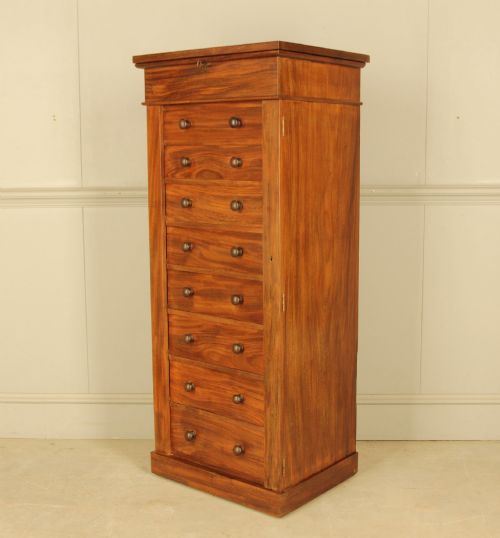
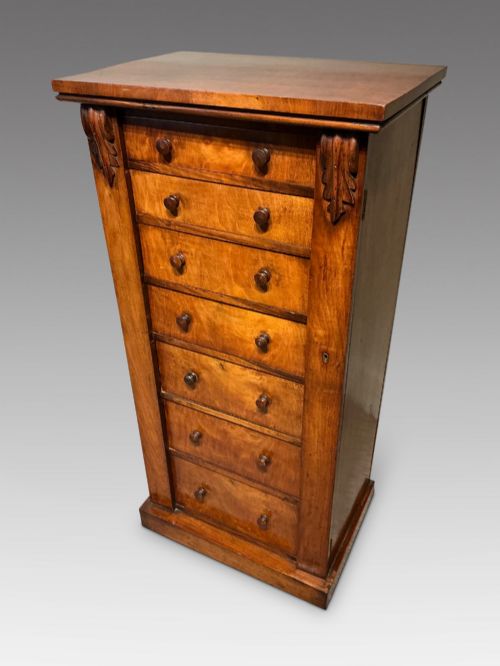
These locking pilaster cabinet examples are tall, slender chests designed to secure precious papers and small treasures behind a locking side stile.
Locking Pilaster Cabinet
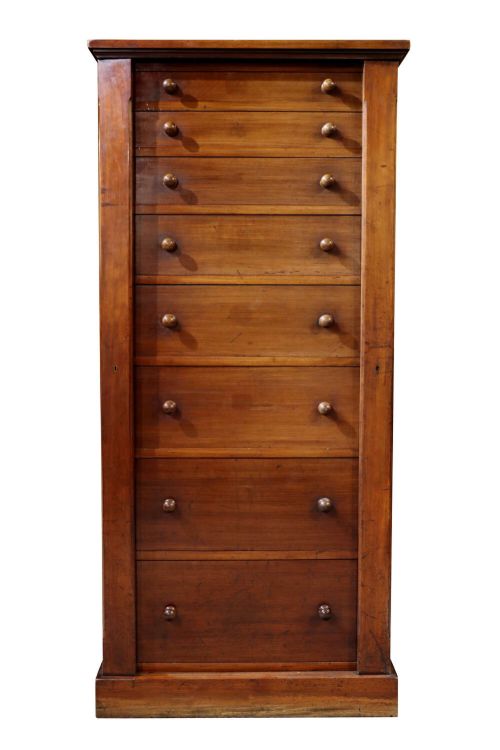
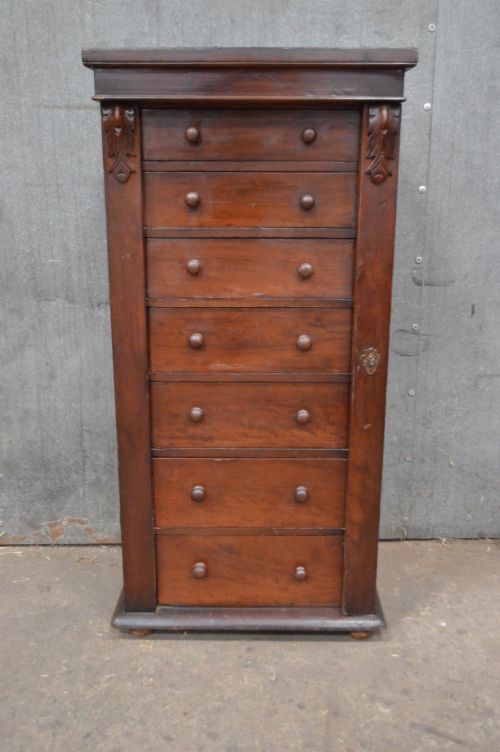
When you search for a locking pilaster cabinet, you encounter the form commonly known as the Wellington chest, which originates primarily in the nineteenth century and the Victorian era. These tall, narrow case pieces house multiple descending drawers secured by a hinged side pilaster that locks in place with a key.
The versions you meet on this page include mahogany, burr walnut, rosewood, and satinwood constructions, spanning English workshops and nineteenth-century French cabinet-making. Most pieces present standard upright chest proportions, though cigar-form cabinets and child's proportions also appear.
Collectors prize the form for its clever security mechanism and compact footprint, which allowed owners to lock away private journals, coin collections, or specimens safely. The surviving examples showcase the restrained elegance of nineteenth-century case furniture designed for domestic studies and dressing rooms.
How they were made
Cabinet-makers constructed these pieces using dense timber carcases faced in figured Honduras mahogany, burr walnut, or rosewood veneers, often accented with satinwood stringing or subtle inlay. The characteristic locking action relies on a hinged wooden pilaster or stile fitted to one vertical edge, which swings or slides over the drawer margins to block them when locked.
Interior construction utilises multiple narrow drawers, frequently numbering six to eight, designed to slide smoothly within closely fitted runner systems. Brass hardware such as escutcheons, drop handles, and locking mechanisms completes the functional structure of the piece.
Locking Pilaster Cabinet Retail Price Guide 2026
Typical asking prices for locking pilaster cabinet among the pieces listed under this phrase on Sellingantiques today, from the lower quarter to the upper quarter. They describe what is for sale here now, not the wider market.
Formats on this page range from standard six-drawer chests and eight-drawer variants to specialised cigar cabinets and French double designs.
What varies in quality
The grade of timber figure sets the baseline for distinction, moving from plain sawn surfaces to intensely figured Honduras mahogany and burr walnut veneers. Master workshops demonstrated superior handling through seamless book-matching on drawer fronts and precise grain continuity along the locking pilaster.
Mechanical integrity defines the upper tier, where original locks, functioning keys, and smooth pilaster hinges operate without binding against the drawer stacks. Refined execution shows in the crispness of inlaid details and the careful selection of secondary timbers within the drawer linings.
Gillows of Lancaster
The Locking Pilaster Cabinet Glossary
- Pilaster
- A vertical architectural element applied to the side of a case piece, which on these cabinets functions as the locking bar. It swings or lifts to release the stack of drawers.
- Wellington chest
- The traditional name for a tall, narrow chest of drawers featuring a locking side stile. It emerged during the nineteenth century for domestic study use.
- Figured timber
- Wood grain possessing distinctive patterns such as flames, curls, or burrs. Cabinet-makers selected these veneers to create decorative symmetry on the primary display surfaces.
- Specimen drawers
- Shallow compartments built into collector cabinets designed to hold small objects, minerals, or coins. They often feature fitted interiors tailored for delicate classification.
Locking Pilaster Cabinet: Frequently Asked Questions
How do you open the locking side?
You unlock the side pilaster using the matching key, then swing or slide the pilaster aside. This action frees the retaining lip that holds the drawer edges in place.
Once the pilaster moves clear, each drawer pulls out independently from top to bottom.
What woods were used?
Cabinet-makers utilised dense hardwoods including Honduras mahogany, walnut, burr walnut, rosewood, and satinwood. These timbers were often selected for striking grain patterns.
Secondary woods like oak or mahogany commonly formed the hidden drawer linings and internal carcase walls.
Where were they placed?
Owners typically positioned these tall, slim chests in studies, libraries, or dressing rooms where floor space was limited. Their vertical proportions provided ample drawer storage without a wide footprint.
They served as private repositories for journals, correspondence, or specialist coin and specimen collections.