
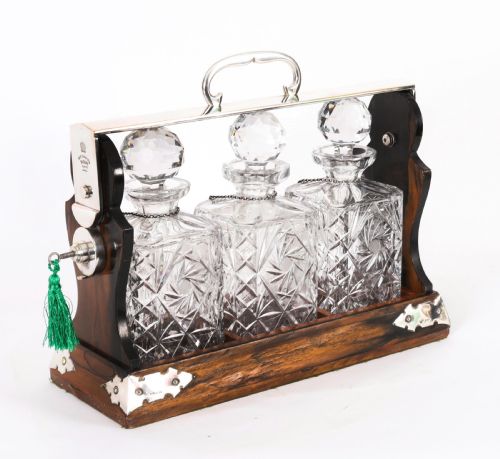


Locking Decanter Stand
A locking decanter stand keeps your spirits secure under a clever mechanism, and these clever Victorian and Edwardian drinking frames bring genuine theatre to any sideboard.
Locking Decanter Stand
A locking decanter stand, frequently known as a tantalus, is a specialised barware container designed to hold glass decanters securely while preventing unauthorised pouring. The form emerged firmly in the Victorian period and continued through the Edwardian era into the Art Deco years of the nineteen thirties.
You will most commonly encounter sturdy oak or rich coromandel wood frames fitted with brass mountings and enclosing two or three cut glass or crystal decanters. These practical after-dinner accessories combine secure storage with visible display, keeping fine spirits locked away from servants or guests until the host releases the mechanism.
The objects listed range from simple single bottle oak cases to elaborate combination pieces that incorporate games compendiums alongside the bottles. Origins span the late nineteenth century into the early twentieth century, reflecting the changing tastes of British hosts across several decades.
Materials and Construction
Cabinetmakers utilised dense timbers such as oak and exotic coromandel wood to build the robust housings required to withstand daily handling. These wooden carcasses frequently feature brass mounts, hinges, and lock mechanisms that secure the metal top bar across the stoppers of the decanters.
The internal vessels consist of heavy cut glass or cut crystal bottles, designed to catch the light on a dining room sideboard or back in the drawing room. Metal components include silver plated mounts and structural brass, paired occasionally with mirror glass panels inside combination games compendiums.
Current listings feature pieces spanning the Victorian, Edwardian, and Art Deco periods, constructed in oak, coromandel, and walnut.
Distinctions in Quality
The standard of a locking decanter stand rests upon the choice of cabinet wood and the precision of the locking mechanism. Richly grained coromandel housing matched with heavy cut crystal bottles denotes a higher grade of production than standard oak frames.
Makers who integrated additional functional elements like games compartments or hallmarked silver fittings elevated the piece from a simple utilitarian container to a luxurious entertaining accessory. The crispness of the glass cutting and the solidity of the brass framework ultimately distinguish finer examples from standard commercial output.
Betjemann·Hukin and Heath
The Locking Decanter Stand Glossary
- Tantalus
- A locking wooden frame designed to hold decanters securely by their stoppers so that the bottles cannot be removed without a key. The name derives from the mythological figure of Tantalus, who was condemned to stand in water that receded whenever he tried to drink.
- Coromandel Wood
- A heavy, durable timber featuring dark brown stripes, prized by Victorian cabinetmakers for luxury boxes and spirit cases. It provides a striking contrast against bright brass mounts and cut crystal.
- Cut Glass
- Glass decorated by grinding facets or patterns into the surface using a rotating wheel. This technique adds considerable weight to decanters and enhances light reflection.
- Silver Plate
- A base metal coated with a thin layer of silver, commonly utilised for the locking bars, handles, and escutcheons on Edwardian and late Victorian barware frames.
- Games Compendium
- A fitted box containing equipment for multiple board or card games, occasionally built directly into the base of a decanter stand.
Locking Decanter Stand: Frequently Asked Questions
How does a locking decanter stand work?
A metal retaining bar locks down across the glass stoppers of the decanters, preventing them from being lifted out of the wooden frame. Turning a key in the brass lock releases this top bar so the bottles can be tilted or removed for pouring.
This clever physical barrier ensured that domestic staff or visiting guests could not access the contents without the permission of the master of the house.
When were these decanter stands made?
The examples on this page date primarily from the Victorian and Edwardian periods, stretching from eighteen seventy up to the nineteen thirties. Oak and coromandel versions appear frequently across the late nineteenth century.
Later pieces from the nineteen twenties and thirties reflect the streamlined tastes of the Art Deco era while maintaining the core locking function.
What is the difference between a tantalus and a decanter set?
A standard decanter set simply displays glass bottles on an open tray or inside an unlocked cabinet. A tantalus incorporates a physical locking mechanism that traps the stoppers and secures the bottles within the frame.
This specific security feature defines the locking decanter stand, distinguishing it from general barware and table decanters.
How do you care for wood and crystal on a stand?
Maintain the timber housing by applying a light coat of traditional beeswax to nourish the oak or coromandel surface. Avoid harsh chemical cleaners on the brass mountings and silver plate.
Wash the cut crystal decanters by hand with warm water, ensuring the stoppers are removed during storage to prevent air locks or moisture retention inside the bottles.