


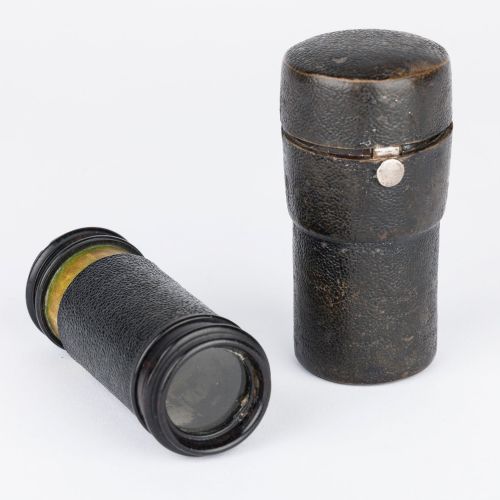


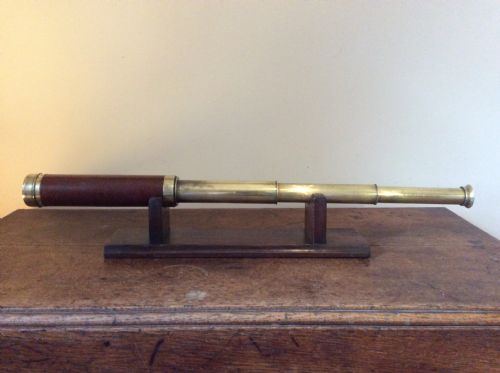


Leather Monocular Telescope
These leather monocular telescope examples are portable optical instruments that bring historical precision to your shelf, offering both function and tangible craft.
Leather Monocular Telescope
When you search for a leather monocular telescope, you are looking at portable optical instruments designed for maritime, military, and civilian navigation. The selection on this page centres primarily on Victorian and Edwardian pieces, alongside examples from the 18th Century and Regency periods. These range from pocket-sized spyglasses to larger naval and officer of the watch telescopes.
The forms vary from simple single draw designs to multi-draw instruments, occasionally accompanied by cases or stands. You will encounter English and German origins, including signed works by known makers such as Ross of London, Newton & Co, and Chadburn Brothers of Sheffield. Whether configured as an explorer's spyglass or a cased observational tool, each piece reflects the utilitarian needs of its era.
How they were made
The construction relies on a combination of brass for the draw tubes and optical fittings, paired with leather to provide a secure grip for the user's hand. Cardboard occasionally appears within the internal barrel construction of certain pocket instruments. Wooden elements, including oak cases, are utilised for storage and protection.
Glass lenses provide the magnification, housed within precision metal threads that allow the tubes to extend smoothly. Leather dressings are hand-stitched or wrapped around the brass body, often finished with decorative tooling or simple plain seams depending on the intended maritime or civilian use.
Leather Monocular Telescope Retail Price Guide 2026
Typical asking prices for leather monocular telescope among the pieces listed under this phrase on Sellingantiques today, from the lower quarter to the upper quarter. They describe what is for sale here now, not the wider market.
The listings show instruments spanning from the 18th Century through to the Edwardian period, utilising brass, leather, glass, wood, and cardboard.
What varies in quality
The distinction between standard and superior examples rests upon the clarity of the optical glass and the precision of the brass draw tubes. Fine instruments maintain a smooth, even action as the sections extend, without undue wobble or looseness when fully opened. Signed pieces by established makers often demonstrate a higher degree of finishing in the engraving and mechanical fit.
The preservation of the exterior materials also influences the character of the piece. Intact leather coverings with minimal scuffing sit alongside well-worn examples that show the patina of actual service at sea or in the field. The presence of original fitted wooden cases further distinguishes complete sets from instruments that survived alone.
Ross of London·Voigtländer & Sohn AG·Newton & Co·Chadburn Brothers of Sheffield
The Leather Monocular Telescope Glossary
- Draw
- A sliding tubular section of a telescope that extends to focus the instrument. Multi-draw configurations allow a longer focal length to collapse into a compact pocket size.
- Spyglass
- A small, portable refracting telescope used historically by mariners and travellers. The term is frequently applied interchangeably with pocket monoculars.
- Objective
- The primary lens at the front of the telescope that gathers light and forms the initial image. Its diameter dictates the light-gathering capacity of the instrument.
- Marine telescope
- A sturdy optical instrument designed for use on ships, typically featuring weather-resistant brass and leather construction to withstand maritime environments.
- Monocular
- An optical instrument for magnification using a single eye, unlike binoculars which utilise two barrels.
Leather Monocular Telescope: Frequently Asked Questions
How do I use a draw telescope?
Gently pull each brass section outward until the tube is fully extended. Hold the instrument steady to your eye and rotate the final smaller section near the eyepiece until the image comes into sharp focus.
Take care not to force the draws past their stop points. Collapse them in reverse order when finished, pushing the sections inward gently.
Can I still look through these antique telescopes?
Many of these instruments retain functional lenses and can be used for viewing distant objects today. The optical quality depends on the preservation of the internal glass elements.
Keep in mind that historical optics do not match modern coatings, so expect a dimmer or narrower field of view compared to contemporary equivalents.
How do I care for the leather wrap?
Keep the leather clean by dusting it gently with a dry, soft cloth. Avoid placing the instrument in damp environments or direct sunlight which can dry out the material.
Occasional application of a neutral leather conditioner can help maintain suppleness if the wrap shows signs of excessive dryness over time.
What is the difference between a spyglass and an officer of the watch telescope?
Spyglasses are typically smaller, lighter, and designed for portability in the pocket or a traveler's bag. Officer of the watch telescopes are larger naval instruments built for prolonged scanning from a ship deck.
Naval service models often feature larger objective lenses and protective leather or canvas body covers to endure harsh weather conditions at sea.